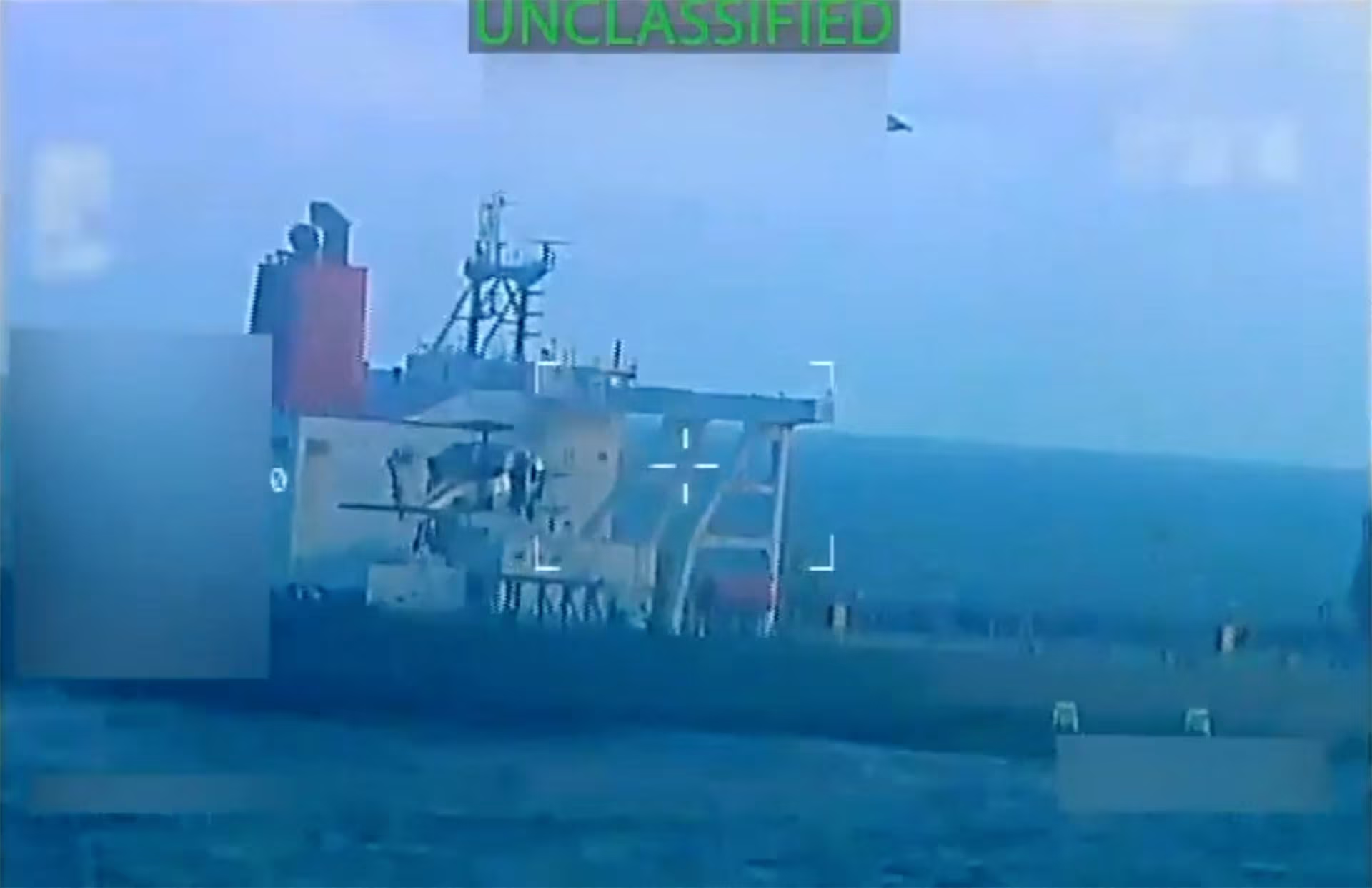
On Wednesday, December 10, the United States seized an oil tanker off the Venezuelan coast—a move that sharply increased pressure from Donald Trump’s administration on Nicolás Maduro.
Speaking at the White House ahead of an event promoting a new luxury-visa program, Trump announced the operation and described the vessel as “a big tanker, a very big one,” adding, without elaborating, that “other things are happening as well.” Asked about the oil on board, he replied, “Well, we’ll probably keep it,” while refusing to identify the ship’s owner. “It was detained for a very compelling reason,” he said.
According to three U.S. officials who spoke on condition of anonymity because of the law-enforcement operation, the tanker was carrying Venezuelan oil. They noted that the crew offered no resistance and no one was harmed. Venezuela’s government condemned the action as “an outrageous robbery and an act of international piracy,” allegedly aimed at stripping the country of its oil resources.
The operation became the latest instrument in an expanding campaign of pressure on Venezuela and on Maduro personally. The Trump administration accuses him of overseeing a “narco-terrorist” cartel that allegedly moves drugs into the United States, though many current and former U.S. officials believe the campaign’s ultimate aim is regime change. Since September, the United States has carried out more than 22 known strikes on vessels in the region, leaving over 80 people dead. Washington maintains—without offering public evidence—that these vessels were engaged in drug trafficking. Legal experts say such strikes may violate international law.
On Wednesday evening, Attorney General Pam Bondi posted a video on social media showing armed U.S. operatives rappelling from a helicopter onto the tanker’s deck. The authenticity of the footage could not be verified. According to Bondi, the FBI, the Department of Homeland Security, and the Coast Guard took part in the operation with support from the Pentagon. She claimed the tanker had been used to transport “sanctioned oil” from Venezuela and Iran.
U.S. officials expect additional seizures in the coming weeks—part of a broader effort to weaken Maduro by undermining Venezuela’s oil market. One official said the vessel, named Skipper, was carrying crude belonging to the state-owned Petróleos de Venezuela, known as PDVSA. He noted that the tanker had previously been linked to Iranian-oil smuggling—a global shadow trade the U.S. Justice Department has spent years trying to disrupt. The ship was sailing under the flag of another Latin American country in which it was not registered, and its listed destination was Asia.

A U.S. Coast Guard helicopter conducts an overflight of the former Roosevelt Roads naval station in Ceiba, Puerto Rico. November 2025.
A federal judge issued a seizure warrant roughly two weeks ago because of earlier episodes of Iranian-oil smuggling, not due to any links to Maduro’s government, an official said. Prosecutors argue that Iran funnels revenue from oil sales to its military and to the Islamic Revolutionary Guard Corps, which the United States designates as a terrorist organization.
The administration has disclosed few details of the operation, including the fate of the crew and the vessel’s future status. It remains unclear whether the sealed warrant covers the ship itself, the oil, or both. The White House did not answer a question about whether the United States has the legal authority to retain the cargo.
The vessel—previously operating under a different name—was placed on the U.S. Treasury’s sanctions list in 2022. At the time, U.S. authorities said it was part of “an international oil-smuggling network that facilitated commercial operations and generated revenue” in support of Hezbollah and Iran’s Revolutionary Guard forces.
According to an analysis of satellite imagery and photographs conducted by The New York Times, the tanker had likely attempted to obscure its location by transmitting distorted coordinates before its seizure. The U.S. Navy, the Coast Guard, Southern Command, and the Pentagon declined to discuss the episode, referring inquiries to the White House.
For Venezuela, whose economy is critically dependent on the oil sector, such confiscations carry significant costs. Oil accounts for the bulk of the country’s export revenue, and proceeds from its sales fund, among other things, the import of basic goods—from food to medical supplies.
Although Venezuela is believed to possess vast untapped oil reserves, its current production is far below early-century levels—undermined by mismanagement, U.S. sanctions, and corruption within PDVSA. The United States was once the largest buyer of Venezuelan crude, but political tensions severed those links. Today, roughly 80 percent of Venezuela’s oil exports go to China.
Smaller volumes reach the United States, primarily to refineries along the Gulf Coast, as well as to Cuba, whose communist leadership has long relied on these shipments as a minimal source of economic stability.

President Nicolás Maduro of Venezuela during a march in Caracas.
In recent months, Donald Trump has ordered a major expansion of the U.S. military presence in the region—more than 15 000 troops and roughly a dozen ships, including the aircraft carrier Gerald R. Ford, are now deployed in the Caribbean. Trump has authorized covert operations against Venezuela and warned that the United States could “very soon” broaden its attacks, striking not only vessels off the Venezuelan coast but also targets inside the country. At the same time, he has recently spoken by phone with Nicolás Maduro about a possible meeting, though, as he noted on Wednesday, they have not talked since their last exchange.
“To all Airlines, Pilots, Drug Dealers, and Human Traffickers”
Trump Announces the Closure of Venezuelan Airspace
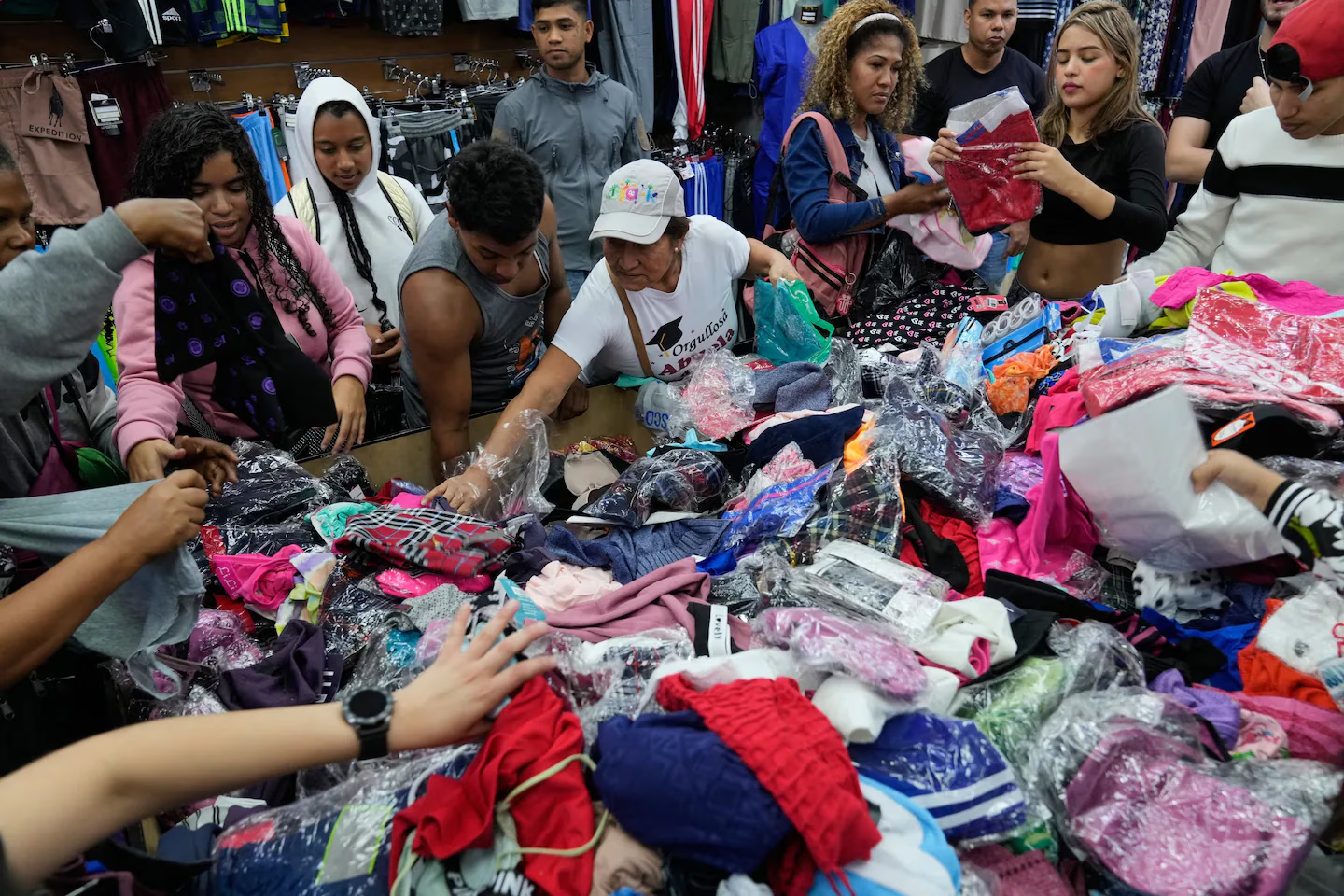
A Country in Waiting Mode
How Venezuela Lives Between U.S. Threats and Maduro’s Manipulations
The administration has developed a range of options for potential military action, including strikes targeting Maduro himself and efforts to seize control of Venezuela’s oil fields. Presidential aides say Trump has repeatedly voiced reservations about an operation to remove Maduro, in part out of concern that it could fail. He has been in no hurry to make a decision, though he has shown particular interest in extracting value from Venezuela’s oil resources for the United States.
The tanker seizure coincided with the ceremony awarding the Nobel Peace Prize to Venezuelan opposition leader María Corina Machado. She was absent from Wednesday’s event in Oslo—her daughter accepted the prize on her behalf, and the Nobel Committee announced that Machado had left Venezuela and was en route to Norway.