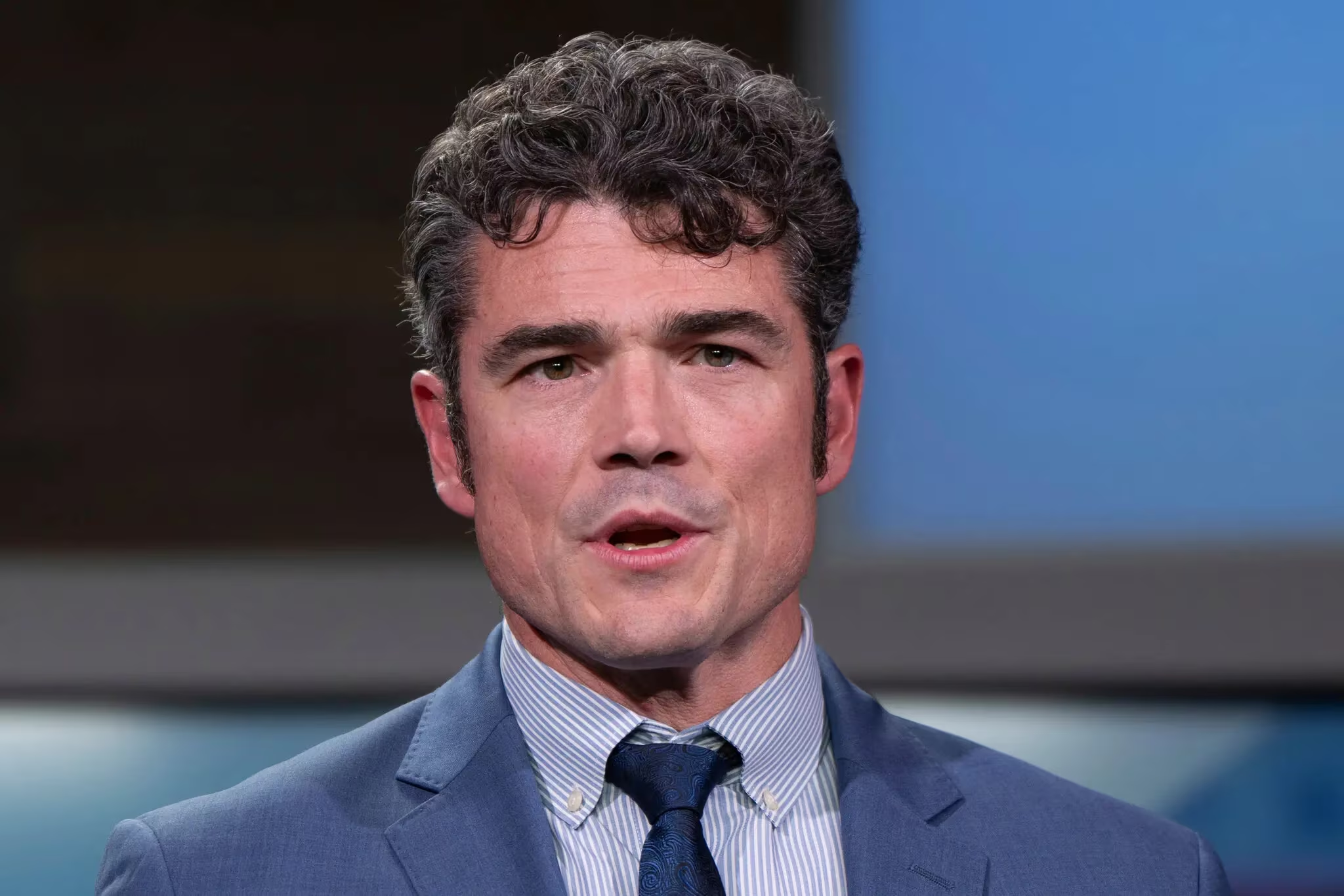
Joe Kent, one of the United States’ key counterterrorism officials, announced his resignation on Tuesday, March 17, saying he could not support the war with Iran and pointing to Israel’s influence over the policies of Donald Trump’s administration.
“I cannot in good conscience support the ongoing war with Iran,” Kent, who headed the National Counterterrorism Center, wrote on social media. “Iran posed no imminent threat to our country, and it is clear that we entered this war under pressure from Israel and its influential American lobby.”
He is the first Trump administration official to step down over the war with Iran, and one of the few to resign openly citing principled disagreements over policy.
His decision underscores how the conflict with Iran is deepening divisions within the president’s coalition. Kent is close to Tucker Carlson—a Trump ally who has emerged as one of the war’s most outspoken critics.
In a brief interview, Carlson backed the move. “Joe is the bravest person I know, and he cannot be dismissed as a crank,” he said. “He is walking away from a position that gave him access to the highest levels of intelligence. The neoconservatives will now try to destroy him for it. He understands that—and did it anyway.”
Kent has long been inclined toward conspiratorial claims—in particular, he has asserted without evidence that intelligence officials may have been involved in the violence surrounding the January 6 events at the Capitol. Several Republicans swiftly condemned his remarks about Israel.
Congressman Don Bacon, a former Air Force brigadier general and member of the Armed Services Committee, reposted Kent’s letter with the comment “good riddance.”
“Antisemitism is an evil I hate, and it has no place in our government,” he wrote on social media.
In his statement, Kent attached a resignation letter addressed to Trump, in which he argued that Israeli authorities had drawn the United States into the conflict with Iran.
He also referred to a “disinformation campaign” by senior Israeli officials and media outlets that, in his view, undermined Trump’s “America First” platform and helped shape pro-war sentiment.
Kent—a veteran of the Iraq War—said that the arguments for striking Iran and the promises of a swift victory echoed the debate over the 2003 invasion of Iraq.
He also mentioned his late wife, Shannon, a military cryptologist killed in Syria. “As a veteran who has served in combat 11 times, and as a husband who lost his beloved wife Shannon in a war created by Israel, I cannot support sending the next generation to fight and die in a conflict that does not benefit the American people and does not justify the cost of American lives,” he wrote.
National security experts say Kent’s resignation confirms the existence of serious divisions within the administration over the war.
“His experience as a battle-hardened combat veteran, as well as his work with U.S. special operations forces and intelligence, gave him a unique understanding of the risks and threats associated with overseas conflicts,” said Javed Ali, a former senior U.S. counterterrorism official who now teaches at the Gerald R. Ford School of Public Policy at the University of Michigan.
Kent was one of the key advisers to Director of National Intelligence Tulsi Gabbard and had advocated within the administration for a more restrained foreign policy.
Gabbard is scheduled to testify before the Senate on Wednesday and the House of Representatives on Thursday as part of the annual hearings on threats to the United States.
Since his nomination to lead the National Counterterrorism Center, his tenure has been shadowed by controversy. Last year, Senator Mark Warner, the top Democrat on the Senate Intelligence Committee, said Kent had “associated himself with political violence, spread false claims that undermine our democracy, and sought to tailor intelligence to fit a political agenda.”