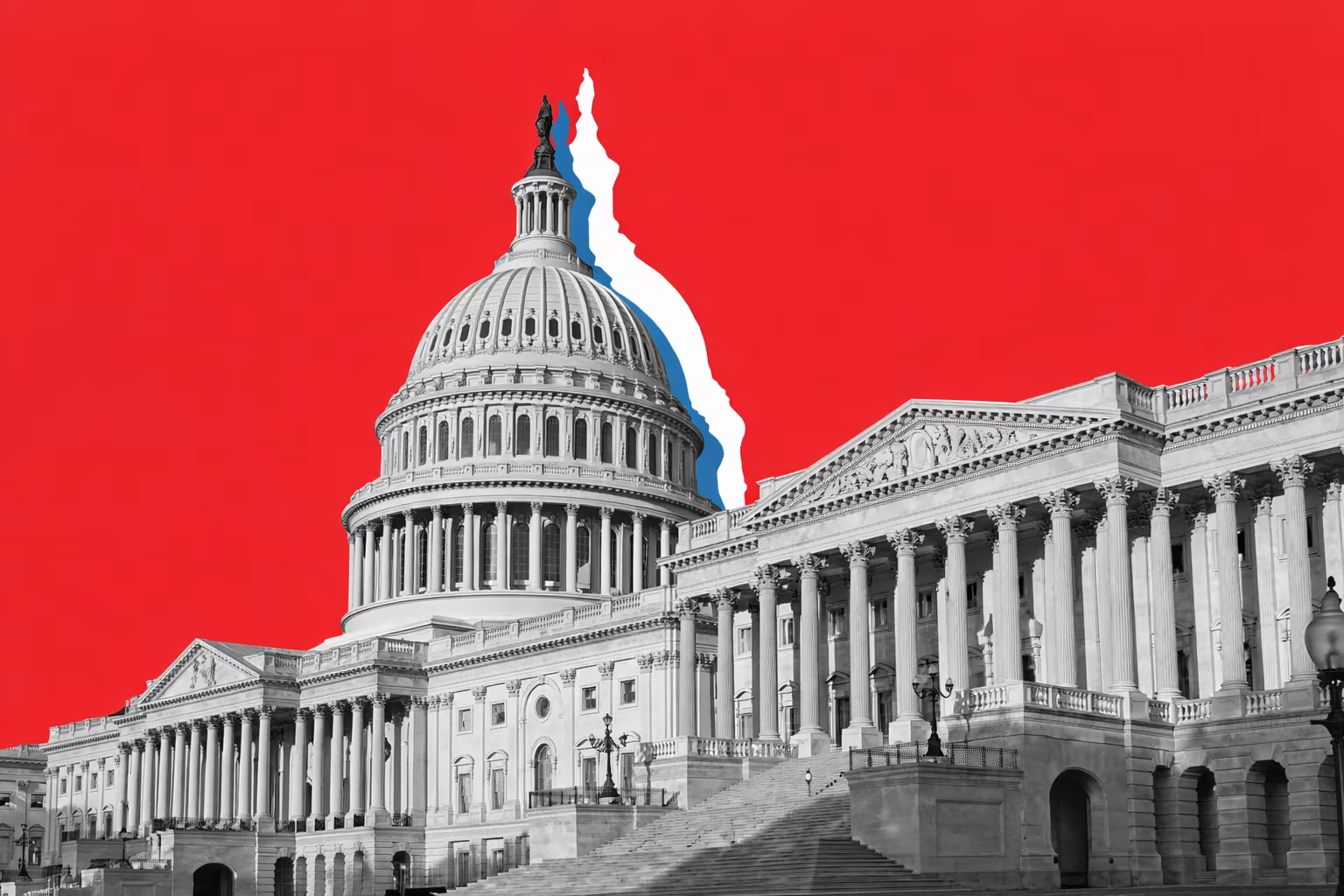
Over the course of 2025, the balance of power in Washington has shifted markedly toward the White House. Donald Trump’s administration has repeatedly relied on executive authority to shut down or hollow out federal agencies, impose tariffs, cancel spending already approved by Congress, and conduct military operations without meaningful legislative involvement. On Capitol Hill, this has produced a rare convergence of views in recent years: both Democrats and a number of Republicans increasingly speak of Congress being sidelined and stripped of its constitutional role. With the 2026 midterm elections approaching and a record number of lawmakers opting to leave Congress, the question is no longer about tactics or partisan maneuvering, but about whether the legislative branch is capable of reclaiming control over the state’s most consequential decisions.
Discontent in Congress is growing, and an increasing number of lawmakers are looking to 2026 as a chance to recover at least some of the powers they believe were ceded to the White House under Donald Trump. Throughout 2025, the administration unilaterally shut down or sharply weakened federal agencies, imposed sweeping tariffs, canceled congressionally approved spending, and carried out military operations in the Caribbean region. Democrats repeatedly warned of an erosion of the separation of powers, while some Republicans openly voiced concern that the White House was disregarding the role of the legislative branch. Dozens of members of Congress decided not to seek re-election even before the new year began.
Against this backdrop, questions are mounting about whether anything will change next year, particularly as the midterms draw closer. “I’ve been concerned about this for ten years already,” Senator Rand Paul said when asked about efforts to restore Congress’s lost influence. In his view, the situation is not improving and, on the contrary, “seems to be getting worse.”
Republicans’ principal legislative achievement this year was a bill titled “One Big Beautiful Bill,” passed using a procedure that allowed them to bypass the Democratic filibuster in the Senate. The measure extended and expanded tax cuts, boosted spending on defense and immigration enforcement, while simultaneously reducing funding for Medicaid and food assistance programs. The sweeping package was widely seen as virtually the only realistic opportunity to advance the party’s priorities in 2025. Although some Republicans speak of a second reconciliation bill, party leaders concede that no other initiative of comparable significance is likely to pass.
Trump’s influence over the Republican Party played a central role in shaping the year, but Congress’s own dysfunction also contributed to the paralysis. A razor-thin and ideologically fragmented Republican majority in the House, combined with a hard-line Democratic caucus, made the passage of substantive legislation exceedingly difficult, while advancing initiatives capable of overcoming a Senate filibuster proved almost impossible. “A conference that includes Andy Harris, Chip Roy, Brian Fitzpatrick, and Don Bacon will never be able to produce meaningful legislation on issues like these…that could pass with full Republican unity. That’s just not going to happen,” said one Republican political strategist, referring both to leaders of the hard-line Freedom Caucus and to moderate lawmakers who regularly defy party leadership. That, he added, is precisely why “all the serious people are just leaving, damn it.”
The situation in the House was further exacerbated by Speaker Mike Johnson’s decision to send members of Congress home during the 43-day government shutdown, effectively cutting them out of negotiations and stalling other legislative work. “I have never seen a shutdown where we voluntarily shut down Congress as well, because we thought it sent a good message,” said Congressman Thomas Massie.
In the Senate, Democrats—as well as some Republicans—also increasingly felt pushed to the margins over the course of the year. A 53-seat Republican majority allowed the chamber to move relatively smoothly through the confirmation of cabinet members and other senior appointments. In response, Democrats sought to challenge the president’s use of emergency powers, with Senator Tim Kaine playing a central role in those efforts. The Virginia Democrat took part in 11 votes aimed at overturning measures adopted under emergency authorities, including tariffs and strikes on suspected drug vessels in the Caribbean Sea. “For too long, the executive branch has been given a blank check…and this president has gone further than most,” he said. In his account, his task is to force colleagues, again and again, to answer a simple question: “Do you agree with this or not?”
Some Republicans were also alarmed by Trump’s decision to rescind funding that had previously been approved on a bipartisan basis. First, the White House invoked a procedure that allowed the funds to be clawed back along party lines, and then unilaterally canceled additional spending. “It is Congress that bears the constitutional responsibility for funding the government, and any attempt to reclaim resources outside the appropriations process undermines that responsibility,” Senator Lisa Murkowski said at the time.
In some cases, lawmakers managed to push back, but the most notable examples involved small groups of Republicans teaming up with the minority to circumvent their own leadership. The clearest case was when four Republicans signed a discharge petition to force a vote on legislation requiring the administration to release materials related to the Jeffrey Epstein case, despite fierce resistance from the White House. That move compelled Trump and party leaders to reverse course and back the initiative, which was ultimately approved by both chambers almost unanimously. Later in the year, several moderate Republicans joined Democrats to force a vote on extending expiring Obamacare subsidies, which had become a central point of contention during the shutdown. Although the speaker is now required to bring the issue to the floor, the bill has virtually no chance of clearing the Senate or being signed into law. “That’s why people are so frustrated with Congress—does it have, what, 15 percent approval? I think that number will keep falling if we don’t do something here,” said Congressman Kevin Kiley.
A record number of departures from Congress has only underscored the growing disillusionment with the legislature’s performance. By the midpoint of the 119th Congress, 43 House members—19 Democrats and 24 Republicans—had announced plans to step down, the highest figure for an odd-numbered year since 2011, according to C-SPAN data. Nine senators—four Democrats and five Republicans—have also said they will leave.
Some see the budget process as a possible way out of the impasse, as the parties attempt to reach an agreement on government funding ahead of the January 30 deadline. The Senate was unable to begin consideration of a package of five bills before the holiday recess—paradoxically because of funding for the National Center for Atmospheric Research, which had earlier been stripped out at the initiative of the Office of Management and Budget. Senators Michael Bennet and John Hickenlooper refused to fast-track the measures unless funding for the center in Boulder was restored. Even so, work on appropriations—which under the Constitution fall squarely within Congress’s remit—is viewed as an important means of reclaiming lost legislative authority. “This is fundamental. It’s about the power of the purse—about ensuring that we decide what gets funded and what does not, and how priorities are set,” Senator John Hoeven said, adding that January would be a decisive month.
Yet with elections approaching, many doubt that progress can be made on politically sensitive issues. “This administration has brought a lot of change—and much of it has been good,” Senator Thom Tillis said. At the same time, he argued, those changes have only driven politicians deeper into their trenches, leaving little expectation of meaningful bipartisan work in contested areas. “People will simply retreat to their corners,” he concluded.