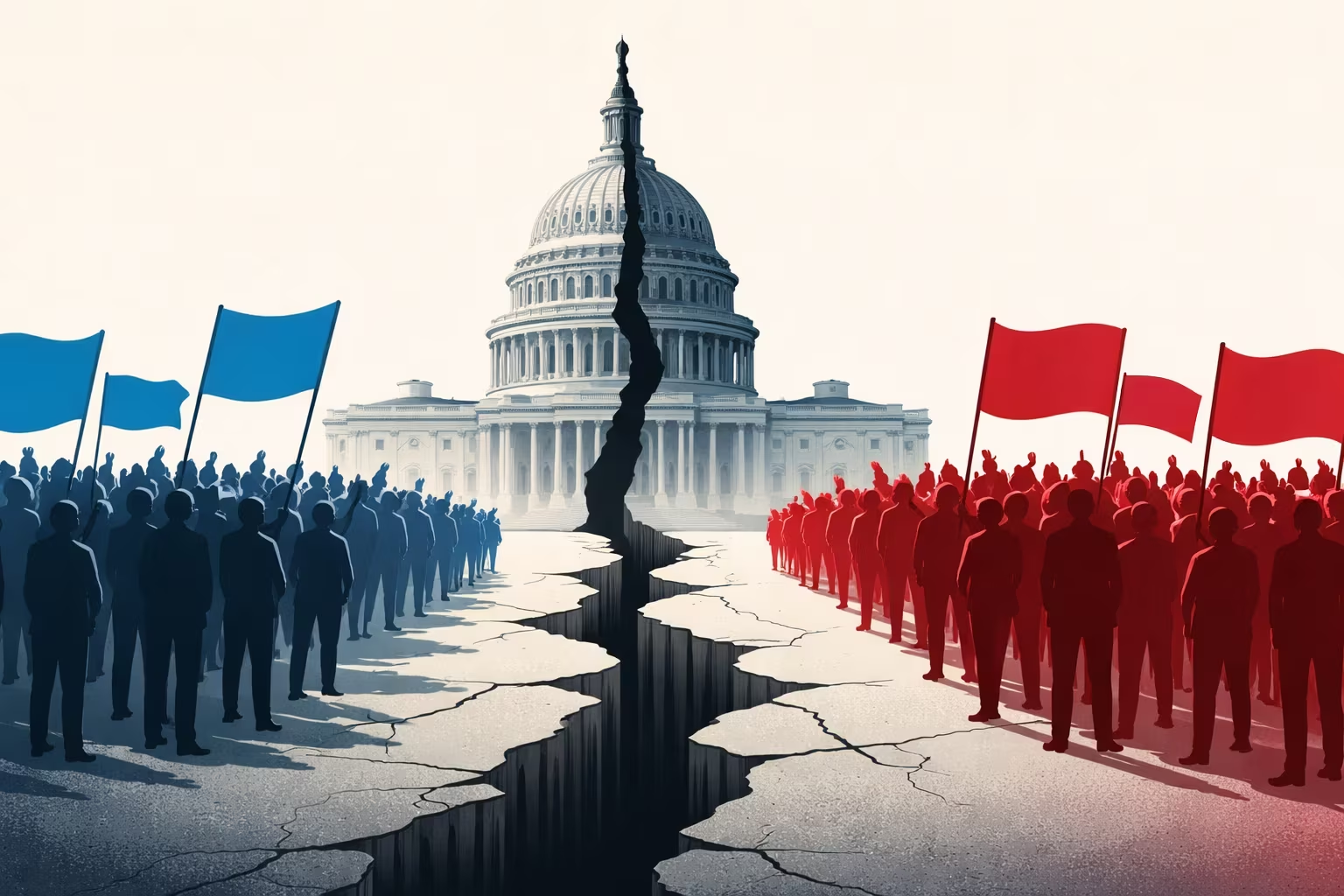
The U.S. Congress is experiencing one of the highest levels of polarization in decades: Democrats have consistently opposed Donald Trump, while Republican lawmakers have largely consolidated around the president.
Preliminary data indicate that this year Republicans have supported Trump more frequently than any other president since the 1950s. This is reported by Congressional Quarterly, which tracks legislative activity in the United States.
The widening divide between the two parties has significantly complicated efforts to cooperate on legislation addressing the most contentious issues, including immigration and, more recently, healthcare.
A partisan deadlock over the extension of health insurance subsidies led this year to a record 43-day federal government shutdown. Against this backdrop, public approval of the legislative branch fell to 15 percent in October, according to Gallup data.
On average, Republican votes in the House of Representatives aligned with Trump’s publicly stated position in 95 percent of cases—surpassing the previous record set in 2017 during his first presidential term. In the Senate, Republican support for the president’s positions reached 96 percent, according to CQ data.
Congressional Quarterly’s statistics cover the period through mid-December and include recorded floor votes on which the president publicly expressed a position—including via social media or official statements from the administration.
Voting behavior within parties is shaped by more than ideology alone. In particular, the Republicans’ razor-thin majority in the House of Representatives has necessitated stricter internal party discipline to advance legislation.
Democrats, while less cohesive than Republicans, have also maintained a high level of party loyalty. During periods when presidents from their party were in power—including former president Joe Biden—they displayed a comparable degree of support for the head of state.
The current level of polarization in Congress has coincided with a White House willing to stress-test established rules and norms, intensifying strain on the system of checks and balances among the three branches of government.
This year, Donald Trump has effectively sidelined Congress by issuing an unprecedented number of executive orders—more than 400, including the imposition of tariffs that have significantly destabilized global trade.
The president has also blocked the disbursement of funds already approved by Congress, including roughly $4bn in foreign aid, thereby challenging the legislature’s budgetary authority—known as the “power of the purse.” An additional variable may be the stance of the Supreme Court: its rulings on tariffs and other cases could shift the balance of power.
Confrontation between the legislative and executive branches has accompanied American history at various stages, notes James Curry, a professor of political science at the University of Notre Dame. However, he says, “Congress is clearly under threat.”
“The Trump administration is showing a willingness to do things it arguably should not be doing when it comes to spending,” Curry explained, adding that the White House has operated “within legal ambiguities” to advance its objectives.
Whether Congress can reestablish cooperation and close legislative loopholes to curb the excessive expansion of presidential authority remains an open question, he notes. Such steps have been taken before—notably in reforming the procedure for certifying election results after Trump’s attempts to challenge the outcome of the 2020 presidential race. Even so, Curry says, any far-reaching changes are likely to be postponed until Trump leaves office.
Despite deep polarization and chronic partisan gridlock, bipartisan lawmaking remains possible and is still regarded as the most effective way to pass legislation, according to scholars who study American politics.
In response to rising polarization, lawmakers have increasingly turned to so-called omnibus bills, which bundle disparate initiatives and interests into a single legislative package. This format compels members of different parties to compromise and seek areas of agreement.
Over the past five years, the use of so-called omnibus legislation has become so widespread that most laws have been enacted not individually but as part of broader packages. The exception was 2024, according to data from the Center for Effective Lawmaking, an academic research institute.
It was during that period that Donald Trump and Elon Musk, according to Craig Volden, a professor at the University of Virginia and co-director of the CEL, pushed Republicans to torpedo a bipartisan spending bill. This, he noted, led to a marked decline in the total number of laws enacted.
“For anyone who says Congress today cannot govern or play a meaningful role, I would point them to four years ago, when it was a dominant institution,” Volden said, recalling bipartisan initiatives passed in 2021 under the Joe Biden administration, including the $1.2tn infrastructure package.
“Look at what happened with the Epstein case, look at what the Oversight Committee did,” he added. In his view, “Congress may be beginning to regain its footing.”