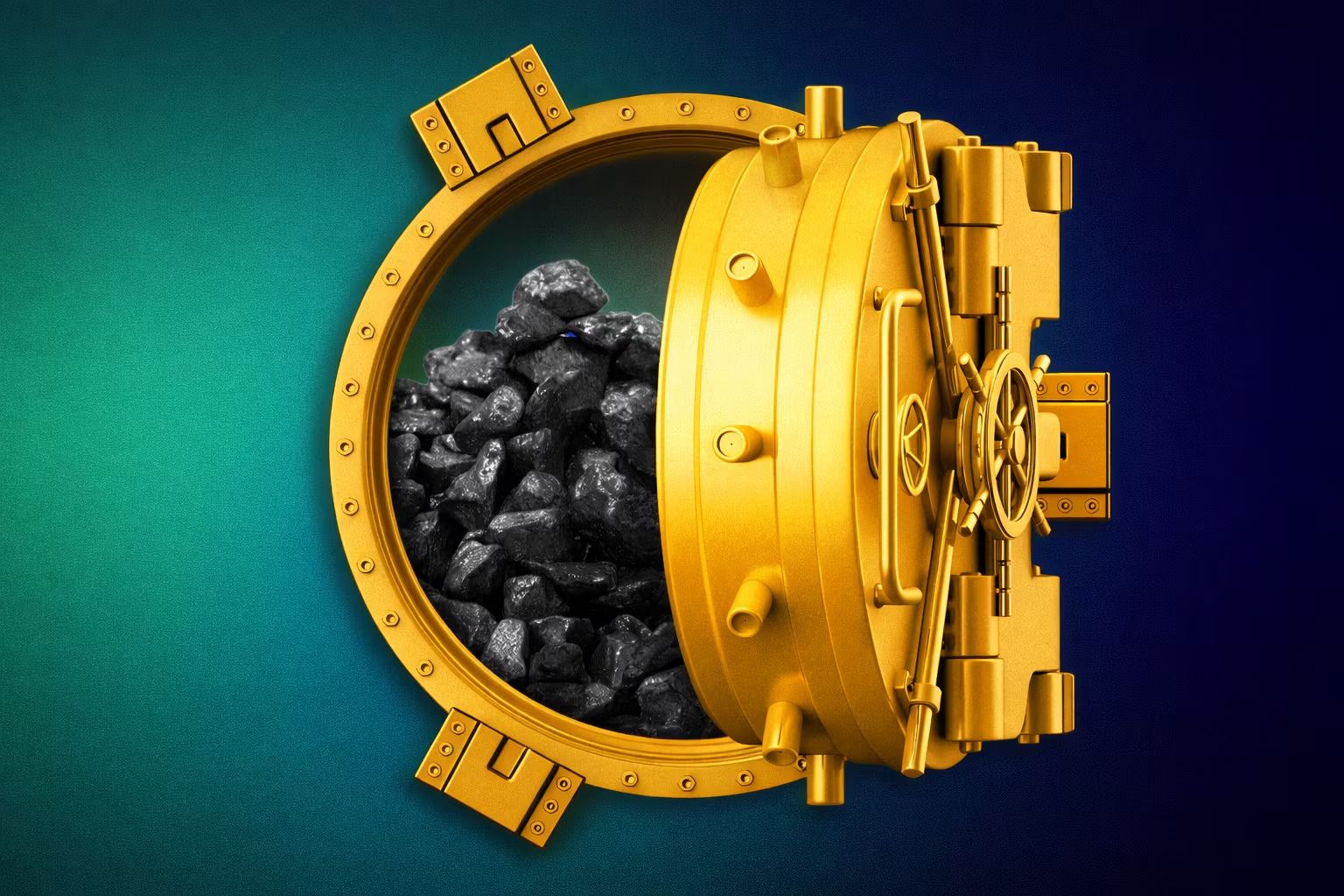
A bipartisan group of lawmakers is set to introduce legislation on Thursday to establish a $2.5 billion “Strategic Resilience Reserve” for critical minerals.
The initiative comes as Donald Trump has steadily pushed to expand US access to mineral resources worldwide—from Ukraine and Venezuela to Greenland—treating them as a foundation for growth in the technology sector. Congress is now joining that race, proposing a mechanism designed to both protect and stabilize the domestic market for rare-earths and other critical materials. Today, a substantial share of global supply is controlled by China, leaving the US exposed to price volatility and supply-chain disruptions for minerals essential to advanced semiconductors and electric-vehicle batteries. The authors envision the reserve as an analogue to the Strategic Petroleum Reserve, created in 1975 after the Arab oil embargo.
The SECURE Minerals Act will be introduced by Senators Jeanne Shaheen and Todd Young, alongside Representatives John Moolenaar and Rob Wittman. The bill proposes creating a clearinghouse of sorts for critical minerals, combining features of the Strategic Petroleum Reserve and the Federal Reserve System. Like the Fed, the new reserve would be overseen by a seven-member board appointed by the president and confirmed by the Senate. And, echoing the petroleum reserve—where millions of barrels are stored in underground salt caverns—the plan calls for dedicated facilities to stockpile key materials.
“Creating such a reserve is a necessary and hard-edged step to safeguard our national and economic security,” Young said. Shaheen argued that China’s dominance in global supply chains for critical minerals gives Beijing substantial leverage and leaves the US vulnerable to economic pressure. She stressed that the bipartisan bill represents a “historic investment” in strengthening the resilience of the American economy and supporting well-paid jobs in industries such as aerospace, automotive manufacturing, and technology.
The struggle for access to rare-earth elements and other raw materials is playing out across the globe, fuelling conflicts in Africa and sharpening Trump’s interest in Greenland. In this sense, the SECURE Minerals Act partly echoes the CHIPS and Science Act, signed by Joe Biden in 2022. That legislation envisioned roughly $280 billion in support for the semiconductor industry and scientific research, but in practice Congress allocated about $52 billion in grants and loans. Trump has repeatedly threatened to roll back parts of that support, and in Intel’s case the administration converted part of an $11 billion grant into a 10% government stake in the company.
The proposed $2.5 billion would amount to only an initial down payment in building the mineral reserve—should the legislation pass, Congress would be able to allocate additional funding. Over the longer term, the ambition goes beyond creating a mere “mineral analogue” of the petroleum reserve, aiming instead to establish a fully fledged domestic market for critical resources, expand production capacity, and provide American companies with a stable and predictable supply base.