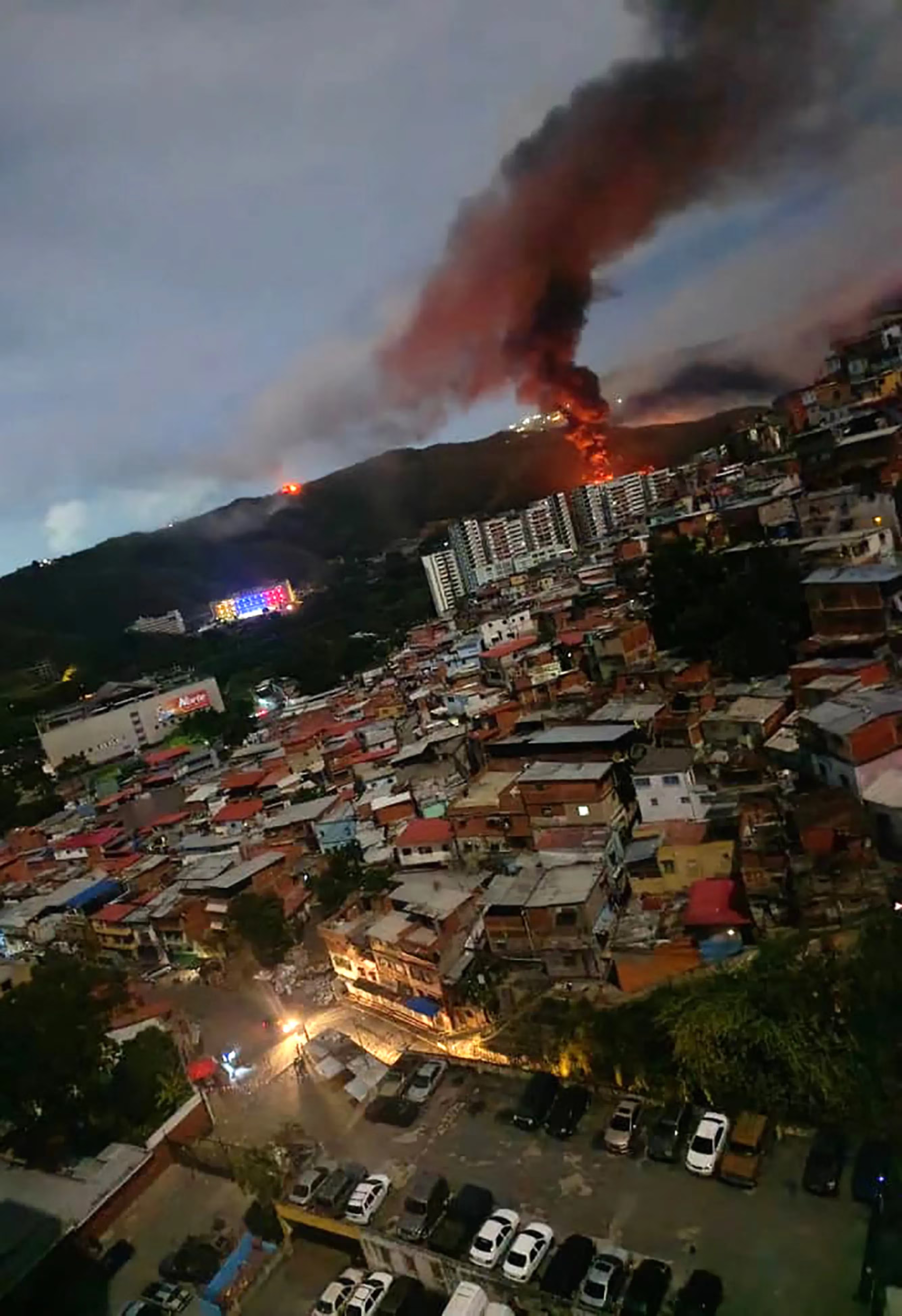
On the night of January 3, the United States launched a military operation against Venezuela, during which—according to the American side—the country’s president was seized. At around 2 a.m. local time, explosions were heard in Caracas. The Associated Press and Reuters, citing eyewitness accounts, reported aircraft flying over the city. Power outages were recorded in several districts of the capital. Videos circulated on social media showing moments of the explosions, helicopter flyovers, and crowds gathering in the streets. As of publication, there were no reports of casualties.
Witnesses also spoke of prolonged and intense sounds of explosions at the Fuerte Tiuna military base, which houses the country’s top military leadership and members of the government, The New York Times correspondent Anatoly Kurmanaev reported. Among the sites said to have been struck was the Generalissimo Francisco de Miranda Air Base, known as La Carlota. Social media posts showed footage of a burning building at Cuartel de la Montaña—a military-historical museum that contains the mausoleum of Hugo Chavez, the predecessor of Nicolas Maduro as president of Venezuela.
Reports of explosions also came from other regions of the country, including the coastal state of La Guaira in northern Venezuela, CNN reported, citing local media.
Roughly two hours after the operation began, eyewitnesses told The New York Times that aircraft continued to fly over Caracas, although the intensity of the explosions had noticeably diminished.
According to Donald Trump, Venezuelan President Nicolas Maduro was captured and taken out of the country together with his wife, Cilia Flores. Venezuelan authorities have not yet confirmed this information; earlier reports said that Maduro had signed a decree imposing a state of emergency. Sources cited by CBS News say the capture was carried out by an elite Delta Force special-operations unit—a scenario The New York Times had written about as early as last autumn.
Venezuela’s vice president, Delcy Rodriguez, publicly demanded that Donald Trump provide proof that Nicolas Maduro and his wife are alive. Her audio address was broadcast on Venezuelan television. Under the country’s constitution, in the event of Maduro’s absence, presidential powers are to pass to Rodriguez. Earlier, a source cited by The Wall Street Journal said that she was safe.
Shortly after the explosions began, Venezuelan authorities said the United States was seeking to “seize Venezuela’s strategic resources” and “break the country’s political independence.” A press release from the Ministry of Information claimed that American strikes hit “civilian and military areas in Caracas” and also affected the states of Miranda, Aragua, and La Guaira.
The same statement said President Maduro had imposed a state of emergency in response to “external shocks.” As Argentina’s La Nacion explained, the measure grants the authorities expanded powers over mobilization, restrictions on civil liberties, and control of the media. The government called on “all social and political forces” in the country to resist what it described as an American “imperialist attack.”
Venezuela’s defense minister, Vladimir Padrino Lopez, released a video address accusing the United States of striking civilian areas in different parts of the country and declaring that Venezuela intended to resist a foreign invasion.
According to CBS News, Donald Trump authorized the strike several days before the operation began. Sources said the military had considered launching an attack over Christmas, but ultimately chose to focus instead on a strike on Nigerian territory, where—according to reports—the target was Islamic State militants. Subsequently, the sources added, the military waited for the most favorable weather conditions to carry out the operation.
Several hours before the explosions in Caracas, Venezuelan President Nicolas Maduro publicly declared his readiness to cooperate with the United States. In a televised interview, Maduro—whom Donald Trump regards as an illegitimate president—described the people of Venezuela as “friends” of the American people and said the country was prepared to work with Washington to combat drug trafficking and expand oil production.
Donald Trump had repeatedly threatened to strike Venezuela, accusing the country’s leadership of “narco-terrorism.” In the second half of 2025, the United States sharply expanded its military presence off Venezuela’s coast and began launching missile strikes against vessels it said were being used to transport наркотики—attacks that killed at least one hundred people. In December, Washington started blocking sanctioned oil tankers traveling to and from Venezuela. By the end of 2025, Trump said it would be a “smart move” for Maduro to step down from the presidency, warning that attempts to “act tough” would be his last.
In late December, the United States carried out its first strike on a target inside Venezuela—a port facility.
Nicolas Maduro came to power in Venezuela in 2013, succeeding Hugo Chavez, the leader of the United Socialist Party of Venezuela, who died the same year. He was subsequently re-elected twice, but the results of those elections were contested by the opposition and questioned by a number of foreign governments. His tenure has been marked by a deep economic crisis, the exodus of millions of people from the country, and large-scale protests that the authorities suppressed with force.