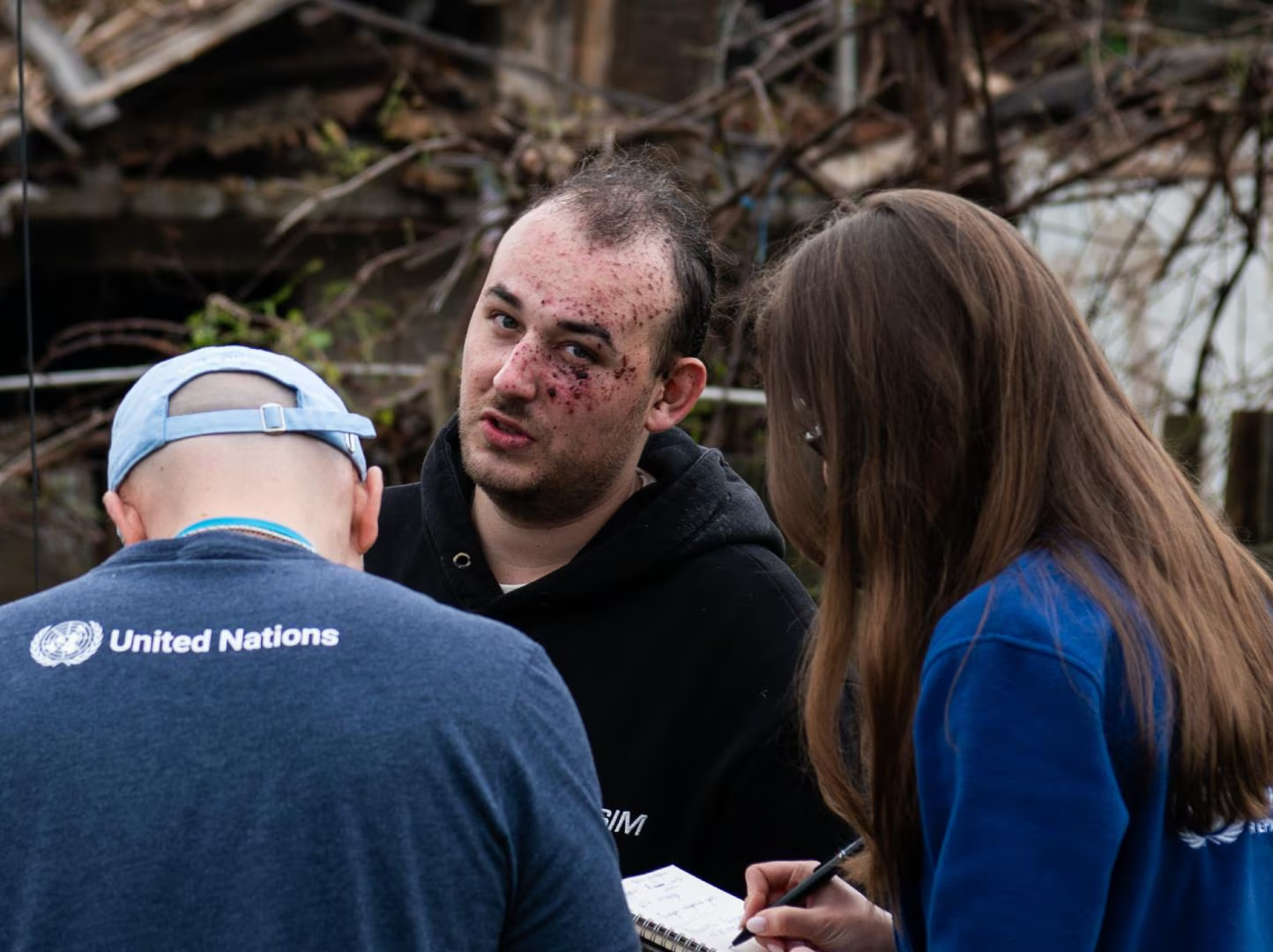
The UN Human Rights Monitoring Mission in Ukraine has summarized the consequences of four years of full-scale war. A consolidated report published on the mission’s website documents violations committed by both Russia and Ukraine.
Regarding Russia, the document cites testimonies from released Ukrainian prisoners of war who reported torture and other forms of ill-treatment in captivity. According to the mission’s assessment, at least hundreds of Ukrainian servicemen were executed or died while in detention.
Cases of torture and ill-treatment were also documented against civilians held under the control of Russian authorities. Most of the released civilians interviewed by the mission said they had been subjected to torture. In territories controlled by Russia, hundreds of civilians were executed—including individuals held in places of detention.
The mission also separately notes numerous episodes of sexual violence committed by representatives of Russia.
The report also details large-scale strikes on Ukraine’s energy infrastructure. By the beginning of 2026, according to the mission, the country had lost more than half of the generating capacity it possessed before the invasion. Ukraine now retains about 11 gigawatts of capacity against an estimated demand of roughly 18 gigawatts during peak winter consumption.
At the same time, the mission stresses that human rights violations have also been documented in territories under Ukraine’s control.
In particular, some convictions in cases involving alleged collaboration, according to the mission’s assessment, do not comply with international law. Of more than 3,000 court rulings analyzed, around 12 percent concerned actions that could have been lawfully required by an occupying authority in territories under its control. In a number of such cases, the mission notes, Ukrainian courts paid insufficient attention to the circumstances of coercion faced by people living under occupation.
The report also raises issues related to freedom of conscience and the rights of religious communities. Ukrainian courts have handed down convictions against representatives of Christian denominations who sought to exercise their right to conscientious objection to military service. The Supreme Court upheld these rulings despite the fact that international law does not permit restrictions on such a right.
The mission also separately addresses the issue of pressure on the Ukrainian Orthodox Church.
The document states that amendments to Ukraine’s legislation on religious organizations—adopted on national security grounds—may contradict international standards on freedom of religion.
The report notes that after these amendments were adopted, the authorities said they had identified links between the Ukrainian Orthodox Church and the Russian Orthodox Church and, on that basis, filed a lawsuit seeking to terminate the activities of the UOC.
At the same time, in a number of regions there were incidents in which groups of people forcibly entered buildings of UOC churches, citing decisions by local authorities to register new religious communities at the same addresses.
The mission also states that certain provisions of legislation on the protection of national minorities do not fully comply with international human rights standards. The report does not provide details of this section. However, the United Nations has previously criticized Ukrainization provisions that significantly narrowed opportunities for education in the languages of national minorities.
The report also discusses violations related to the treatment of prisoners of war and detainees.
More than half of the interviewed Russian prisoners of war reported ill-treatment—mainly during the initial stages of captivity before their transfer to official places of internment. The mission also documented cases of executions of Russian prisoners of war, primarily in the early years of the war. Some detainees held on criminal charges related to the conflict reported torture and ill-treatment, particularly in 2022. In addition, the mission notes instances of sexual violence committed by Ukrainian officials against prisoners of war and certain detainees.