The war in Ukraine has repeatedly approached moments when a way out seemed possible. At such points, talk of compromise emerged, negotiating formulas took shape, and a pause in escalation appeared within reach. Yet each time a solution seemed close, something intervened to unravel these understandings and return the conflict to a force-based trajectory. In the country’s modern history, this logic has played out more than once.
The same pattern unfolded during the Maidan protests in February 2014—at the moment when, after several days of acute confrontation, the sides for the first time in a long while appeared to have a chance to halt the crisis through political means.
On February 21, 2014, amid street protests in Kyiv, violent clashes, and mounting pressure from European mediators, President Viktor Yanukovych and opposition leaders signed an agreement on the peaceful settlement of the crisis in Ukraine. The document was brokered with the participation of the foreign ministers of France, Germany, and Poland and was intended to formalize de-escalation and return the process to an institutional track. At the time, many believed the confrontation could be stopped and that the country was moving toward a political resolution of the conflict.
The agreement provided for a return within 48 hours to the 2004 Constitution, with reduced presidential powers, the formation of a new parliamentary coalition and government, the launch of constitutional reform, and presidential elections to be held no later than the end of 2014.
History does not deal in the subjunctive. Yet it is hard to rule out that, had these commitments been implemented, Ukraine might have avoided the annexation of Crimea, the war in Donbas, and the current full-scale invasion. The conflict could have been resolved through political means—much as many today retrospectively view the Istanbul arrangements of March 2022: as a missed opportunity to halt the war quickly.
History does not deal in the subjunctive. Yet it is hard to rule out that, had these commitments been implemented, Ukraine might have avoided the annexation of Crimea, the war in Donbas, and the current full-scale invasion. The conflict could have been resolved through political means—much as many today retrospectively view the Istanbul arrangements of March 2022: as a missed opportunity to halt the war quickly.
The February 21 agreements were never implemented. On the Maidan, they were met with sharp discontent, with protesters demanding Yanukovych’s immediate resignation. The president himself also hesitated over their implementation. The very next day, the Verkhovna Rada, under the leadership of its new speaker, Oleksandr Turchynov, voted to remove Yanukovych from power—before the 48 hours allotted to him to sign constitutional amendments had expired. The decision was taken in violation of the Basic Law, which did not provide for stripping the president of his powers under the formula of “self-removal from the performance of duties.” It was this episode that later became the basis for Moscow’s—and its supporters’—claims of a “coup d’état.”
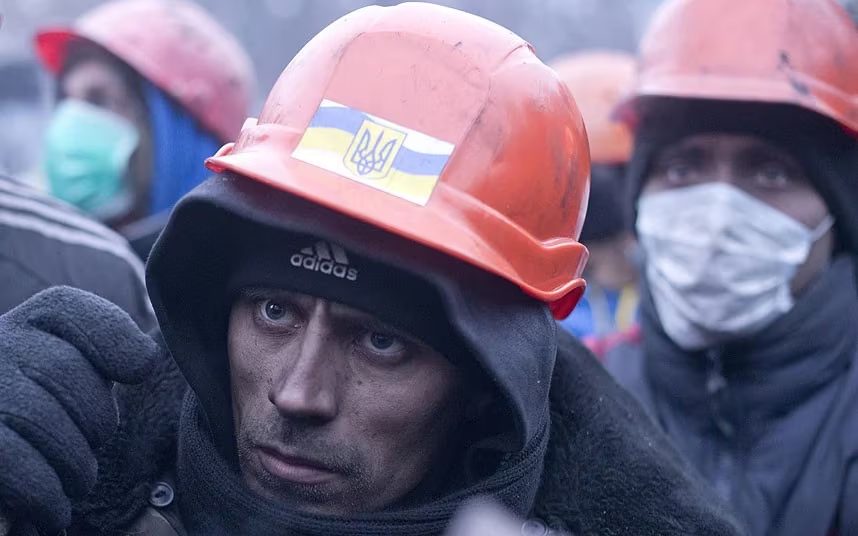
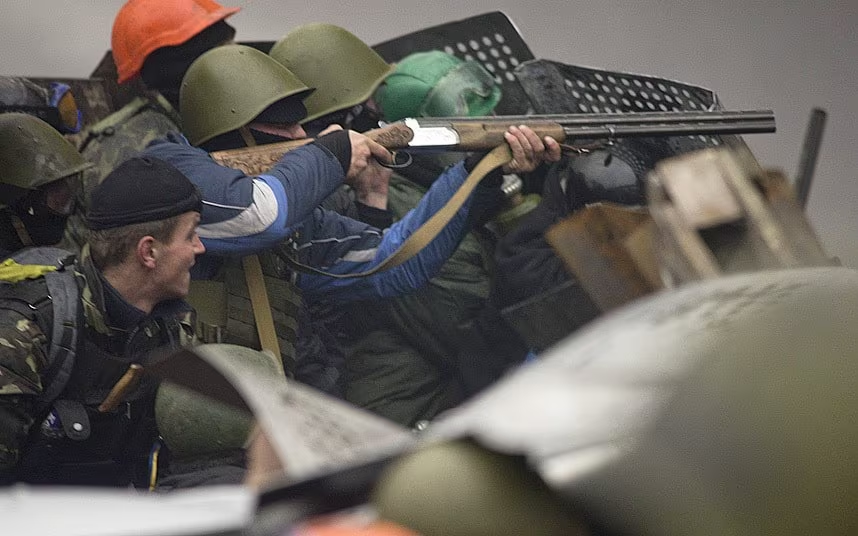
To a large extent, this course of events was embedded in the agreement itself. It provided for the withdrawal of government forces from the line of confrontation and their use solely to guard government buildings—which is what was done. The Maidan, meanwhile, where a significant number of armed participants were present by that point, remained in place. Formally, the document also required the surrender of illegal weapons, the освобождение of seized administrative buildings, and the unblocking of streets. Yet under those circumstances, compelling the protesters to disarm and disperse was impossible.
By the evening of February 21, control over Kyiv had effectively passed to the opposition. From there, events unfolded according to a principle formulated long ago by Mao Zedong: power grows out of the barrel of a gun. The opposition seized the moment to take control of parliament and remove Yanukovych from office.
At the same time, the decisive factor behind the collapse of the agreements was the massacre on the Maidan on February 20, 2014.
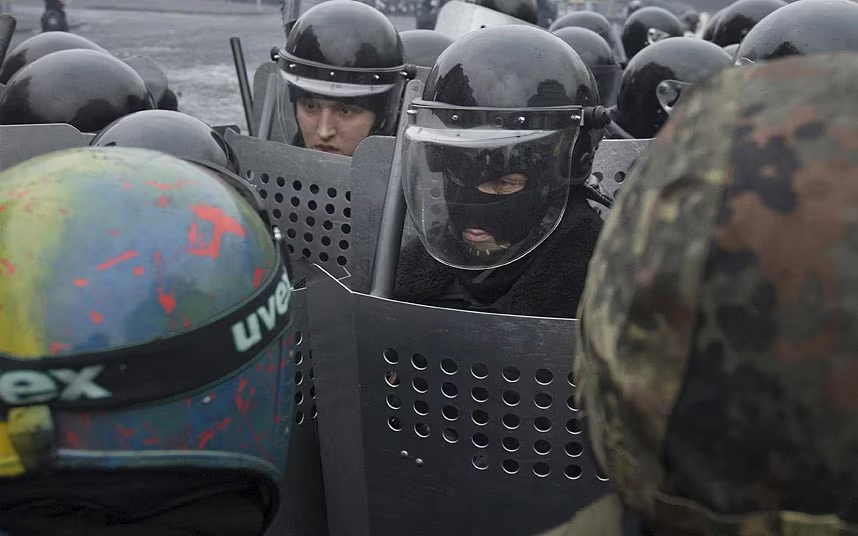
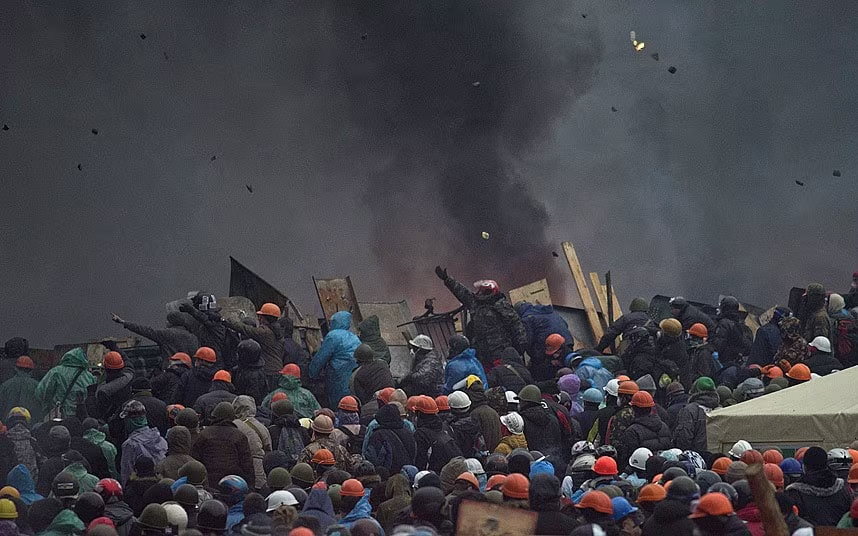
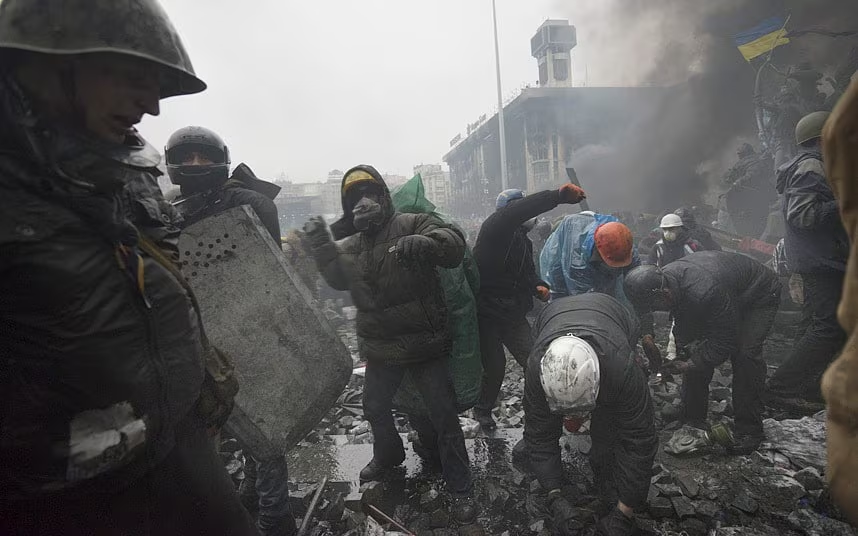
On February 18, after Maidan supporters attempted to break through to the Verkhovna Rada, clashes erupted in which Berkut riot police and internal troops pushed protesters out of the government quarter. An attempt to clear the Maidan by force faltered by the morning of February 19. From that point on, the confrontation became positional, without active operations.
On the evening of February 19, a truce between the authorities and the opposition was officially announced. A visit to Kyiv by the foreign ministers of France, Germany, and Poland was scheduled for February 20 to discuss a peace plan. That same evening, the Security Service of Ukraine denied reports that an “anti-terrorist operation” had begun in the capital. Everything suggested that the authorities, at a minimum, intended to pause until the arrival of the European mediators, later joined by Vladimir Lukin, a representative of Vladimir Putin.
Nevertheless, shooting began on the Maidan on the morning of February 20. Dozens of protesters and law enforcement officers were killed and wounded.
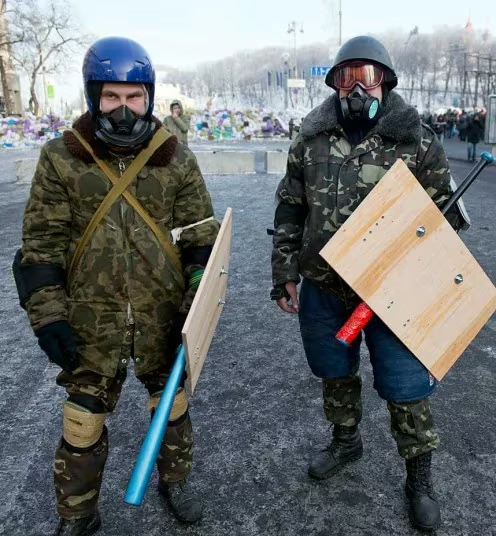
Despite this, negotiations between Yanukovych and the opposition, with the participation of European ministers, did take place, and compromise agreements were signed. Yet the backdrop created by the mass killings fundamentally altered the situation.
The authorities were demoralized by accusations over the shootings. A split began to emerge within the pro-government majority in parliament: some deputies from the Party of Regions rushed to distance themselves from Yanukovych and defect to the Maidan’s side. This enabled the opposition to seize control of the Rada and, in effect, abandon the implementation of the February 21 agreements.
More important still was something else: after the mass killings, the Maidan was no longer prepared for any compromises with Yanukovych. Any arrangement that left him in power provoked fierce rejection. Even warnings from Poland’s foreign minister, Radoslaw Sikorski, proved ineffective; according to the recollections of Viktoriya Syumar, he said that if the agreements were not supported, there would be war.
Syumar recalled that after the shootings it became clear the agreement simply would not work. Shock and anger fully displaced rational arguments. Implementing the negotiated terms was practically impossible.
It was precisely the shootings of February 20 that set off the chain of subsequent events—from the annexation of Crimea and the war in Donbas to Russia’s full-scale invasion.
The key question—who started the massacre on the morning of February 20?
The answer was provided by the Prosecutor General’s Office of Ukraine after the Maidan had ended, during the presidency of Petro Poroshenko. The investigation examined not only the killings of protesters but also the deaths of law enforcement officers. It concluded that the first shots were fired by Maidan participants—the so-called “Parasyuk group.” They opened fire on internal troops, resulting in killed and wounded personnel. After that, security forces abandoned their positions and retreated to the government quarter.
Maidan forces then went on the offensive and were halted by return fire. According to the Prosecutor General’s Office, the shots were fired by Berkut officers. According to their lawyers, the shooters were unidentified “Georgian snipers” from the Ukraina Hotel. However, the investigative materials unequivocally establish that it was the Maidan side that opened fire first, in the absence of any escalation by law enforcement.
This was reflected in the notice of suspicion issued to Ivan Bubenchyk, a member of the so-called “Parasyuk group,” who was detained in 2018, as well as in a draft notice of suspicion prepared for Nazar Yuskevych. The documents explicitly stated that the shooting was intended to disrupt the truce and destabilize the situation. The investigation found that on the morning of February 20, law enforcement officers were lined up in formations without firearms and were not engaged in any active operations. After the first shots were fired, two members of the internal troops were killed and another 28 were wounded.
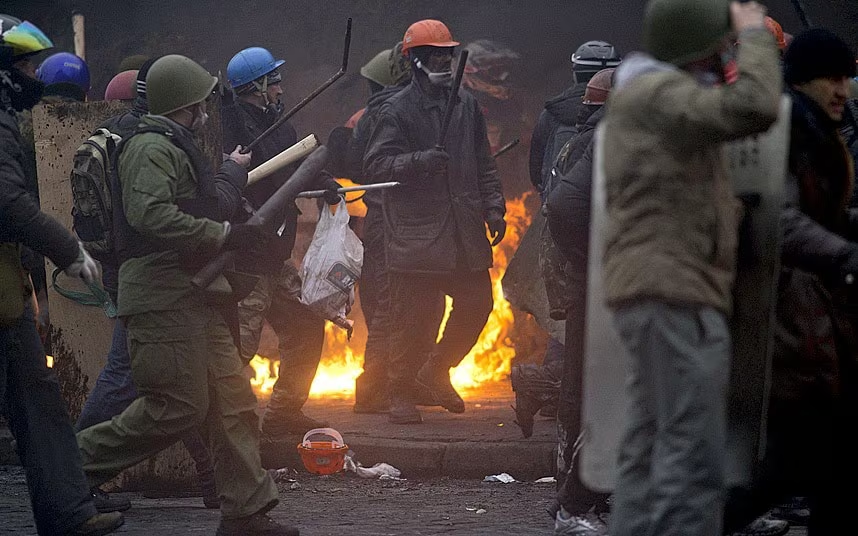
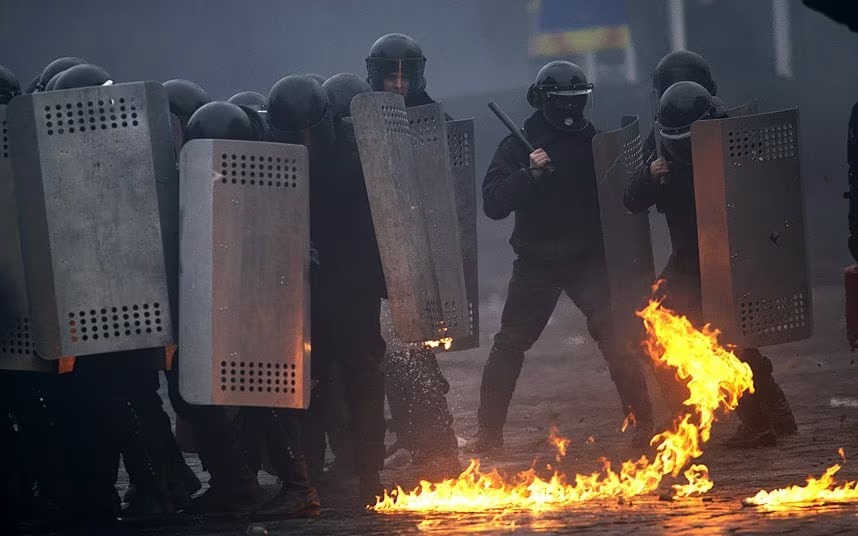
The investigation into the killings of law enforcement officers was effectively curtailed under pressure from activists. The notice of suspicion for Yuskevych was never served, and the Bubenchyk case was quietly allowed to stall. At the same time, both Bubenchyk himself and Volodymyr Parasyuk had previously acknowledged the fact that shots were fired at security forces.
According to investigators, the group acted on its own initiative. Whether some coordinating force stood behind it remains one of the central unanswered questions of Ukraine’s modern history.
Since then, moments have repeatedly arisen when the situation seemed capable of turning toward compromise and peaceful settlement. Each time, something intervened to derail those understandings. The events of February 2014 were only one such episode.
Perhaps there was no “invisible director” at all. Perhaps the decisive force was a vortex of hatred that, once blood had been shed, began to draw in ever more people. The logic of war—“one does not negotiate with the enemy”—proved stronger than political calculation, reinforced by the personal ambitions and fears of leaders.
One way or another, the events of twelve years ago became one of the key triggers of the tragedies that followed. The central question today is therefore not about the past, but about how to break out of the closed circle of war, bloodshed, and mutual destruction—even as resistance to such an outcome remains extraordinarily strong.