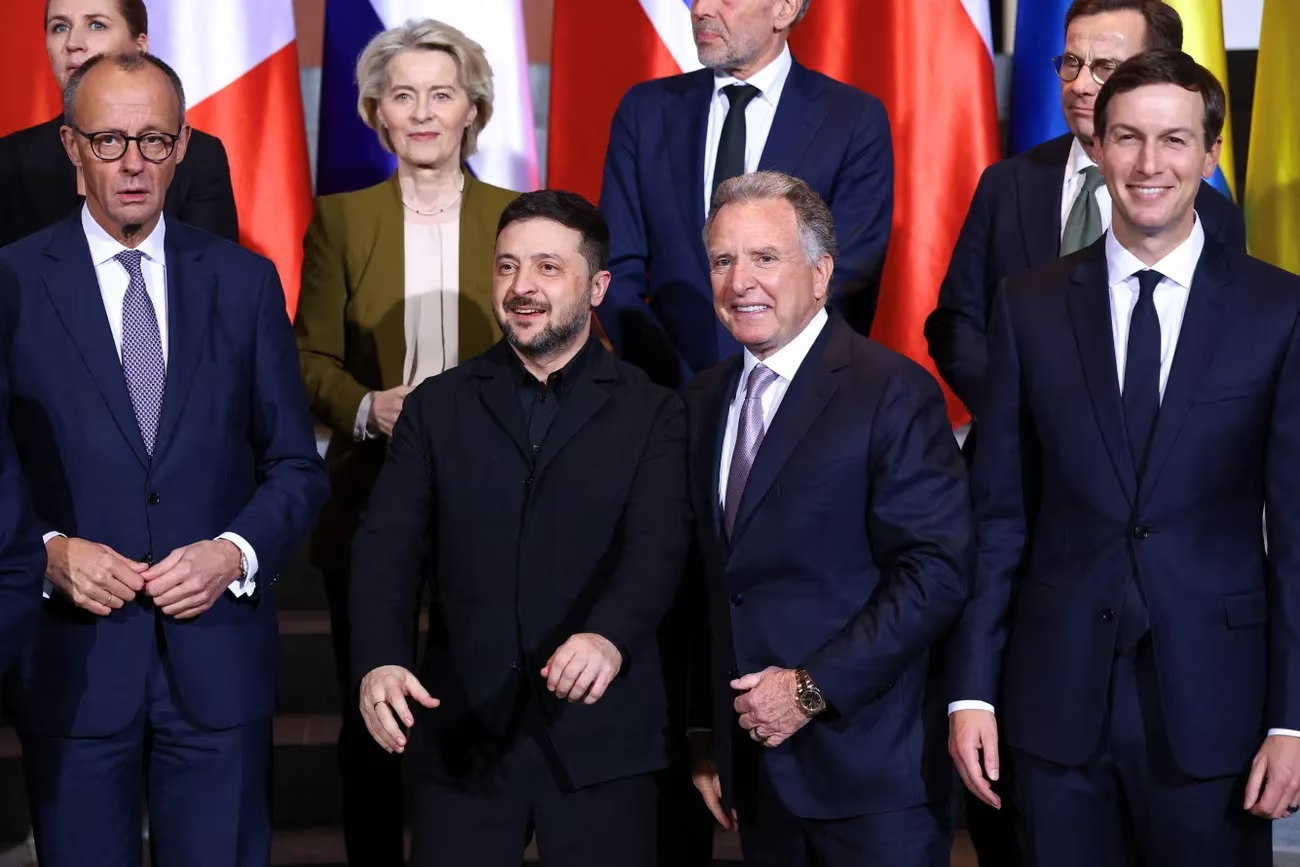
Talks between Ukrainian and U.S. delegations took place in Berlin on December 14–15. Among the participants were U.S. President Donald Trump’s special envoy and longtime associate Steve Witkoff, Trump’s son-in-law Jared Kushner, Ukrainian President Volodymyr Zelensky, and National Security and Defense Council Secretary Rustem Umerov. The central focus was a plan intended to bring the Russia–Ukraine war to an end, as well as potential security guarantees for Ukraine.
As Western media reported, the talks were difficult. Sources cited by AFP said the U.S. side pressed for the withdrawal of Ukrainian forces from Donetsk Oblast, including areas that at the time were not under Russian control. Moscow has advanced the same demand, and such a provision featured in the initial U.S. proposals. For Kyiv, it remains unacceptable. According to Axios, the sharpest disagreements centered on the territorial issue. Even so, both sides said the meeting had produced “significant progress” and described the dialogue as “productive.” Ukrainian officials separately urged the public not to trust the “media speculation” that accompanied the talks.
Volodymyr Zelensky confirmed that Kyiv’s and Washington’s positions on territorial issues do not yet align. He said this at a joint press conference with German Chancellor Friedrich Merz following the meeting with the U.S. delegation. “There was ample dialogue on territories. It seems to me that we currently have different positions. But I believe my colleagues heard my personal position,” the Ukrainian president said. He described the territorial question itself as “principled and painful,” while emphasizing the readiness of all participants to continue working on solutions “with respect for Ukraine” that could bring the war closer to an end.
Asked about possible territorial concessions to Russia, Zelensky said: “I do not believe the United States demanded anything from us. I see the United States as our strategic partner. We view this (territorial concessions) as demands from the Russian Federation.”
The key outcome of the talks, according to European media citing U.S. officials, was a U.S. pledge to provide Ukraine with security guarantees comparable to those enshrined in NATO’s charter. “At the core of this arrangement are extremely strong guarantees—essentially equivalent to Article 5—along with very robust deterrence mechanisms. They concern the size of Ukraine’s armed forces and the weapons available to them,” the sources said.
According to sources cited by Western outlets, negotiators managed to agree on “90% of the issues” during the talks. Among the remaining topics were territorial questions and the status of the Zaporizhzhia nuclear power plant. U.S. officials say Trump does not intend to “pressure” Ukraine on territorial matters, leaving Kyiv free to make its own decisions. As for the plant, one option under discussion involves splitting its capacity between Ukraine and Russia on a 50–50 basis. “It appears we are close to an overall agreement on dividing the capacity,” one U.S. representative said.
According to U.S. officials, Donald Trump is “satisfied with the progress” and believes he can persuade Russia to accept the security guarantees proposed for Ukraine. The text of the U.S. proposals has not been made public, and officials speaking to the press declined to disclose details of the guarantees mechanism.
At the same time, European leaders released a joint statement outlining Europe’s and the United States’ commitments to security guarantees for Ukraine and to postwar reconstruction. It remains unclear whether this document fully aligns with the proposals advanced by Washington.
The statement declares Europe’s readiness to deploy “multinational forces” to Ukraine. In total, the document sets out six commitments. The first calls for sustained military support for Kyiv, with Ukraine’s armed forces numbering up to 800,000 personnel in peacetime to deter aggression and defend the country’s territory. The second concerns the creation of “multinational forces for Ukraine,” led by Europe under a “coalition of the willing” with U.S. backing—to rebuild Ukraine’s armed forces, ensure security in the air and at sea, and, if necessary, conduct operations on Ukrainian territory. The third commitment предусматривает monitoring of a ceasefire, led by the United States with international participation—to provide early warning of attacks, document violations, and respond to them. The fourth includes security guarantees that establish a legal obligation to respond to any renewed attack using military, intelligence, economic, and diplomatic means. The fifth addresses investment in Ukraine’s reconstruction, including financing rebuilding efforts, trade agreements, and compensation for damage from Russia, while maintaining the freeze on Russian assets in the EU. The sixth commitment reaffirms support for Ukraine’s accession to the European Union.
“We are closer to peace now than ever before,” Donald Trump said. Speaking at the White House, he noted that on the evening of December 15 he had discussed ending the Russia–Ukraine war by phone with European leaders and Volodymyr Zelensky. “We had a very good discussion, and things seem to be going well,” the U.S. president said, adding that he feels strong support from European leaders who are keen to see the war brought to an end.
Trump also said he had recently spoken by phone with Russian President Vladimir Putin, who, according to him, is interested in ending the war. He did not specify the date of the conversation. “The problem is that they all want this, and then suddenly they don’t. We need to bring them [presumably Russia and Ukraine] to a common position, but I think it’s working… a very good conversation,” the U.S. leader said.