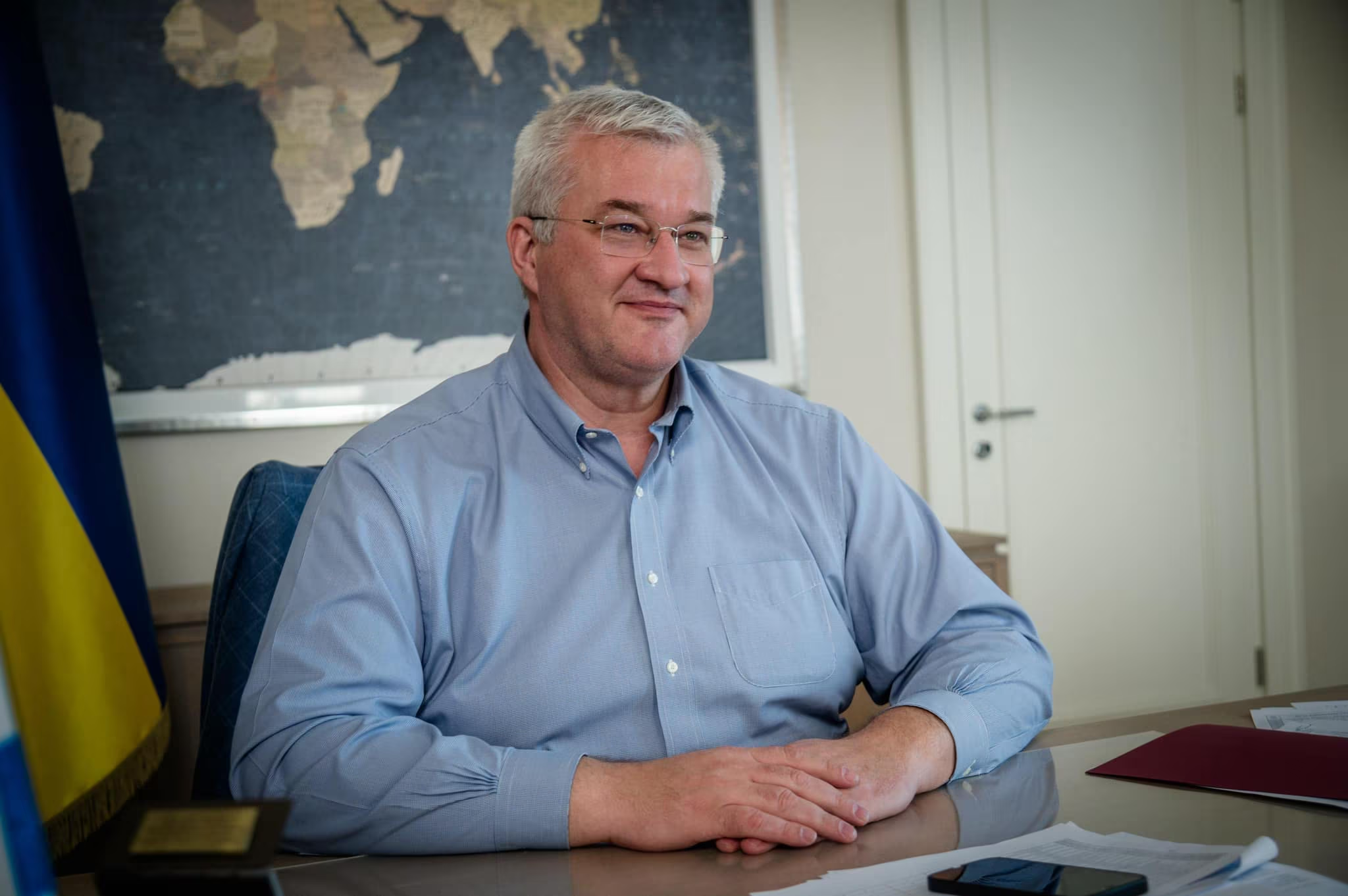
About eight million Ukrainians are now living abroad—and not every country wants them to return. Foreign Minister Andrii Sybiha said in parliament that Kyiv’s goal is to bring these people back by creating the necessary conditions.
“We see that not all countries are interested in Ukrainians returning, given their contribution to economic development, their qualifications, and their adaptability. We will have to compete for our people,” the minister said.
Andrii Sybiha’s statement about eight million Ukrainians living abroad.
A similar point was made by migration service chief Nataliia Naumenko. According to her, Ukraine and European countries are already discussing how to return refugees home “gently and without pain.”
“Today we are speaking with many European politicians and many European agencies. They are all looking for ways to develop a fairly soft and painless program for returning Ukrainians to Ukraine, because they also understand how important it is for us to bring our citizens back. And the state will be interested in creating absolutely all conditions for our citizens to return,” she said.
Both speeches repeated the same word—“conditions.” According to officials, the state is interested in creating them. But neither Sybiha nor Naumenko explained what those conditions actually are. No program, no figures, no timeline. The phrase “creating conditions” remains empty precisely at the moment when people expect specifics.
And the reality people are being asked to return to looks very different. Destruction across the country is not stopping—it is increasing. Strikes on the energy system continue, and the coming winter could prove even harder than the previous one: entire regions may once again face prolonged blackouts, unstable heating, and water shortages. People are not being asked to return to the country they left, but to one where basic infrastructure survives from day to day.
There is also another reason authorities prefer not to mention when discussing “return.” For families with children, the issue is first and foremost about safety—parents are trying to protect their children from an ongoing war and constant strikes. Added to this is the state requirement for military registration at territorial recruitment centers starting at age 17. Against the backdrop of repeated calls from parts of Europe to lower the mobilization age, such families have little desire to return—for many, it represents a direct risk that a teenager could soon fall into the orbit of conscription after reaching adulthood.
This is compounded by the condition of the education system itself—the one children are supposedly meant to return to. On the same day, Ukrainian ombudsman Dmytro Lubinets wrote after meeting Education Minister Oksen Lisovyi that the education system is “lagging behind reality,” causing the state to “begin losing its children.” According to him, schools are failing to prepare graduates for the National Multisubject Test, forcing parents to rely on private tutors, while the minister himself acknowledged that the system does not meet the level of knowledge expected from school graduates.
The situation is especially severe in frontline, liberated, and mountainous communities, where education is effectively inaccessible due to school closures, lack of transportation, and poor roads. Lubinets also noted that the number of applicants from occupied territories is declining because they are not properly informed about opportunities for enrollment, while the Education Ministry does not even maintain separate statistics for this category—meaning, in his words, that state policy is being shaped “blindly.”
“Launching a reform of upper secondary school that will effectively lead to school closures, without a prepared system and during wartime, is simply abuse of Ukrainian children and education,” the ombudsman said.
In the end, there appears to be a complete disconnect between the rhetoric and the reality of people’s lives—or an unwillingness to understand it. Officials speak about the return of eight million people as a matter of goodwill and properly designed “conditions,” constructing explanations for why Ukrainians do not want to come back while avoiding the central reasons. Those reasons are obvious: the ongoing war, missile strikes, military registration from age 17, pressure to lower the conscription age, and a system where, quite literally, there is nowhere safe to bring children back to.
For now, only one parameter is changing—time. The current EU protection program for Ukrainians expires in March 2027, and no decision on its extension has been made. It may ultimately be this deadline, rather than any “created conditions,” that becomes the real mechanism of return.