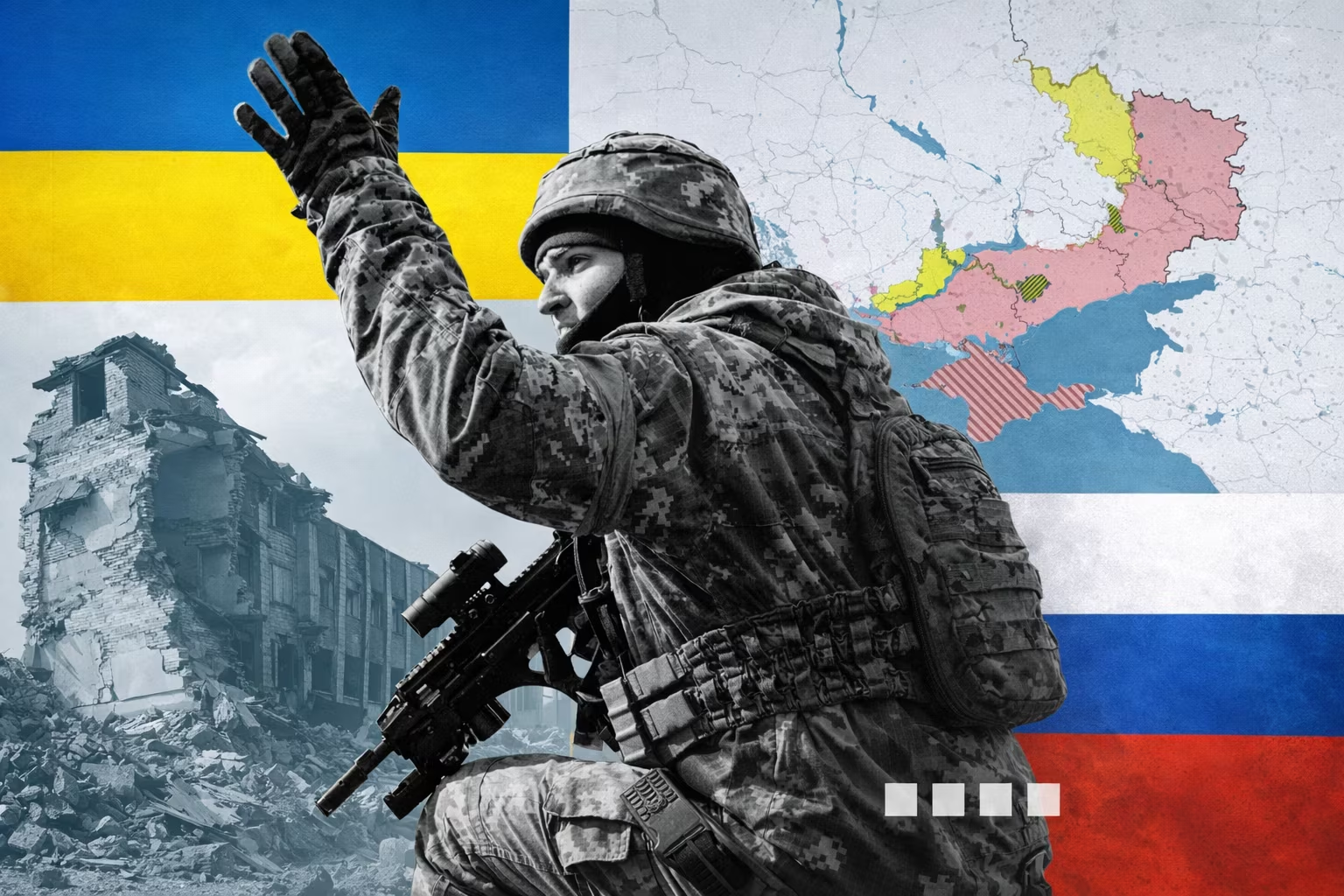
Ukrainian authorities have begun working through a scenario in which a presidential election would be held simultaneously with a referendum on a possible peace agreement with Russia, according to sources cited by the Financial Times. The move followed pressure from the administration of Donald Trump, which, the FT’s interlocutors say, has made it clear to Kyiv that both votes must take place no later than May 15—otherwise Ukraine risks losing the US security guarantees currently on offer.
According to Ukrainian and Western officials, as well as people familiar with the discussions, the initiative forms part of broader pressure from the White House aimed at accelerating the conclusion of peace talks between Ukraine and Russia as early as this spring, the Financial Times reports.
This approach aligns with the US logic outlined by Volodymyr Zelensky when he spoke to journalists on Friday. As the FT notes, Washington expects all documents required to bring Europe’s largest military conflict since World War II to an end to be signed by June.
“They say they want to get everything done by June—so that the war is over,” the Ukrainian president said, referring to the White House’s desire to shift its focus to the US midterm elections in November. “They want a clear timetable.”
Holding elections would mark a sharp political reversal for Zelensky. He has repeatedly stressed in the past that voting is impossible under martial law, amid mass displacement and Russia’s ongoing occupation of roughly 20 percent of the country’s territory, the Financial Times recalls.
According to Ukrainian and European officials involved in preparing the initiative, as well as other sources briefed on the discussions, Zelensky plans to announce a roadmap for holding a presidential election and a referendum on February 24—the fourth anniversary of Russia’s full-scale invasion, the FT reports.
“Among Ukrainians, there is a firm belief that all of this must be tied to Zelensky’s re-election,” said one Western official familiar with the situation, according to the Financial Times.
Zelensky’s office did not respond to a request for comment. The US embassy in Kyiv also declined to comment, the FT notes.
At the same time, Ukrainian and Western officials stress that neither the proposed timeline nor the US ultimatum is likely to prove realistic, as both depend on a range of factors—including whether progress can be made toward a peace agreement with Russia’s president, Vladimir Putin, according to sources cited by the Financial Times.
Even so, the plan itself, they say, signals Zelensky’s effort to both shore up his position ahead of a potential re-election bid and send a message to US president Donald Trump that Kyiv is not dragging out the peace process—provided that a deal can genuinely be reached, the FT writes.
According to national polling, public support for Zelensky remains substantial, but has declined markedly from the near-unanimous approval he enjoyed four years ago, the Financial Times notes.
Voter sentiment is being shaped by fatigue from the protracted war, as well as by corruption scandals that have touched the president’s inner circle.
People close to Zelensky say that he and his team have made clear to the Donald Trump administration that they are prepared to consider only compressed timelines, despite the obvious logistical challenges of holding elections during wartime and within such a short period, FT sources report.
Zelensky himself has said that Ukraine and the US have already agreed on security guarantees and that Kyiv is ready to sign the relevant documents with Trump, the Financial Times notes.
However, the US president has signaled to the Ukrainian side that the provision of such guarantees would be tied to the conclusion of a broader peace agreement—one that would likely entail ceding the Donbas region to Russia and that Washington would like to finalize by May 15, the FT writes.
Zelensky has so far rejected demands for territorial concessions. Last week, he again said that Ukraine “will remain on the positions it holds,” the Financial Times reports.
According to officials, the Donald Trump administration has previously set deadlines that were later pushed back, but this time Washington is leaving Kyiv little room for maneuver as the US midterm elections draw closer, the FT notes.
Sources tell the Financial Times that implementation of the plan could also be delayed by the persistence of deep disagreements between Kyiv and Moscow over the core issue of territory—above all control of the Donbas and the Zaporizhzhia nuclear power plant.
An additional source of uncertainty could be a possible escalation of Russian strikes on Ukraine’s critical infrastructure, along with an intensification of ground offensives in the country’s southeast, where Russian forces continue to advance despite sustaining heavy losses, the FT writes.
Vladimir Putin, according to Financial Times sources, is insisting on pressing ahead with his maximalist objectives, including the forcible seizure of the Donbas, should Kyiv and Western countries fail to accept his demands. This comes despite statements by Trump and his special envoy, Steve Witkoff, who have said they believe the Russian leader is prepared to strike a deal.
Ultimately, the prospect of holding elections, FT sources say, will depend on whether Zelensky can secure a peace agreement that he himself considers fair and acceptable to Ukrainian society. The Ukrainian president has long maintained that any peace deal must be put to a nationwide vote—as a condition of its legitimacy.
Under the working schedule, parliament is expected to take up legislative changes in March and April that would make it possible to hold a vote during wartime, the Financial Times reports. The current state of martial law explicitly bans nationwide elections while hostilities are ongoing.
Experts warn that such a compressed timetable would mean holding elections at a moment when hundreds of thousands of servicemen are deployed on the front line and millions of Ukrainians remain displaced inside the country or abroad—calling into question the legitimacy of such a vote, the FT notes.
“Six months of preparation for elections is not a maximum—it is a minimum,” said Olha Aivazovska, chair of the board of the Kyiv-based analytical center OPORA, which advises the authorities on democratic governance, electoral law, and parliamentary reform, according to the Financial Times.
The core problem, she said, is that without a ceasefire the voting process would be vulnerable to interference from Russia. In particular, the pervasive presence of Russian drones “poses a threat to polling stations across Ukraine,” she told the FT.
“There has never been a situation like this before. It is absolutely unprecedented,” Aivazovska added.
Many Ukrainian politicians oppose holding elections before a durable peace agreement backed by credible security guarantees is in place, fearing that such a move would only deepen internal political divisions, the Financial Times writes.
“Political competition during wartime is bad,” Kyiv mayor Vitali Klitschko said. “We could destroy the country from within… and that is exactly what Russia wants,” the FT quotes him as saying.
At the same time, people close to the president say that Zelensky sees this year as his best chance of re-election in a country where voters have traditionally been reluctant to back incumbents, the Financial Times reports. His position, they argue, could be even stronger if the vote is held alongside a referendum.
Officials and election experts add that holding the two ballots simultaneously would likely ensure higher turnout, the FT notes.
According to one Western official, international recognition of the results would require participation by at least half of the electorate registered before the war. Otherwise, there would be grounds—above all for Russia—to question the legitimacy of the outcome, the Financial Times reports.
“If we do this wrong… if we rush it, we will cause serious damage to the quality and future integrity of our democratic process,” Olha Aivazovska said. “And it will be perceived as illegitimate,” the Financial Times quotes her as saying.