According to the UK Home Office, the number of refugees granted resettlement through UN-supported programmes has fallen by more than a quarter in the past year. In the period up to September 2025, only 7,271 people were offered protection, roughly half of them Afghans whose safety was compromised after a British defence official inadvertently leaked their personal data. A year earlier, 9,872 people had entered via the same routes, a drop of 26%.
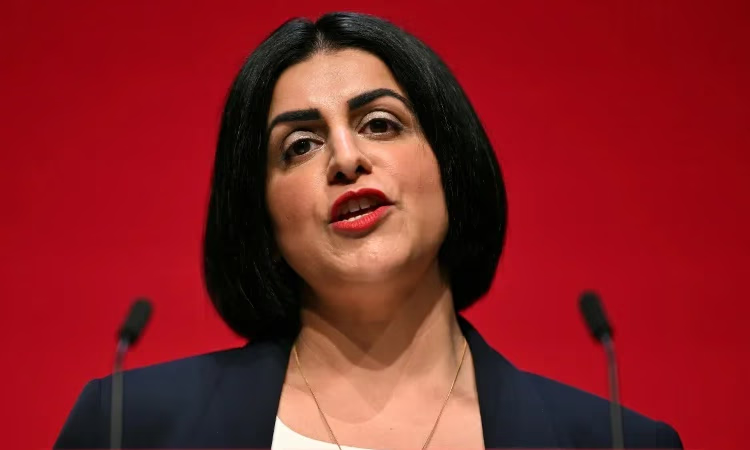
The figures emerged two weeks after Home Secretary Shabana Mahmood sought to justify a tougher policy stance, announcing plans for three new “safe and legal” pathways for a “limited” number of applicants. At the same time, the programme that had allowed refugees to bring family members to the UK was suspended in September.
Enver Solomon, head of the Refugee Council, said the data shows that existing “safe and legal” routes are effectively being dismantled, pushing people towards irregular migration, including Channel crossings in small boats.
He argued that “the sharp fall in resettlement numbers demonstrates that the few safe and legal routes available to people fleeing war and persecution are disappearing precisely when they are most needed”. When lawful options vanish, he said, “people fall into the hands of smugglers and attempt perilous journeys. Halting the family-reunion scheme, which largely benefited women and children, makes it even harder for relatives to remain together in safety”. He added: “If the government is serious about tackling criminal networks and reducing Channel crossings, it should set out clearly how many people it is prepared to help each year and how it intends to expand safe routes so families have a genuine choice rather than a dangerous gamble.”
According to the latest Home Office data, 3,686 people whose lives were put at risk after an accidental data leak by the Ministry of Defence were admitted to the UK last year through the Afghanistan Response Route. The scheme was established after a London-based defence official mistakenly sent to Afghanistan the personal details of nearly 19,000 people who had applied for resettlement together with their families.
In addition, 1,087 Afghan interpreters and assistants to British forces were resettled this year under the Afghan relocations and assistance policy, along with 1,658 people admitted through the Afghan citizens resettlement scheme. A further 830 arrived via the UK resettlement scheme, under which the UN Refugee Agency selects candidates, conducts interviews and refers them to the UK.
Only four people entered the UK under the mandate scheme in the period up to September, compared with 23 the previous year. This programme is designed for refugees who are minor children, spouses, parents or elderly relatives over 65 and who have family members in the UK.
On 17 November, Shabana Mahmood set out a plan to end permanent protection for refugees. Instead, their cases would be reviewed every 30 months. The proposal also includes speeding up the removal of those whose claims are rejected, including their children, and seizing the assets of people arriving in small boats. Mahmood said the government would create three new routes for refugee admissions and would prioritise individuals identified by the UN Refugee Agency. However, speaking to reporters, she stressed that the scheme would initially take in only “a few hundred” people. UNHCR said it is still awaiting details on the mechanisms being prepared.
Britain Is Radically Changing Its Asylum Rules, Turning Refugee Status Into a Temporary One
London Is Linking the Reform to Pressure on Countries That Refuse to Take Back Deported Migrants
UK Conservatives Create a Deportation Service for Migrants
The New Agency, Modeled on the U.S. Immigration Enforcement Unit ICE, Will Receive a £1.6 Billion Budget and Aim to Remove 750,000 People
Under the “one in, one out” scheme operated jointly with France, the authorities removed 153 people and admitted 134 applicants whose asylum claims were deemed valid.
A Home Office spokesperson said: “The government is committed to protecting genuine refugees fleeing war and danger. That is why, as part of the most sweeping reform of the asylum system in modern times, we will open new safe and legal routes for those in need of protection.”