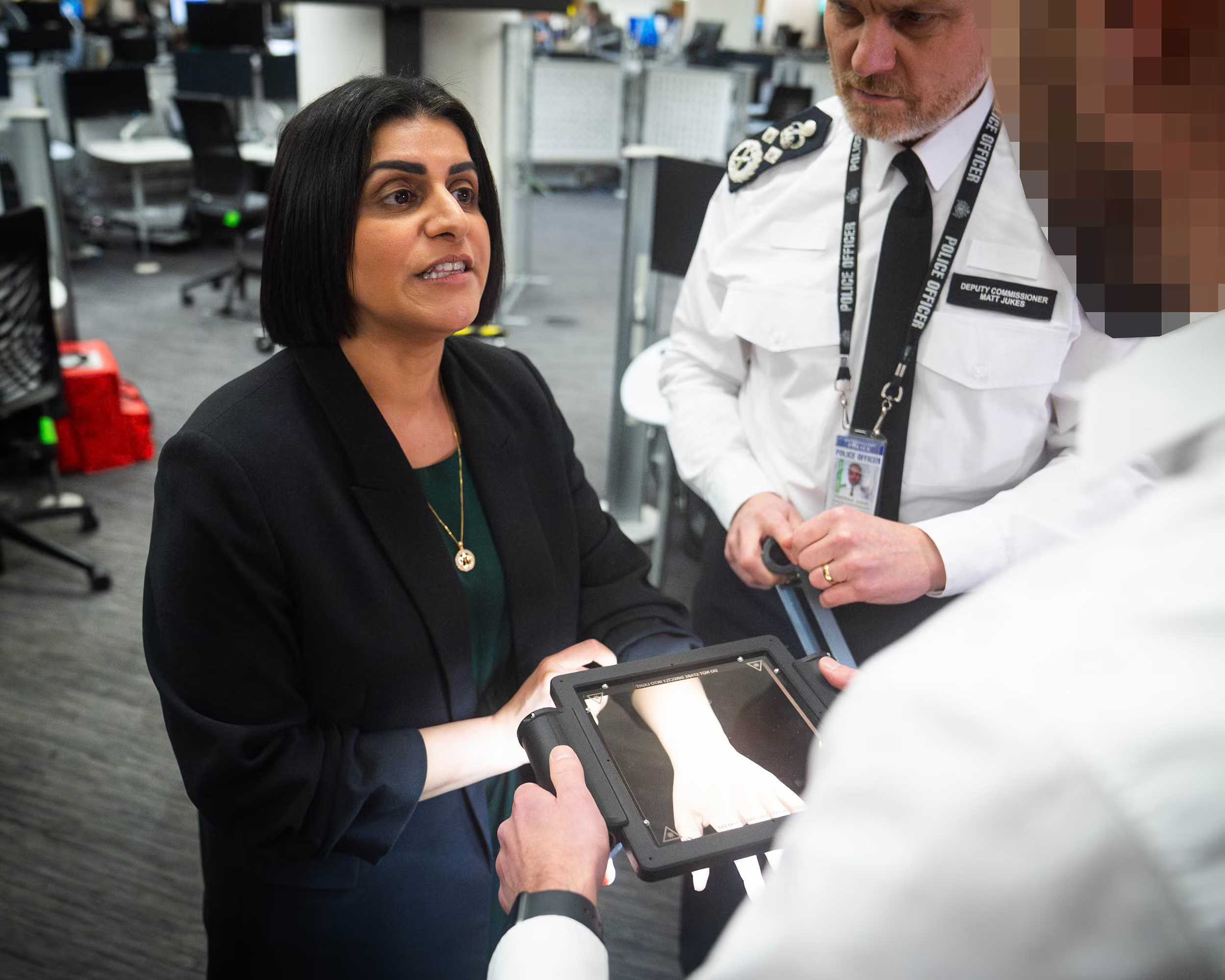
The UK government plans to establish a National Police Service—a body already informally dubbed the “British FBI”—that would take responsibility for investigating organised crime, terrorism, fraud and the online exploitation of children. The move would mark one of the most sweeping changes to policing in England and Wales in recent years.
The Home Office is set to announce the creation of the new service on Monday in a dedicated policy document. The reform would abandon the current model, under which investigations into fraud, the activities of organised crime groups and nationwide counterterrorism operations are split across several agencies—including the National Crime Agency and regional units reporting to local police forces.
Under the proposal, these functions would be consolidated within a single body. Ministers say the National Police Service would draw on “world-class specialists” and “cutting-edge technology”, freeing up local police resources and allowing forces to focus on less complex but socially sensitive offences—from shoplifting to anti-social behaviour.
Under the plans, a range of other key functions would also be brought under the control of the new body, including the counterterrorism unit currently led by London’s Metropolitan Police, the National Police Air Service overseen by West Yorkshire Police, and road-policing operations. The service is expected to share technology, intelligence and resources on a centralised basis, operating beyond regional boundaries.
“The current policing model was designed for a different century,” said Home Secretary Shabana Mahmood. She argued that a number of local forces lack the expertise and resources needed to tackle complex forms of modern crime—such as fraud, the online abuse of children and the activities of organised crime groups. The new structure, she said, would allow local police to focus on keeping their own communities safe.
The National Police Service will be headed by a national police commissioner—the most senior policing post in the country. The service will set uniform standards and a single training system for all units, and will centrally procure technologies, including facial-recognition cameras. This aspect of the reform has already drawn criticism over its potential implications for privacy and human rights.
A joint statement by London’s Metropolitan Police, counterterrorism units and the National Police Chiefs’ Council says that “modern crime requires a modern policing response”. The authors note that calls to bring together the country’s strongest policing teams have been discussed for years, and that the reform builds on the high international standing of the UK’s counterterrorism units, whose professionalism and capabilities are recognised globally.
At the same time, police leaders stress the need for a cautious transition. In their view, the success of the reform will depend directly on maintaining close ties with local police forces and communities. Neighbourhood officers are described as indispensable in tackling organised crime and terrorism—their knowledge, contacts and constant presence on the ground form the backbone of public safety. Preserving these links is seen as a key condition for strengthening trust between the police and the public.
The creation of the National Police Service is planned to be phased. During the transition, it will operate alongside existing agencies and regional organised-crime units.
The idea was endorsed by Neil Basu, the former head of counterterrorism policing, who said that as a single national mechanism the new body would be “far more effective” in tackling serious and organised crime and terrorism. Support also came from Graeme Biggar, director-general of the National Crime Agency, which is expected to be integrated into the new service.
“I am proud of the outstanding work carried out by NCA staff to protect the public from serious and organised crime and emerging threats,” he said, adding that the entire policing system is outdated: crime has changed, technology has changed, and the methods of response must change as well. New threats, he argued, affect people at the local level but require a national and international response.
London’s police chief, Mark Rowley, has previously also argued in favour of moving responsibility for counterterrorism to the national level, beyond the remit of his own force.
The initiative, however, has also prompted concern. Graeme Wetherall, a policing analyst and former operational officer with 30 years of service, has taken a critical view of the plans. He is troubled by the logic of how the reform is being prepared and by what he describes as a lack of consultation with those who actually do the policing—operational officers, detectives and patrol staff. “I do not believe such consultations have taken place,” he said, adding that the initiative appears to have originated within the Home Office and among advisers with no practical experience of police work.
At the same time, Wetherall acknowledged that fraud investigations are indeed highly complex and in many cases require national coordination. The scale of online fraud is such that offences often span multiple regions, with perpetrators and victims located in different parts of England. In such circumstances, he said, managing investigations through a single regional unit becomes virtually impossible.
“There is a logic to this,” he stressed, adding that the nationalisation of certain functions is justified because organised crime groups do not respect administrative boundaries and exploit the fragmentation of the system to their advantage.