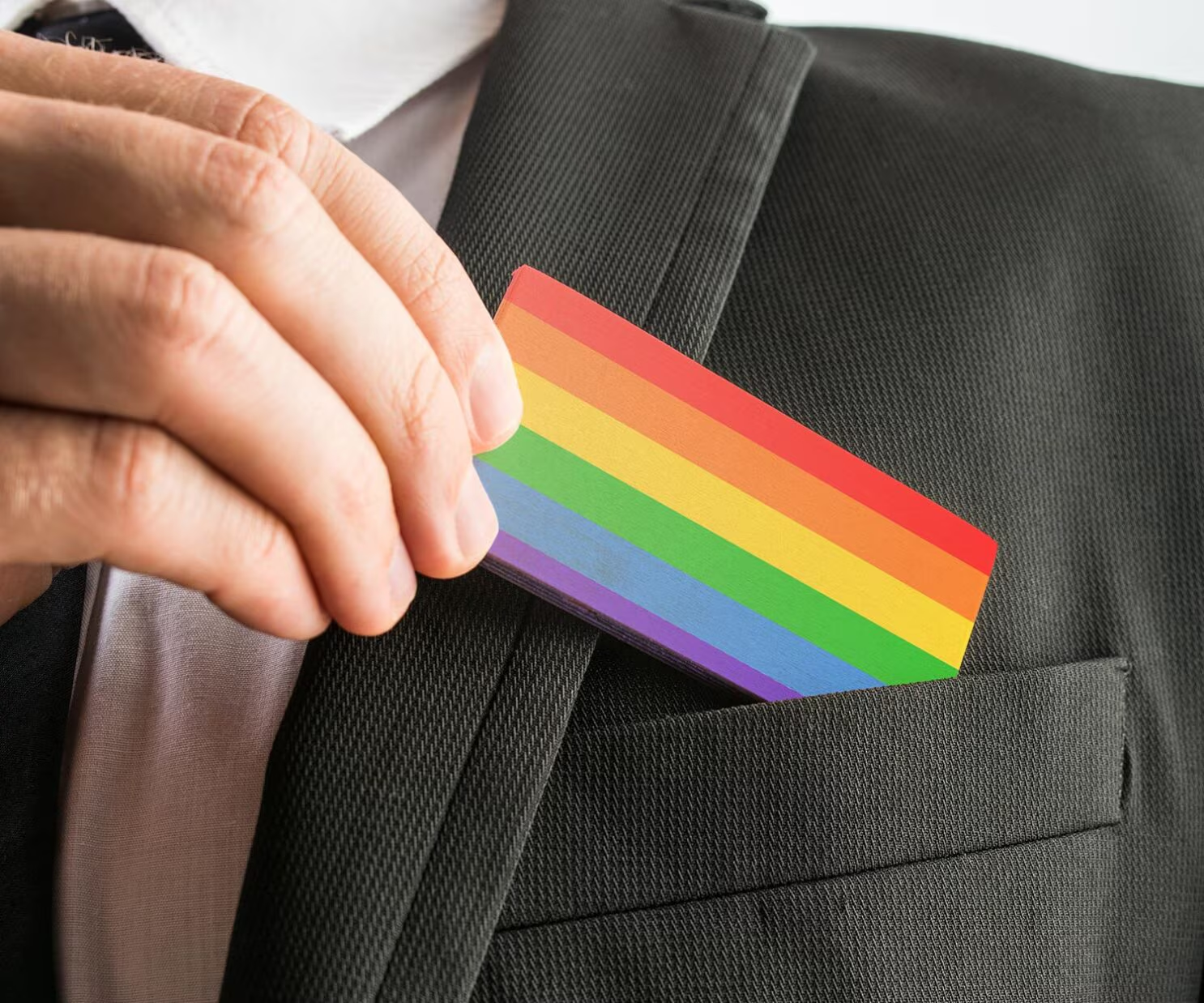
Britain’s largest companies are increasingly scaling back their public support for Pride events. This has raised concerns among human rights advocates, who warn of the need for “clear signals” at a time of growing hostility toward LGBTQ+ communities worldwide.
An analysis of social media posts by major British corporations shows that references to Pride have fallen by 92% compared with 2023. A similar pattern had previously been observed among leading US companies.
The shift follows a series of executive orders signed in 2025 by US President Donald Trump, which dismantled federal programs on diversity, equity, and inclusion (DEI). In response, companies on both sides of the Atlantic began rebranding, scaling back, or abandoning initiatives tied to equity and inclusion policies altogether.
In 2023, 52 posts by major British companies were published on Facebook, Instagram, and X that used the word or hashtag Pride—in reference to Pride events, months, weeks, or weekends, as well as internal corporate LGBTQ+ employee networks.
In 2024, the number of such posts fell by 48%—to 27. In 2025, it dropped to just four, representing an 85% decline year on year and a 92% decrease compared with 2023 levels.
HSBC remained the British company most consistently referencing Pride on social media throughout the period under review, but even here the number of posts fell by 94%, in line with the broader trend. AstraZeneca, Shell, and Unilever published virtually no Pride-related material between 2023 and 2025.
“Counting social media posts does not capture the full breadth of our approach,” HSBC said.
A similar picture emerged from an analysis of the ten largest US companies as of December 1. In 2023, a total of 39 posts containing the word “Pride” appeared on the main customer-facing Facebook, Instagram, and X accounts of Alphabet, Amazon, Apple, Berkshire Hathaway, Broadcom, Eli Lilly, Meta, Microsoft, Nvidia, and Tesla. In 2024, that number fell by 46%—to 21. In 2025, there were 18 such posts, marking an overall decline of 54%.
Among US brands, Apple was the most active in addressing Pride. It was the only company to buck the broader decline: between 2023 and 2025, the number of its posts rose by 22%.
Berkshire Hathaway, Broadcom, and Tesla proved the least inclined to reference Pride.
Simon Blake, chief executive of the LGBTQ+ rights organization Stonewall, said that “in a world where LGBTQ people in many places feel increasingly unsafe and increasingly unwelcome,” it is important for companies to send “clear signals” of support. At the same time, he stressed, a far more telling measure of genuine commitment to inclusion is how a business “shows up in its day-to-day operations,” rather than patterns in social media posting.
“For me, it is essential that this is about real action every day, throughout the year, not about repainting a logo in rainbow colors for Pride month,” Blake said. “But I also think it is important to use flags and other symbols, because they do send a signal.”
Such messages, he said, help LGBTQ+ people understand: “you are welcome here, we want you to thrive, and we want you to have the same opportunities as everyone else.”
Blake added that he remains broadly optimistic about corporate commitment to inclusion: companies continue to sponsor Pride events, and internal Pride networks are showing “renewed energy.” “Every week I take part in meetings where very senior leaders speak openly about continuing to invest in and support LGBTQ inclusion in the workplace,” he said.
Reflecting on the political backdrop, Blake said: “Has the environment become more hostile for people? Yes. Are we seeing a global rollback of LGBTQ rights across many different countries? Yes. Is the UK insulated from that? Absolutely not.”
“I’m Afraid of Living Here.”
Canada Increasingly Seen as a Haven for LGBTQ+ Americans
Meloni’s Government Restricts Discussion of Gender and LGBTQ+ Issues in Schools
The Bill Bans “Gender Theory,” Allows Parents to Withdraw Children From Lessons on Sexuality and Equality, and Tightens Control Over Teaching
Paul Sesay, the founder of the Inclusive Top 50 UK Employers initiative, the National Diversity Awards, and the Elevate 1000 program, which connects young people from less advantaged backgrounds with employers, said his research shows that cuts to diversity budgets have had a disproportionately severe impact on corporate LGBTQ+ networks. According to his findings, these structures were the largest and best funded within companies.
“We regularly hold roundtables and speak with participants in our programs, and over recent months DEI budgets at a number of companies have been noticeably reduced,” he said.
At the same time, Sesay said, many employees acknowledge that diversity and inclusion policies were in need of some reassessment. “Many feel that DEI should have been simplified and brought back to first principles, because it became overly politicized and drifted away from its original purpose—equality for everyone within the organization,” he said.
Bruce Daisley, a workplace culture expert and podcast host who previously served as vice-president of Twitter EMEA and YouTube UK, noted that some companies have formally retained initiatives but are seeking to operate more quietly. “All of this is happening in a context where Trump has created an atmosphere of fear around corporate support for these issues,” he said.
In Daisley’s view, for the groups meant to benefit from such programs, the situation reinforces an old maxim: “a principle is only a principle when it costs something.” He added that this is a particularly difficult moment for many within the LGBTQ+ community, including the trans community.
Daisley also pointed out that the increased visibility of “toxic responses” and “far-right” views on X, formerly Twitter, following the platform’s acquisition by Elon Musk may further deter companies from making prominent public statements on social media.
Arm Holdings said that “inclusion has always been at the heart of our culture and values,” and that its social media activity reflects “a broad range of topics.” Rio Tinto stressed that diversity “matters greatly” to the business, adding that the company supports employee participation in Pride events in Brisbane, Perth, Montreal, and London.
A GSK spokesperson said: “We are committed to fostering an inclusive culture that values different perspectives and experiences. This includes our ongoing support for Pride in the UK and in many of the countries where we operate, through social media, partnership initiatives, and participation in Pride events.”
HSBC UK said: “We are committed to inclusion for all our colleagues and customers and support the LGBTQ+ community in a variety of ways, including an active Pride network, ambassador and mentoring programs, and participation in the Conduct for Business initiative.”