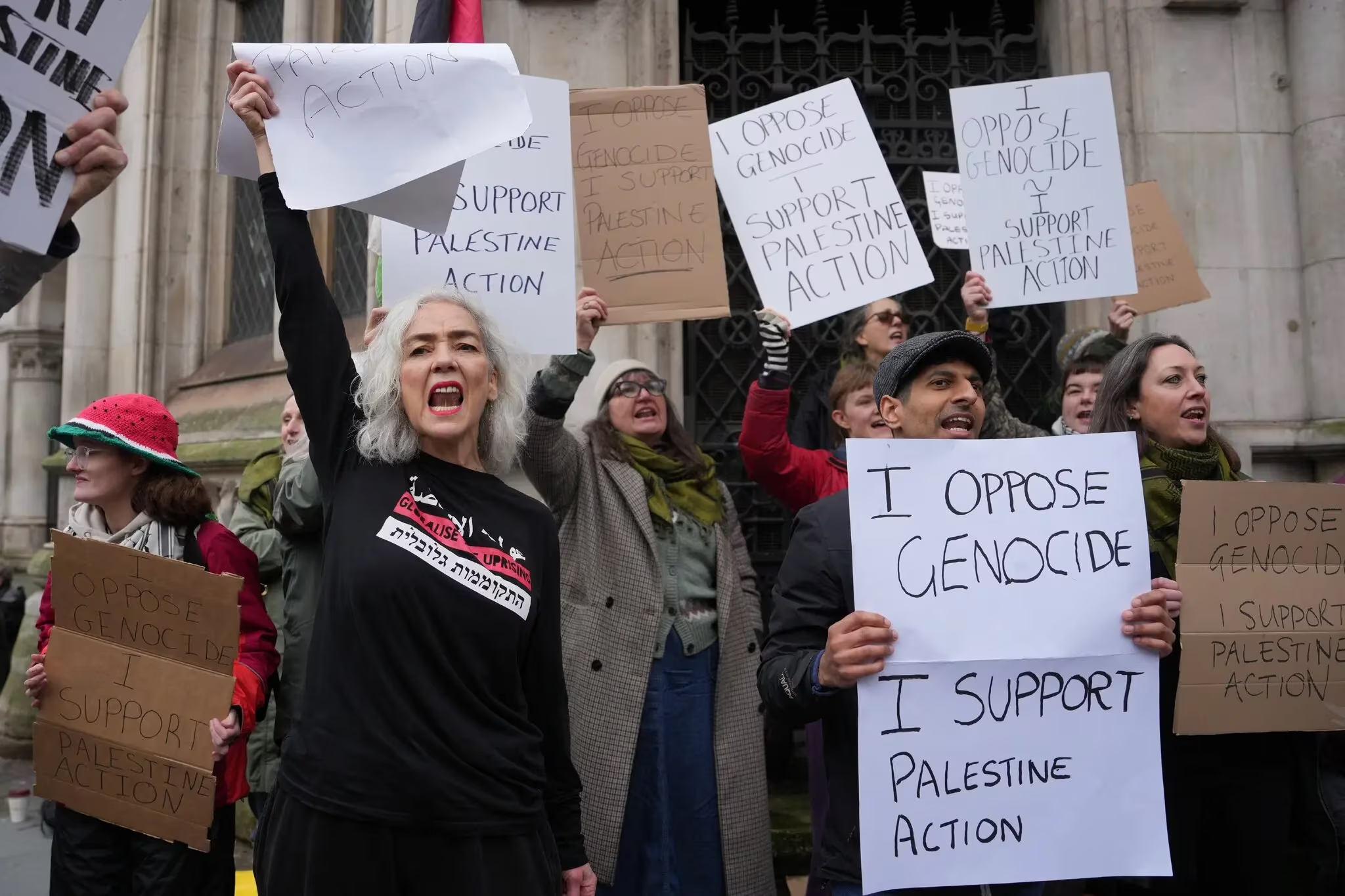
The British government’s decision to ban a pro-Palestinian protest group as a terrorist organization has been ruled unlawful. On Friday, London’s High Court held that the measure was disproportionate and infringed fundamental rights to freedom of expression and assembly.
The ruling dealt a blow to Prime Minister Keir Starmer’s cabinet, which had already faced sharp criticism over the ban’s implications for free speech and the right to protest.
At the same time, the court noted that the ban itself remains in force for now. This is to allow the parties to present legal arguments on its continued application, given the government’s right to appeal. London’s police, however, said they would no longer arrest people for publicly supporting the group, though they would continue “gathering evidence” for the possible use of the law “at a later stage.”
The government, for its part, said it intends to challenge the ruling in the Court of Appeal.
The case concerns Palestine Action, a group that does not call for violence against people. At the same time, its members have carried out actions involving damage to property linked to an Israeli arms manufacturer. In June last year, activists entered the Royal Air Force base at Brize Norton in Oxfordshire—the UK’s largest airbase—and damaged two aircraft.
As a result of the government’s decision, Palestine Action was placed in the same legal category as terrorist organizations such as Al Qaeda, the neo-Nazi Atomwaffen Division, and Hezbollah.
This was the first time British authorities had used the mechanism for banning terrorist organizations not because of the use or threat of violence, but on the grounds of “serious damage to property.” The move drew criticism from a broad range of human-rights groups and international bodies.
Since the ban came into force in July, at least 2,000 people have been arrested for expressing support for the group—including for holding placards or wearing T-shirts bearing the slogan “I oppose genocide, I support Palestine Action.”
Palestine Action co-founder Huda Ammori described the court ruling as “a monumental victory for our basic freedoms in Britain and for the struggle for the freedom of the Palestinian people,” and called for the ban to be lifted immediately.
In a summary of its decision, the High Court noted that Palestine Action advances its political objectives “through criminal activity and the encouragement of criminal activity.” However, the judges stressed that “even setting aside the non-fully peaceful nature of Palestine Action’s actions, the ban itself resulted in a very significant interference with the rights to freedom of expression and freedom of assembly.”
In the court’s view, this runs contrary to the Human Rights Act 1998—the cornerstone of UK law protecting fundamental freedoms.
The court also found the ban to be disproportionate, noting that only a small fraction of the group’s activities fell within the definition of terrorism under British law. “The nature and scale of Palestine Action’s activities that meet the legal definition of terrorism have not yet reached a level of seriousness, breadth, and persistence that would justify inclusion on the list of proscribed organizations,” the court summary said.
The UK home secretary, Shabana Mahmood, commenting on the ruling, said the court itself had acknowledged that Palestine Action “had carried out terrorist acts.” According to her, the group’s actions are incompatible with democratic values and the principle of the rule of law. “For these reasons, I am disappointed by the court’s decision and do not agree with the assertion that banning this terrorist organization is disproportionate,” she said, adding: “I intend to challenge this ruling in the Court of Appeal.”
In a separate statement, London’s police said officers would continue to record instances of support for Palestine Action, but would do so “for possible enforcement at a later stage, rather than for immediate arrests.” According to the police, this approach is “the most proportionate,” given the court’s ruling and the fact that the legal proceedings have not yet concluded.
The decision to ban the group under anti-terrorism legislation was taken by Mahmood’s predecessor as home secretary, Yvette Cooper. It made membership in Palestine Action, fundraising, organizing meetings, and any form of public support—whether in person, online, or through placards and items of clothing—illegal.
At hearings in November, Ammori’s lawyers argued that before the ban was imposed, many members of Palestine Action had already been prosecuted for specific offences committed during protests, including damage to property. In their view, the use of what they described as “draconian” powers and the designation of the group as terrorist were neither necessary nor proportionate.
An assessment prepared in March last year by a security body overseen by the MI5 counterintelligence service found that only three of Palestine Action’s 385 actions met the legal threshold for “the commission of terrorist acts.” All of them involved damage to property. The security services also submitted additional material to the court during closed hearings that were inaccessible to the public and the press.