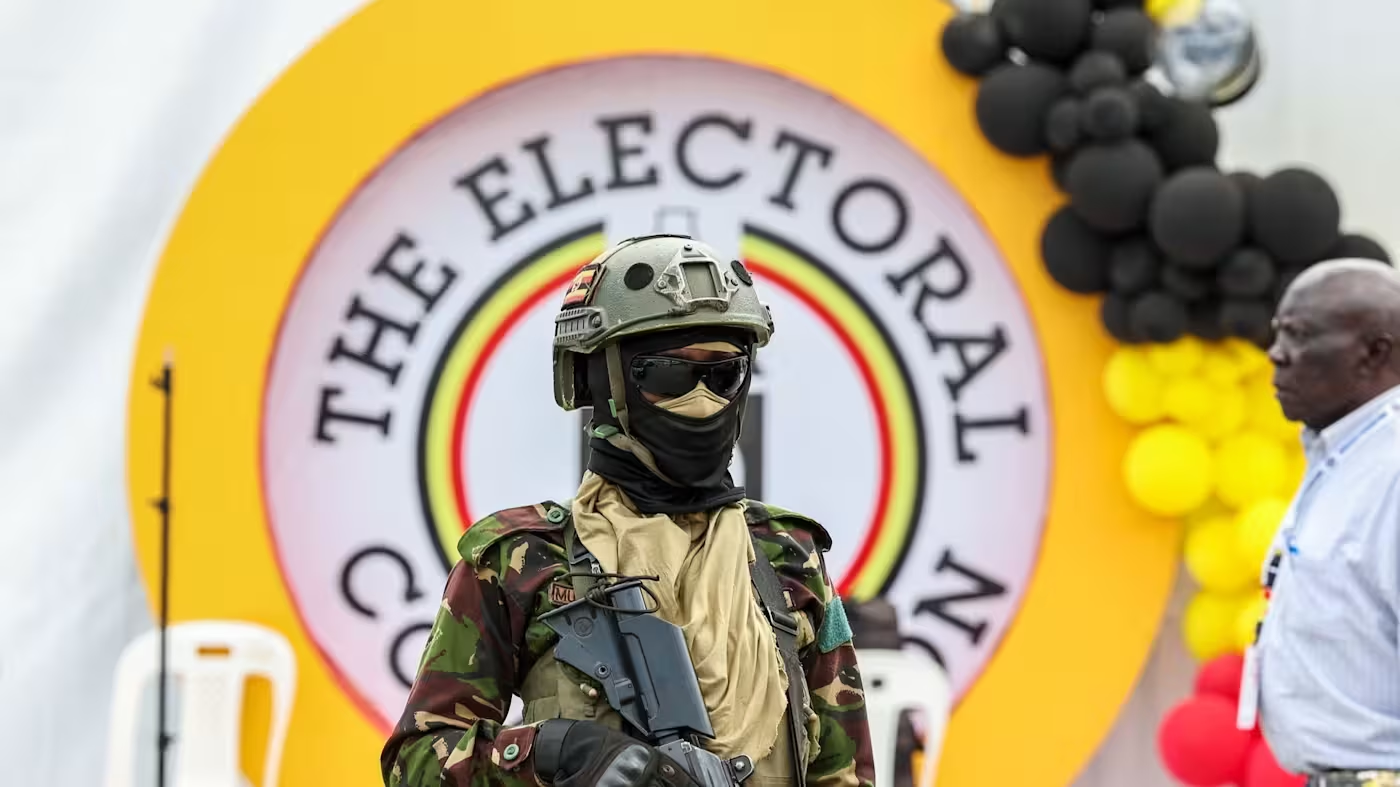
Ugandan security forces stormed the home of Bobi Wine, the leading challenger to the incumbent president, as the vote count from Thursday’s election neared completion, the country’s main opposition party said.
According to the National Unity Platform, late on Friday evening “security operatives” cut electricity to Wine’s residence, beat his private security guards, and broke into the house. The NUP said that Wine—whose real name is Robert Kyagulanyi—was then “forcibly taken” by an army helicopter to an unknown destination.
On Saturday morning, there were conflicting reports about his whereabouts. The politician’s son, Solomon, said he had received information indicating that his father managed to escape during the raid. “My father was able to get away, my mother remains under arrest, and no one is being allowed to enter the house,” he wrote on X.
Police acknowledged that unrest had occurred in parts of the capital, Kampala—where the opposition enjoys strong support among younger voters—and said Wine’s home had been surrounded ostensibly for his own protection. The government did not immediately respond to requests for comment.
Wine himself said on Friday that the elections were marred by widespread “ballot stuffing” and were conducted amid an internet shutdown imposed by the authorities. He said that senior figures from his party, as well as polling station observers, had been detained or abducted in various parts of the country.
The NUP also said that ten party supporters were killed on Friday when security forces carried out a raid at the home of one opposition leader southwest of the capital. Police, for their part, said the deaths occurred after opposition supporters surrounded a police station.
According to official figures, the 80-year-old President Yoweri Museveni, who is seeking a seventh term, is leading Wine by 74 percent to 23 percent. Wine described the results as “fabricated” and said that “the people of Uganda will have the final word on this absurdity.”
Wine emerged as one of the most prominent critics of the Museveni regime after building a successful career in pop music, writing songs about social and political injustice. In recent years, he and many of his allies have repeatedly been placed under house arrest or detained, and in 2018 Wine received treatment in the United States after being tortured.
The alleged irregularities in Thursday’s election fit into a broader pattern of eroding civil liberties across East Africa, amid uncertainty over how Uganda’s ageing president will manage a transition of power.
Museveni came to power in 1986 after a guerrilla war that followed the 1980 elections, which he described as rigged. After seizing power, he wrote that “the problem of Africa in general, and Uganda in particular, lies not with the people but with leaders who seek to cling to power for too long.” He later steered the country out of war and chaos and became a key Western ally in the region. In the current campaign, he has emphasized stability, using the slogan “preserving what has been achieved.”
Wine’s campaign, by contrast, appeals to change and has drawn mass rallies of Uganda’s young and protest-minded population, more than three quarters of whom are under the age of 25.