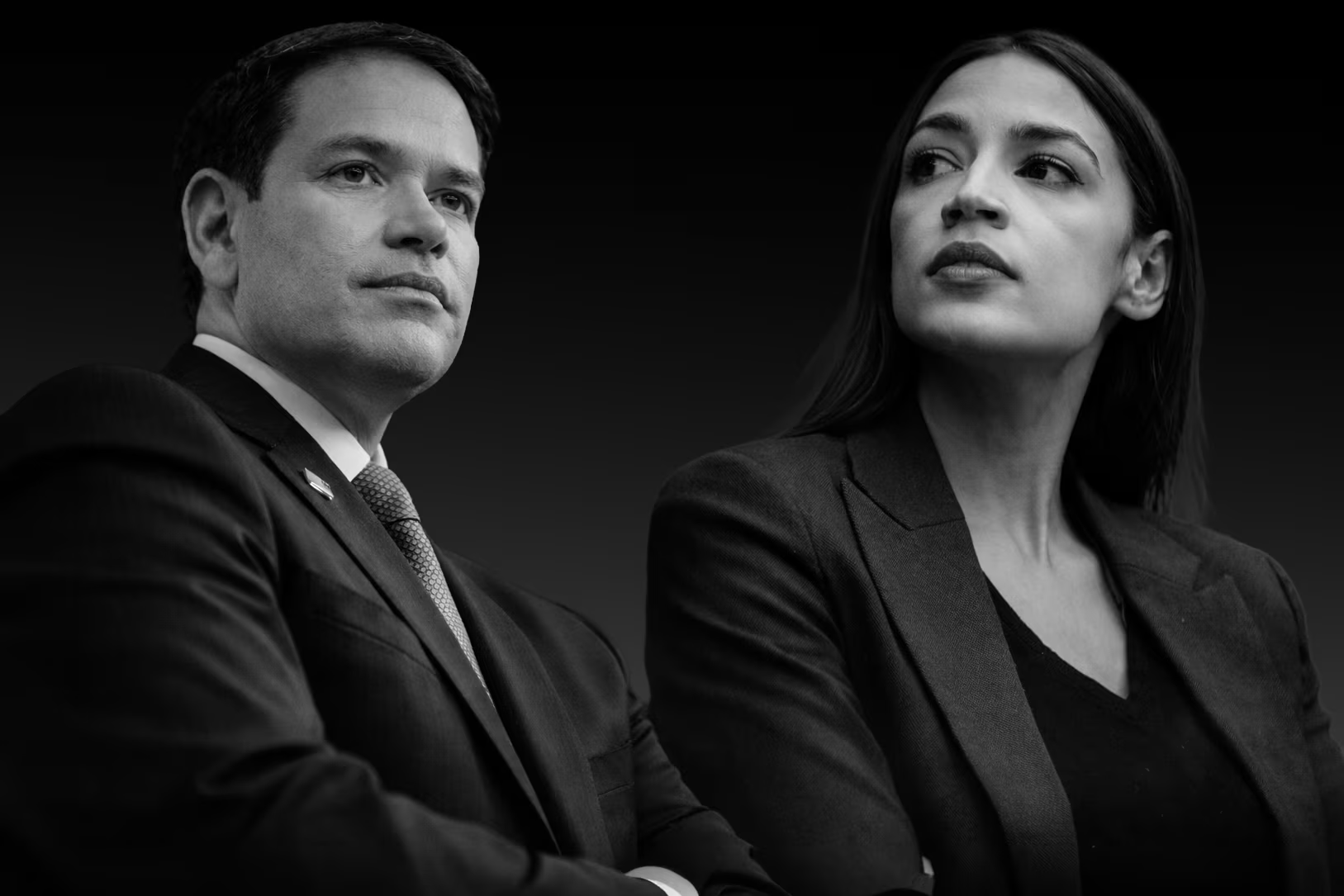
US Secretary of State Marco Rubio and Congresswoman Alexandria Ocasio-Cortez are set to present sharply opposing visions of America’s role in the world at a key European security forum, where leaders will attempt to grapple with the most acute global crises.
At the Munich Security Conference, both politicians—already seen as potential contenders in the 2028 presidential race—intend, in their own ways, to challenge Europe’s political elites. At the same time, both the Democratic and Republican establishments in the United States are still trying to persuade voters of the importance of their respective foreign-policy doctrines.
Rubio, who is leading the US delegation in Germany, is widely viewed as a kind of “good cop” against the backdrop of a deepening confrontation between the Trump administration and Europe—over defense spending, Greenland, internet regulation, and migration policy. Unlike Vice President J.D. Vance, who shocked conference participants a year ago with claims of Europe’s “civilizational decline,” Rubio is expected to focus on more familiar criticism—the continent’s dependence on US military support.
Ocasio-Cortez, for her part, plans to address the influence of billionaires and corporate interests on international policy, which she sees as hostile to the working class. “She brings an understanding that oligarchy and corruption are part of the problem in our foreign policy and have been for a long time,” said Matt Duss, an informal adviser to the congresswoman and executive vice president of the Center for International Policy.
The elite conference, which invited 50 world leaders, is known for promoting the idea of a Western “rules-based international order.” Yet the concept is increasingly coming under criticism—on both the right and the left—as outdated or even illusory. “The consensus around the rules-based order is collapsing beneath their feet, and only now are they beginning to realize it,” Dass said. In his view, Ocasio-Cortez has long argued that the growing influence of wealthy interests over the state fuels right-wing populism and threatens Western democracy. “This is a chance to hear a progressive leader articulate a position that is rarely voiced at the Munich Security Conference,” he added.
Dass’s involvement in preparing Ocasio-Cortez’s first appearance in Munich has heightened expectations that she will also speak forcefully about the Israeli-Palestinian conflict—a subject he has worked on for many years. This was noted by Jeremy Shapiro, director of research at the European Council on Foreign Relations. “It is an unmistakably progressive issue, and in Europe it will find a more receptive audience for a somewhat more pro-Palestinian approach than the one that dominates the American mainstream,” he said.
Since 2024, Ocasio-Cortez has condemned Israel’s actions in Gaza, describing them as “genocide”—a term endorsed by many genocide scholars but avoided by some other potential Democratic Party contenders in the 2028 election, including California Governor Gavin Newsom and Pennsylvania Governor Josh Shapiro.
Rubio, as the most senior U.S. official attending the conference, will defend the Trump administration’s policies, which have unsettled both Washington’s allies and its adversaries. These include a package of punitive tariffs, risky negotiations aimed at ending the war in Ukraine, as well as periodic provocative remarks about “acquiring Greenland” and turning Canada into the “51st state” of the United States.
Rubio’s keynote address is scheduled for Saturday. Ocasio-Cortez, according to her office, will speak at a public session on Friday and later the same evening take part in another panel discussion.
Ahead of the conference, organizers in Munich published a report declaring a fundamental break with the U.S. postwar strategy. That strategy rested on multilateral institutions, economic integration, and support for human rights and democracy. According to the authors, the Trump administration is systematically undermining each of these pillars.
“The most powerful of those wielding the axe against existing rules and institutions is U.S. President Donald Trump,” the report says. “Yet it remains unclear whether demolition will truly clear the ground for policies that ultimately serve the public.”
The document also warns that principled cooperation may give way to transactional deals, private interests may increasingly outweigh public ones, and regions may come under the dominance of great powers rather than being governed by international rules and norms. The U.S. State Department did not immediately respond to a request for comment on the report.
The Trump administration, for its part, has made clear that the sense of disappointment across the Atlantic is mutual. In its latest National Security Strategy, Washington urged Europe to “stand on its own feet” and assume “primary responsibility for its own defense.” The document also condemns Europe’s migration policies “that are transforming the continent,” its “cratering birth rates,” as well as “censorship of free speech and suppression of political opposition.”
European officials, however, have made equally clear that they have little interest in such lectures from the United States—a country that revokes visas from students critical of Israel and is itself experiencing record-low birth rates. “Attempts by the Trump administration to accuse Europeans of suppressing free speech in Europe rightly provoke bewilderment,” said Jeff Rathke, president of the American-German Institute and a former State Department official. “Approaches to responding to individual incidents may differ, but claims of some broad suppression of free expression in countries like Germany are simply not borne out by the facts.”