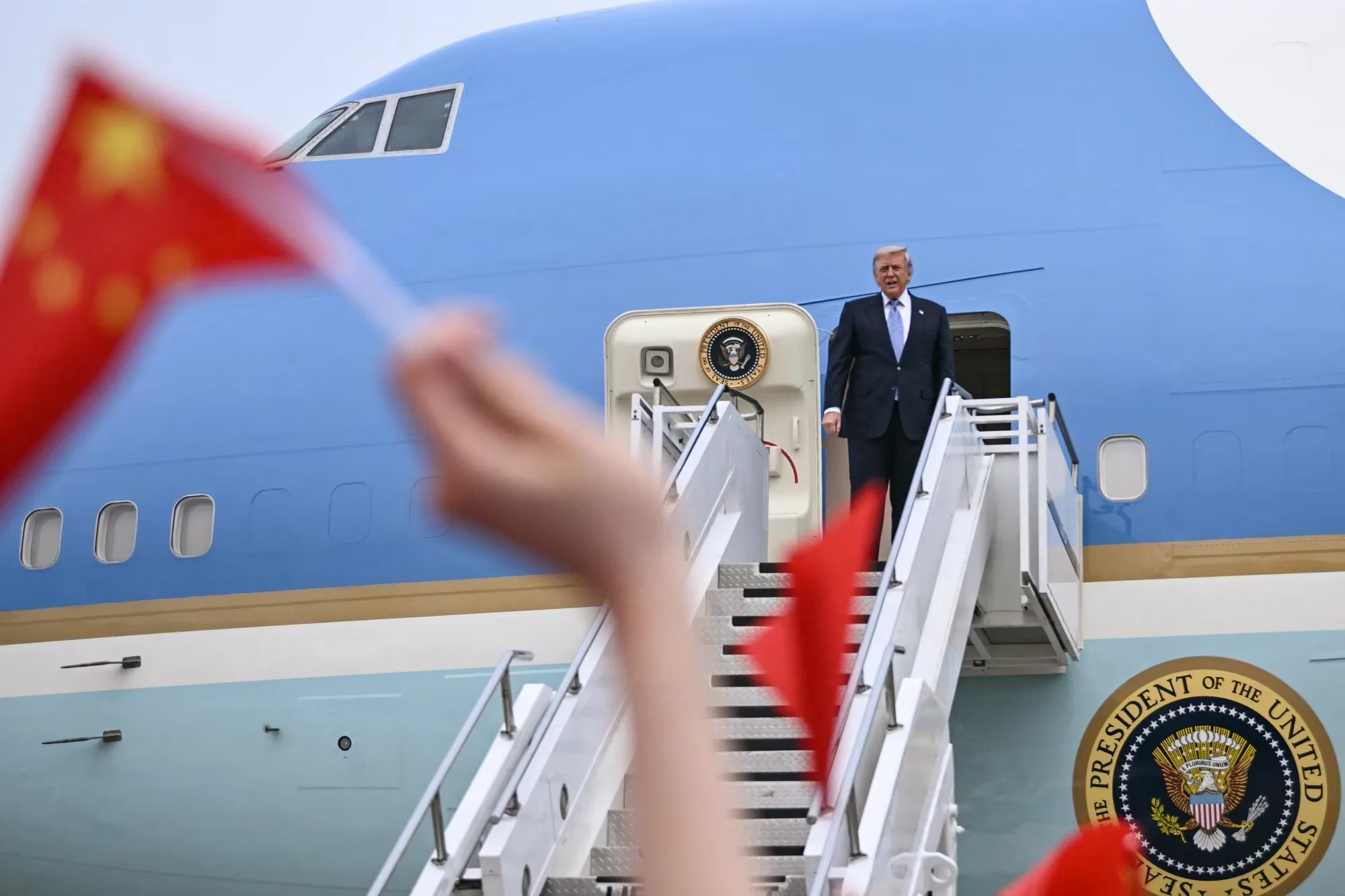
On Friday, May 15, Donald Trump concluded his two-day visit to Beijing—the first trip by a sitting U.S. president to China in nearly nine years. Across two rounds of talks, the leaders discussed trade, access for American companies to the Chinese market, efforts to curb fentanyl shipments, as well as Iran, Ukraine, and the Korean Peninsula. Xi Jinping received an invitation to visit the White House on September 24. Trump, who on the first day declined to comment publicly on the summit’s most sensitive issue—Taiwan—made more detailed remarks only after departing Beijing.
Donald Trump said he made no commitments to Xi Jinping on Taiwan and would soon decide whether to proceed with a planned $14 billion U.S. arms package for the island.
Speaking to reporters aboard Air Force One, the U.S. president said the Taiwan issue had been discussed extensively during the Beijing talks.
“On Taiwan, he feels very strongly. I made no commitments either way,” Trump said.
According to Trump, he will make a final decision on the Taiwan arms sale “within a fairly short period of time” after consulting with the person “who runs Taiwan.” He did not clarify whom he meant.
Trump also said Xi Jinping directly asked whether the United States would defend Taiwan in the event of a conflict.
“There’s only one person that knows that—and it’s me,” Trump said. “I told him I don’t discuss those things.”
The very fact that Taiwan was discussed in such detail between the U.S. and Chinese leaders drew attention from observers, as Washington has for decades maintained a policy of so-called “strategic ambiguity”—preserving the option of intervening if China attacks Taiwan without ever explicitly confirming whether it would do so in practice.
Any consultations with Beijing regarding arms sales to Taiwan are considered an especially sensitive issue in American diplomacy.
Since 1982, U.S.-Taiwan relations have largely been shaped by the Reagan administration’s so-called “Six Assurances.” They state that Washington will not consult with China on arms sales to Taiwan and will not abandon the Taiwan Relations Act, which obligates the United States to provide the island with defensive weapons.
Asked by reporters whether his remarks undermined that longstanding policy, Trump said 1982 was “a very long time ago,” but again stressed that he had made no promises to Xi. At the same time, he signaled that the fate of the arms package remains uncertain.
“I think the last thing we need right now is a war 9,500 miles away,” the U.S. president said.
Taiwan has not yet commented on Trump’s remarks.
The U.S. president’s comments came after Xi Jinping warned during the talks that mishandling the Taiwan issue could lead the United States and China toward “confrontation and even conflict.”
The White House’s official statement following the meeting did not mention Taiwan. Administration officials later said the U.S. position on the island had not changed.
Secretary of State Marco Rubio told NBC that Washington continues to follow its longstanding approach of supporting Taiwan without formally recognizing its sovereignty.
China, meanwhile, continues to strongly oppose the new U.S. arms package for Taiwan and is demanding that Washington formally declare its opposition to Taiwanese independence.
If the Trump administration blocks the deal, it would almost certainly trigger a fierce reaction from both parties in Congress.
If the weapons transfers are approved, however, Washington is likely to face a new escalation in relations with Beijing.
Taiwan, which has its own democratically elected government, remains one of the main flashpoints in U.S.-China relations. Beijing considers the island part of its territory and has not ruled out the use of force in the future.