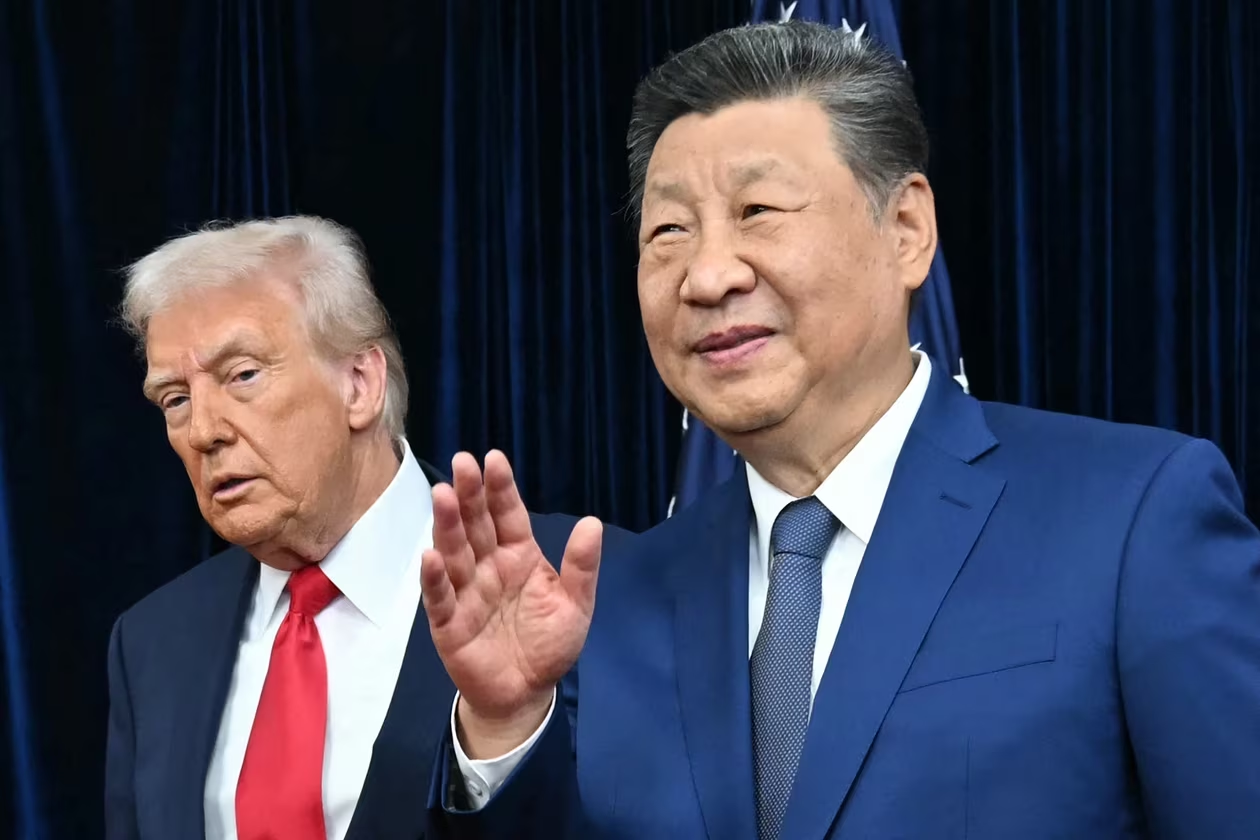
In October, Donald Trump publicly presented his meeting with Chinese President Xi Jinping as a breakthrough and the beginning of a thaw in the protracted trade confrontation between the world’s two largest economies. The White House spoke of mutual concessions, China resumed selected purchases, and Washington suspended its most punitive tariff measures. Yet more than two months after the talks, none of the core elements of these understandings has been put into writing or formally confirmed by both sides. This has turned the announced trade truce into a set of blurred expectations, leaving businesses, markets, and US allies in a state of uncertainty and casting doubt on the prospects for a comprehensive trade deal in 2026.
Donald Trump described his October meeting with Chinese President Xi Jinping in South Korea as “tremendous.” However, more than two months after the talks, no formal agreement has emerged, leaving mutual commitments ill-defined and dampening expectations of a far-reaching trade deal in 2026.
Trump rated the October 30 negotiations as “12 out of 10,” and the White House announced a series of understandings intended to ease tensions in the trade war. Among the key points were China’s resumption of purchases of US agricultural products, including soybeans, and Beijing’s removal of restrictions on exports of critical minerals. In return, the United States agreed to extend its pause on imposing triple-digit tariffs on Chinese goods. The statement from China’s Ministry of Commerce, however, did not confirm these commitments, limiting itself to a reference to the US tariff pause.
In late October, US Trade Representative Jamieson Greer told reporters that negotiators were “moving toward the final details” of an agreement. Several weeks later, Treasury Secretary Scott Bessent said the administration expected to finalize arrangements on rare earths by Thanksgiving. That deadline passed without the release of any text or an official announcement.
The absence of written terms formally confirmed by both sides gives Washington and Beijing room to maneuver in implementing the trade truce. Critics, however, argue that this leaves the understandings open to competing interpretations and makes renewed disputes all but inevitable. Without a broader US-China agreement, the irritants that already undermined trade ties in 2025—retaliatory tariff hikes, export controls on key goods, and targeted import bans—could once again become triggers of economic instability next year.
“There’s nothing complicated here,” says Cameron Johnson, a senior partner at the Shanghai-based supply-chain consultancy Tidalwave Solutions. “The Chinese can drag it out, or they can choose not to, but this is Diplomacy 101—what did you agree to, and what is the timeline for delivery?”
According to experts, the situation also casts doubt on the prospects for the sweeping overhaul of trade relations between the world’s two largest economies that Trump promised at the outset of his term. The president has already announced a visit to Beijing in April as the next stage of the talks.
“If the sides cannot even agree on what is contained in the US fact sheet and on the broad contours of the commitments, that raises questions about whether they share any common understanding at all of what implementation is supposed to look like,” notes Greta Peisch, a partner at Washington-based law firm Wiley Rein and a former general counsel of the Office of the US Trade Representative under President Joe Biden.
Despite this, the White House remains optimistic about the outlook for trade ties with China. “President Trump’s close relationship with Chairman Xi helps both countries continue to build on the progress achieved and address the remaining issues,” the administration said in a statement, adding that it “continues to monitor how China is complying with our trade agreement.”
The Office of the US Trade Representative referred to previously released statements outlining the administration’s expectations of Beijing. The Treasury Department did not respond to a request for comment.
Allies of the president insist that the lack of a written framework for the October understandings is not a failure but a deliberate element of Trump’s strategy. In their view, it gives both sides greater flexibility in managing tensions and helps avoid disputes over minor differences in implementation.
“China doesn’t want a real, definitive agreement, and from Trump’s perspective, in some ways that suits him as well—so long as they live up to their spoken commitments,” says Wilbur Ross, who served as commerce secretary during Trump’s first term.
Signs of confusion, however, are already evident. A White House fact sheet released on November 1 said China had agreed to purchase 12 million tons of US soybeans by the end of 2025. A statement from China’s Ministry of Commerce referred only to “expanding agricultural trade”—without citing any specific volume of soybean purchases.
Beijing has indeed resumed purchases of US soybeans, buying at least 4 million metric tons since late October. Those volumes, however, fall well short of the pace required to reach the 12-million-ton target in 2025. Greer told senators last month that the discrepancy reflected differences in timing: the initial purchases, he said, were intended to be spread over the current crop year, which typically runs into mid-to-late 2026, rather than confined to a single calendar year.
Liu Pengyu, a spokesperson for the Chinese embassy, declined to comment on whether Beijing would meet the soybean purchase commitment.
Meanwhile, US soybean farmers fear that China’s promises could prove vulnerable if trade tensions flare up again.
The opacity of the understandings is also weighing on industries that depend on supplies of Chinese rare-earth magnets. Rare-earth elements are essential to the production of a wide range of goods—from washing machines and iPhones to medical equipment. When China announced sweeping new export restrictions in October, it sent shockwaves through global manufacturing supply chains. The White House says Beijing agreed to ensure uninterrupted supplies of rare-earth metals and magnets, but companies report that shipments remain subject to licensing and continue to be unpredictable.
“Supply chains are slowing, and some investments that could otherwise go ahead are not being made, because businesses don’t understand what the rare-earth roadmap is supposed to look like,” Johnson says.
At the same time, US trade concessions to Beijing continue to mount. On December 8, Trump announced that Nvidia would be allowed to sell its powerful H200 artificial-intelligence chips in China—despite concerns that the move could give Beijing a technological edge at Washington’s expense. There has so far been little sign of reciprocal steps from China.
This has prompted warnings from national-security hawks, who argue that Beijing may feel confident enough to press in future trade talks for the removal of similar curbs on advanced technologies.
“President Trump has taken more direct control of China policy than he did in his first term, so we are seeing his personal inclinations come through far more clearly,” says Christopher Adams, a former senior China coordinator at the US Treasury Department and now a senior adviser at Covington and Burling. “He prioritizes transactional deals over the advancement of national-security concerns.”
That approach, according to Peter Harrell, a former senior director for international economics at the Biden administration’s National Security Council, could also sap Beijing’s incentive to pursue more ambitious trade goals with the United States next year and to lock agreements into writing.
“The Chinese understand that as long as they meet the bare minimum expectations on soybeans and rare-earth exports, they will not face strong, immediate pressure to codify everything in final texts,” he said.
This diverges sharply from how the administration framed its “Liberation Day” tariff campaign launched in April. At the time, Bessent argued that the pressure of Trump’s high “reciprocal” tariffs would force China to abandon its export-driven economic model. In the same month, Trump predicted that Beijing would rush to the negotiating table to avoid losing access to the US market. Instead, tariffs escalated—briefly reaching triple-digit levels—and both sides deployed export controls as leverage against key economic vulnerabilities, until Trump and Xi agreed in October to halt the confrontation.
“In the end, we ended up with a fairly limited bilateral deal, with no meaningful market access or structural reforms aimed at addressing unfair competition or Chinese industrial overcapacity,” concludes Barbara Weisel, a former US trade negotiator from 1994 to 2017 and now a senior fellow at the Carnegie Endowment for International Peace.