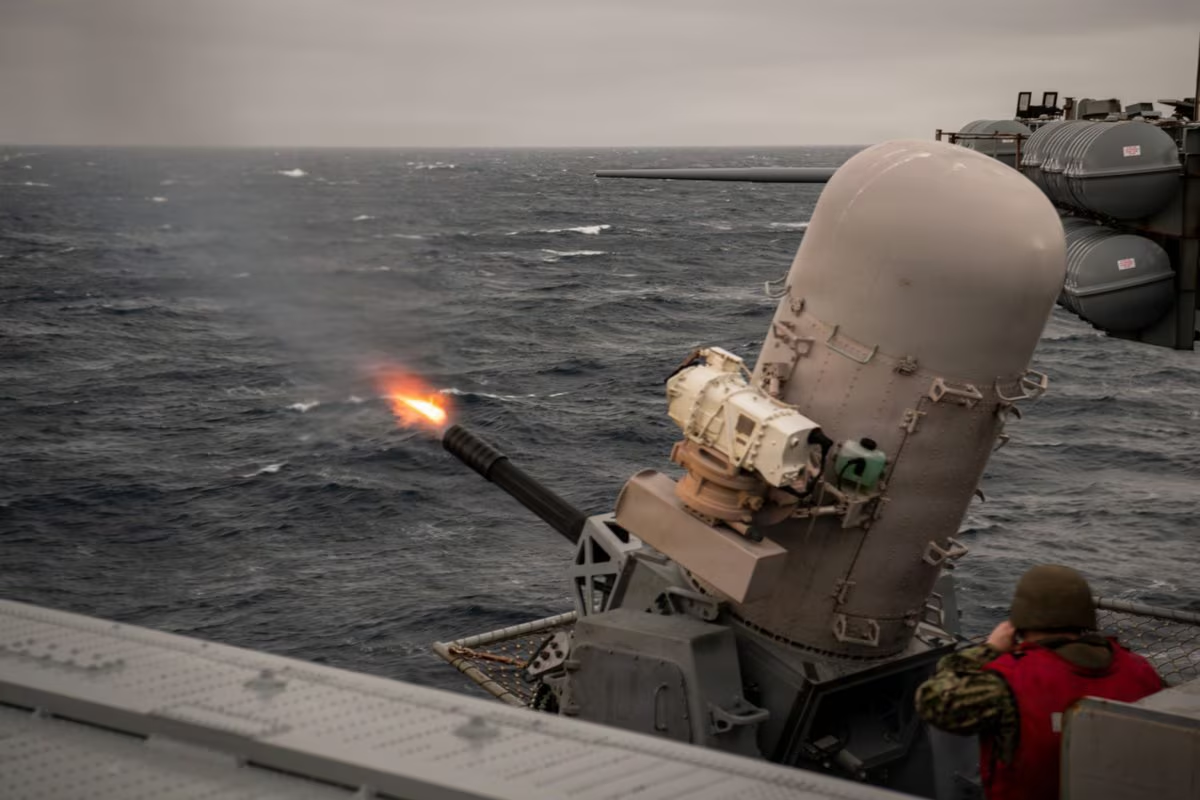
On Saturday, March 14, President Donald Trump said that the United States and a number of other countries would deploy warships to the Persian Gulf to restore commercial shipping through the Strait of Hormuz.
Attacks in the area of the strait have virtually paralyzed commercial shipping in and out of the Persian Gulf, sharply disrupting the region’s oil exports and adding to volatility in global energy markets. According to American, Israeli, and other Western officials, developments around the Strait of Hormuz have in recent days become one of the main concerns for the Trump administration.
“Many countries—especially those that have suffered from Iran’s attempt to close the Strait of Hormuz—will send warships, together with the United States of America, to ensure that the strait remains open and safe,” Trump wrote on the social network Truth Social.
While asserting that the United States had “destroyed 100% of Iran’s military potential,” Trump also acknowledged that Iranian forces continue to attack vessels in the strait—launching drones, laying naval mines, and deploying anti-ship missiles.
“I hope China, France, Japan, South Korea, the United Kingdom, and other countries suffering from this artificial restriction will send their ships to the region so that the Strait of Hormuz no longer poses a threat from a state that has been completely decapitated,” he added.
Meanwhile, Defense Secretary Pete Hegseth is deploying the amphibious assault ship USS Tripoli, along with its Marine expeditionary unit, to the Middle East amid the crisis around the Strait of Hormuz.
The Marine expeditionary unit could, if necessary, be used for ground operations should such an order be issued. A U.S. official declined to comment on the possibility of such a scenario.
On Friday, U.S. forces carried out a large-scale strike on Iran’s Kharg Island—the country’s key oil export hub.
U.S. Central Command said the “large-scale, high-precision” strike on Kharg Island destroyed naval mine depots, missile storage bunkers, and a number of other military facilities. In total, 90 military targets on the island were hit.
According to sources, the strike was intended as a warning from Trump—a signal to Iran’s leadership to stop attempts to close the Strait of Hormuz, which have already seriously destabilized the global oil market.
In his post on Truth Social, Trump emphasized separately that the oil infrastructure on the island was not targeted in this strike, but warned—it could be next if Iran does not stop attacks on vessels in the strait.
Sources said on Friday that before the U.S. military begins escorting commercial vessels, it is considering operations to destroy land-based anti-ship missiles deployed by Iran in the area of the strait.
Trump effectively confirmed this in his post on Saturday.
“Meanwhile, the United States will bomb the coastline to hell and constantly sink Iranian boats and ships. One way or another, we will soon make the Strait of Hormuz OPEN, SAFE AND FREE!” he wrote.