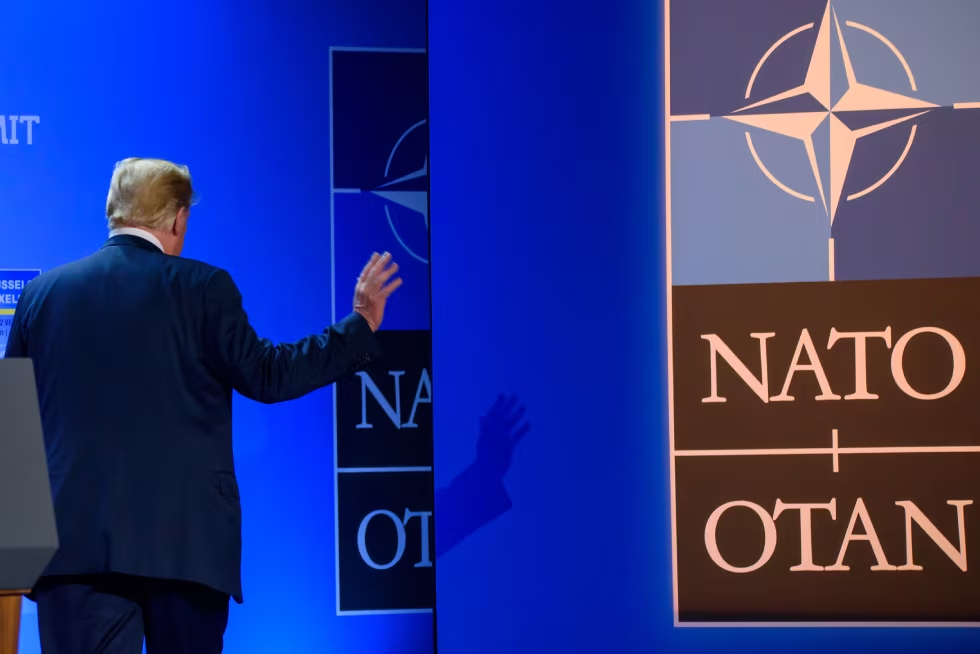
For decades, the idea of the United States leaving NATO belonged to the arsenal of political fringe figures and academic thought experiments. In April 2026, that question is being discussed in the White House—literally. Trump received the alliance’s secretary general, Mark Rutte, and, according to sources, raised the possibility of withdrawal directly. That same evening, he wrote on Truth Social: “NATO WAS NOT THERE WHEN WE NEEDED THEM, AND THEY WILL NOT BE THERE AGAIN.” The trigger was the war with Iran—and the refusal of European allies to take part in it.
Why Now
On February 28, 2026, the United States and Israel launched a military operation against Iran. Tehran blocked the Strait of Hormuz—a key corridor for global oil supplies. Trump demanded that NATO allies assemble a naval grouping to reopen it. European countries responded with caution and resistance, refusing to send warships into the strait. The situation was further aggravated by France and Spain restricting or closing access to their bases and airspace for American operations linked to the war with Iran.
For Trump, this amounted to a personal insult. In an interview with The Telegraph, he said he was considering withdrawal “beyond a review”: “I was never under NATO’s influence. I always knew they were a paper tiger—and Putin knows that too.” In an interview with Reuters, he confirmed that he was considering leaving “absolutely.”
At the same time, the grievances are not new. One European diplomat described the situation this way: “It is like Groundhog Day. The reasons may differ—defense spending, Greenland, the Strait of Hormuz—but the threats keep coming back again and again.” The difference now is that the rhetoric is backed by a specific military conflict in which the United States is actually fighting—and in which it has genuinely failed to secure support.
The Legal Question. Can Trump Withdraw Unilaterally
This is where one of the administration’s sharpest constitutional paradoxes emerges.
In 2023, Congress passed a law requiring either the approval of two-thirds of the Senate or an act of Congress for the United States to leave NATO. The law also blocks funding for any withdrawal attempt made without such approval. One of its co-authors was then-Senator Marco Rubio—now U.S. secretary of state. Announcing the bill, Rubio wrote: “NATO serves as a critical military alliance that protects our shared national security interests and bolsters America’s international presence.” Now the same Rubio is publicly attacking allies for refusing to support the war with Iran.
Trump, however, has said he does not consider congressional backing necessary if he decides to withdraw. His legal argument rests on presidential powers in the realm of foreign policy. Experts point to a precedent. In 1978, President Jimmy Carter unilaterally withdrew from the mutual defense treaty with Taiwan without seeking Senate consent—and that move survived in the courts. NATO, however, is an entirely different order of commitment, and the law now in force creates a direct legal obstacle.
According to a report by the Congressional Research Service, the question of whether a president can withdraw from NATO without Congress “touches on a longstanding and still unresolved dispute over the constitutional allocation of authority to terminate treaties.” If Trump tries to act around the law, the matter will inevitably end up in court. Given that the Supreme Court has often sided with the administration in recent years, Congress may find it difficult to prevail—but lawsuits could also come from other parties, such as contractors working with NATO and suffering financial losses.
Historical Cases
No country has ever fully left NATO in the alliance’s history. But there are precedents for partial or redefined forms of membership.
France, 1966
A Partial Exit Without a Legal Break
President de Gaulle withdrew France from NATO’s integrated military command structure, insisting on strategic autonomy and refusing to place French nuclear forces under collective command. In 1967, all NATO bases on French territory—around 30 facilities, mostly American—were dismantled. France nevertheless formally remained a member of the alliance and returned to the military structure only in 2009 under Sarkozy. That path is now being actively discussed as a possible model for the United States.
The United States—Taiwan, 1978
A Constitutional Precedent for Unilateral Withdrawal
Not NATO, but an important precedent. President Carter unilaterally terminated the Mutual Defense Treaty with Taiwan without seeking Senate consent. Senators challenged the move in court, but the Supreme Court declined to rule on the merits, effectively allowing the president’s action to stand. Trump and his legal advisers cite this case as grounds for the executive branch’s authority to leave treaties on its own.
Iceland, 2019
Skepticism Inside the Alliance Long Before Trump
Icelandic Prime Minister Katrin Jakobsdottir spoke in favor of leaving NATO. No parliamentary majority existed for such a step. The case was marginal in scale, but still revealing. Skepticism existed within the alliance long before the possibility of a U.S. withdrawal became a subject of public discussion.
Trump—First Term, 2017–2021
Threats Without Action—and Their Consequences
Trump threatened to leave NATO, the Europeans paid more, and the alliance held together. In 2024–2025, all 32 NATO members met the benchmark of spending 2% of GDP on defense—for the first time in history. At the Hague summit in June 2025, participants pledged to raise spending to 5% of GDP by 2035. Trump called it a “big victory.” The difference in the second term lies in the nature of the trigger. Back then, the issue was the abstract complaint that allies were “not paying enough.” Now allies have publicly refused the United States in a specific military operation.
The Military Balance. What NATO Loses if the United States Leaves
Infographic · 2025–2026 Data
What Happens to the Balance of Power if the United States Leaves NATO
Military spending, nuclear arsenals, and troop strength of the three key players—NATO, Russia, and China
Military Spending · 2025, $bn
If the United States Leaves NATO
The alliance’s combined military budget shrinks from $1.4 trillion to $518 bn—a 63% drop. Russia and China together spend $385 bn: about one-third more than NATO without the United States.
Nuclear Arsenal · Total Warheads
If the United States Leaves NATO
NATO’s nuclear umbrella contracts from 5,550+ to 515 warheads—the arsenals of the United Kingdom and France. Russia retains a 12:1 nuclear advantage over the European part of the alliance.
Active-Duty Personnel · Million Troops
If the United States Leaves NATO
NATO without the United States and China reach rough parity in troop numbers—at around 2 million each. Russia and China together outnumber the European alliance by 1.6 to 1. More critical still is the loss of American military logistics, command structures, and intelligence: Europe lacks the infrastructure to close that gap quickly.
Sources. NATO (2025), SIPRI Military Expenditure Database, Bulletin of the Atomic Scientists, Global Firepower 2025. The data for Russia and China are estimates. Russia’s spending has been adjusted to reflect the military component, based on SIPRI’s assessment.
Four Scenarios
Scenario 1 — Full Legal Withdrawal
Trump sends formal notice of denunciation of the North Atlantic Treaty, invoking his powers as commander in chief. Congress challenges the move in court. The case reaches the Supreme Court, where the outcome is unpredictable. At the same time, the withdrawal of American troops from Europe begins—around 100,000 personnel, the largest redeployment since the Cold War.
Probability—low in the short term. The key contradiction. The United States is using European bases and airspace to wage the war with Iran right now. Trump cannot simultaneously fight Iran through Europe and cast Europe out of America’s allies.
Scenario 2 — A French-Style “Half-Exit”
The United States remains a formal member of the alliance but leaves the integrated command structure. American troops gradually depart Germany—where around 37,000 service members are currently stationed—participation in joint exercises is reduced, and the United States stops funding NATO’s common structures. Article 5 is, in practice, reduced to an empty declaration.
Probability—the most realistic option over the next 12–18 months. This is precisely the path experts describe as an “interesting model,” drawing on the French precedent. It allows Trump to project resolve without immediately creating a constitutional crisis.
Scenario 3 — Pay-to-Play: Internal Degradation
According to The Telegraph, Trump is considering a concept under which countries that fail to meet the defense-spending target of 5% of GDP would lose their voting rights in alliance decision-making. The United States remains in NATO legally, but turns it into an instrument of pressure—those who pay command; the rest stay silent.
This is not withdrawal—it is the refounding of the alliance on American terms. And it is the most dangerous scenario for European unity. It splits NATO from within, pitting Poland and the Baltic states, which meet the benchmark, against Germany and France, which are still moving toward it.
Scenario 4 — Rhetorical Pressure Without Action
The threats continue, allies grow nervous, concessions on military spending increase—but no formal rupture takes place. That is what the first term looked like. Trump threatened, the Europeans paid more, and the alliance held together.
The difference from the first term lies in the nature of the trigger. Then the issue was the abstract complaint that allies were “not paying enough.” Now the allies have publicly refused the United States in a specific military operation. That is a different level of grievance—and a different starting point for the next round of pressure.
Who Benefits From a Rupture
Senator Tillis flatly called Trump’s threats the embodiment of “the greatest dream” of Putin and Xi Jinping. In the view of David Cutler of the Center for European Policy, the permanent American presence in Europe gives the United States direct access to the potential front lines of future conflicts—and the destruction of the alliance offers little benefit to America itself. On the other hand, there is the “America First” argument. The United States accounts for about 60% of NATO’s total defense spending—more than $880 billion out of $1.4 trillion. Trump has long regarded this as a subsidy for other countries’ security.
Final Assessment
A full legal U.S. withdrawal from NATO in the near term is unlikely—there are too many legal, military, and logistical obstacles. But the threats themselves are already having a destructive effect. Poland’s foreign ministry has already advised the government to treat a U.S. withdrawal from NATO “as a possible scenario”—and that, perhaps, captures the alliance’s new reality more accurately than anything else.
The most likely path is gradual degradation. A reduction of troops in Europe, a refusal to fund common structures, the transformation of Article 5 into a conditional guarantee. This is not a divorce, but a slow estrangement—and possibly something more destructive than a formal break, because it leaves allies with neither clarity nor the ability to build an alternative.
The real question is not whether the United States will leave NATO tomorrow. It is whether the allies will continue to trust the United States in the role of leader. And that question has already been answered—and not in Washington’s favor.