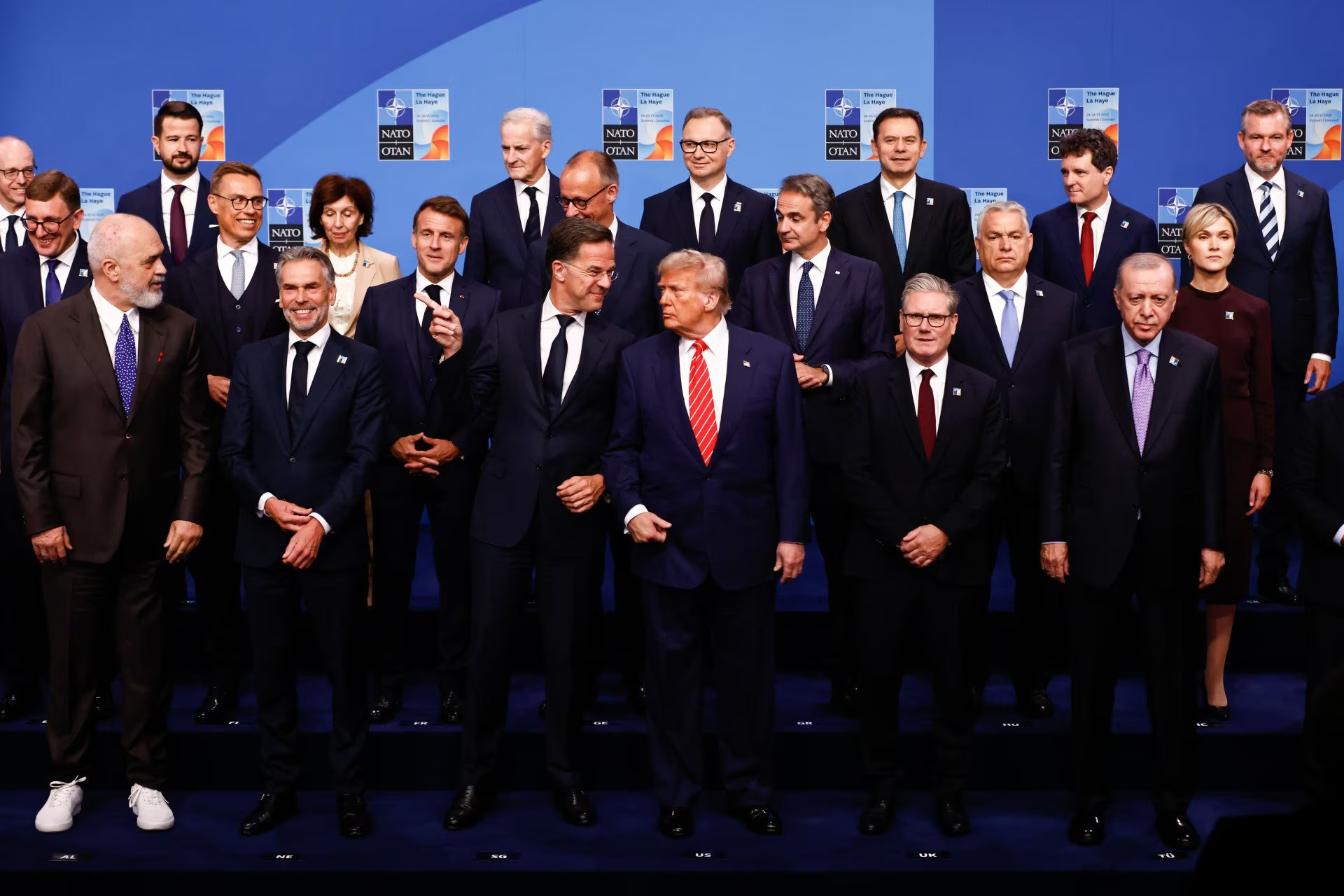
Until now, relations between the United States and Europe within NATO have been measured in percentages of GDP and defense bills. But the dispute over Greenland shifts the conversation onto a different plane: no longer about who pays how much, but about what is considered acceptable between allies when borders and sovereignty are at stake.
Two logics collide around the island. The first is the familiar European one, where decisions rest on procedures, treaties, and mutual commitments. The second is Trump’s, where pressure is treated as a functional tool and concessions are expected to be tangible and irreversible. That is why the debate over Greenland is read in Europe as a stress test for the alliance itself—and as a signal of how far Washington is prepared to go if diplomacy fails to deliver the desired outcome.
Last summer, when NATO countries agreed to increase defense spending, they lavished praise on Donald Trump, crediting him with a decisive role in the shift. European capitals hoped that flattery would help keep the U.S. president within the bounds of the alliance and preserve his commitment to transatlantic security. Trump, however, drew a different conclusion from the episode—pressure, threats, and displays of force proved an effective way to compel even long-standing allies to act. That is why, on Greenland, he is once again turning to the same tactic, starting from an emphatically hard line and operating on the belief that only this approach can push Denmark toward selling the island to the United States.
“He succeeded in getting all these countries to pay their fair share for NATO’s security, and he did it through fear and sheer force of will,” a senior White House official said on condition of anonymity, commenting on the president’s strategy. “In that, he was right—and he will be right again now.”
Europe, Washington officials acknowledge, has already made repeated concessions to Trump. Beyond higher defense spending, the European “coalition of the willing” has effectively assumed full responsibility for supporting Ukraine, sending billions of dollars in military aid. In addition, the European Union agreed to absorb a 15-percent U.S. tariff on most European goods in order to avert further escalation.
But Trump’s drive to acquire Greenland is viewed by many European officials and diplomats as a threat of a different order—one that touches the very principle of European sovereignty and therefore demands a firmer response. At most, they say, what they are prepared to offer in the name of placating Washington is an additional deployment of troops.
“Once you start redrawing borders on a whim or by force, it becomes impossible to know where it will end,” one diplomat noted, also speaking on condition of anonymity given the sensitivity of the issue.
Trump’s rhetoric about the possibility of taking Greenland from Denmark—echoed and amplified by several of his closest allies—sharpened dramatically within hours of a successful military operation that removed Venezuela’s long-time dictator Nicolas Maduro from power.
“This is a very effective signal,” a White House official said. “Everyone now understands that America is serious—especially now.”
Trump himself, answering reporters’ questions at the White House on Friday, said that control over Greenland was merely a matter of timing and method. “We’re going to do something with Greenland, whether they like it or not, because if we don’t, Russia or China will move in there, and we don’t want Russia or China as a neighbor,” he said. “I would prefer to reach a friendly agreement, but if we can’t do it the friendly way, we’ll do it the unfriendly way.”
The president also questioned Denmark’s claim to the island. “I actually like Denmark,” he remarked. “But the fact that they landed a boat there 500 years ago doesn’t mean that the land belongs to them.”
In practice, Denmark has controlled Greenland for roughly 300 years, and in 1916 the United States formally recognized its interests on the island in exchange for the Danish West Indies, which later became the U.S. Virgin Islands.
The president and his closest allies repeatedly stress that Donald Trump’s threats should not be dismissed as rhetoric for public consumption—especially if diplomatic channels reach a dead end. This point is pressed insistently and publicly within the administration, underscoring that the president’s words are meant to be taken literally.
“My advice to European leaders and everyone else is to take the president seriously,” Vice President J.D. Vance said on Thursday, urging Europe to take a more active role in securing Greenland amid a growing Chinese and Russian presence in Arctic waters. “If they don’t, the United States will have to do something. What exactly—that is for the president to decide.”
When Trump first floated the idea of laying claim to Greenland early in his term, Danish authorities chose to play it down, hoping the issue would fade away. Now, with renewed interest from the White House, Copenhagen is doing the opposite, urging European partners to address the matter openly. Denmark and six European leaders issued a joint statement emphasizing that decisions concerning Denmark and Greenland are made by Denmark and Greenland themselves.
Against the backdrop of an expected meeting between Secretary of State Marco Rubio and his Danish counterpart in Washington next week, Vance and other administration officials have sought to signal that the use of military force remains a distant prospect. According to a source familiar with the discussions, Rubio told lawmakers in a closed-door briefing earlier this week that Trump is considering the option of purchasing the island from Denmark, rather than pursuing an immediate military scenario.
At the same time, senior officials, both publicly and in private, refuse to fully rule out a forcible seizure of Greenland—a step that would, in effect, spell the end of NATO. Trump has signaled that he understands this cost, telling The New York Times in an interview that, ultimately, “it may come down to a choice.”
Openly contemplating a possible rupture of the transatlantic alliance, in place since the Second World War, may be shocking to Europe, but it is hardly new for Trump. His pressure on NATO to raise defense spending began as early as the alliance’s summit in Brussels in 2018, where he threatened to withdraw the United States if nothing changed. Russia’s invasion of Ukraine in 2022, along with a growing conviction among allies that Trump could genuinely carry out that threat in a second term, ultimately pushed NATO countries to increase military spending.
The threat of a forcible seizure of Greenland as a last resort, voiced just days after the operation to remove Maduro, has prompted Europeans—and even some of Trump’s own allies and advisers—to question how far he is prepared to go.
“The signals we are hearing regarding Greenland are extremely alarming,” EU foreign policy chief Kaja Kallas said on Thursday in Cairo. “We have discussed this among Europeans—whether this is a real threat, and if so, what our response might be.”
At the same time, Denmark is seeking to clarify Washington’s position and to strengthen its ties in the United States. Earlier this year, the Danish embassy hired the lobbying firm Mercury Public Affairs—the former workplace of White House chief of staff Susie Wiles.
This week, Danish officials held meetings with Republican and Democratic lawmakers on Capitol Hill. Denmark’s ambassador, Jesper Moller Sorensen, and the head of Greenland’s representation, Jacob Isbosethsen, during a meeting on Tuesday, according to Representative Mike Flood, “expressed a willingness to discuss any measures that could strengthen the security of the United States, while at the same time respecting the sovereignty of the Kingdom of Denmark.”
At the height of the Cold War, the United States stationed up to 10,000 troops in Greenland and operated several military facilities there. After the conflict ended, the American presence was sharply reduced—today, just one base and about 200 soldiers remain.
The Trump administration, however, rejected Copenhagen’s proposals to deploy additional U.S. forces or open new bases on the island. In private conversations with European partners, the president’s advisers have meanwhile sent mixed signals about what exactly Washington is seeking.
Trump’s remarks in an interview with The New York Times this week suggested that enhanced defense cooperation or joint investment projects may be insufficient for the former real-estate developer. “Ownership is critical,” he said. “Because, in my view, that is what is psychologically necessary for success… ownership gives you things and elements that you cannot get simply by signing a document.”
According to some European participants in closed-door discussions, they have come away with the impression that Trump is firmly determined to obtain Greenland one way or another. Others, by contrast, believe that some of his advisers, including Rubio, are looking for an exit ramp, two sources familiar with the situation said. It is also telling that meetings with diplomats on the issue are being handled by the director for the Western Hemisphere at the U.S. National Security Council, Michael Jenner, rather than the official responsible for Europe—underscoring the gap in how the problem is perceived on the two sides of the Atlantic.
For European capitals, Greenland is a matter of European security. For Trump and his team, it is another extension of the so-called Monroe Doctrine, premised on American control over its own “backyard.”
“They have an intellectual framework in which they think about the entire hemisphere as a whole, and they fit Greenland into that framework—and there is a certain logic to it. In the first term, we didn’t have that kind of integrated vision,” said Alex Gray, who served on the National Security Council during Trump’s first presidency and now heads American Global Strategies.
Europeans, experts acknowledge, have so far struggled to formulate a convincing response. “The Danes and Europeans more broadly need to be far more effective,” said Fabrice Pothier, NATO’s former head of strategic planning and now the chief executive of Rasmussen Global, arguing that Trump’s push for Greenland is neither rational, nor economic, nor driven by security considerations. “The problem is that this cannot simply be answered with economic concessions or new national-security arrangements,” he added.
Within NATO, meanwhile, options for reinforcing the Arctic flank are being discussed following Trump’s claims of a supposedly large-scale presence of Russian and Chinese vessels off Greenland’s coast. According to two alliance diplomats, the process reflects both a genuine need to strengthen Arctic presence and a desire to take the U.S. president’s concerns seriously.
Some European officials worry that Trump’s team could try to fold Greenland into a broader deal on Ukraine. According to a senior White House official, that is unlikely. Still, the official added, nothing is definitively fixed.
“We will try to exhaust all diplomatic options and see whether we are moving in a positive direction,” he said. “We proceed step by step and reassess our approach at each stage. It’s like a business deal.”