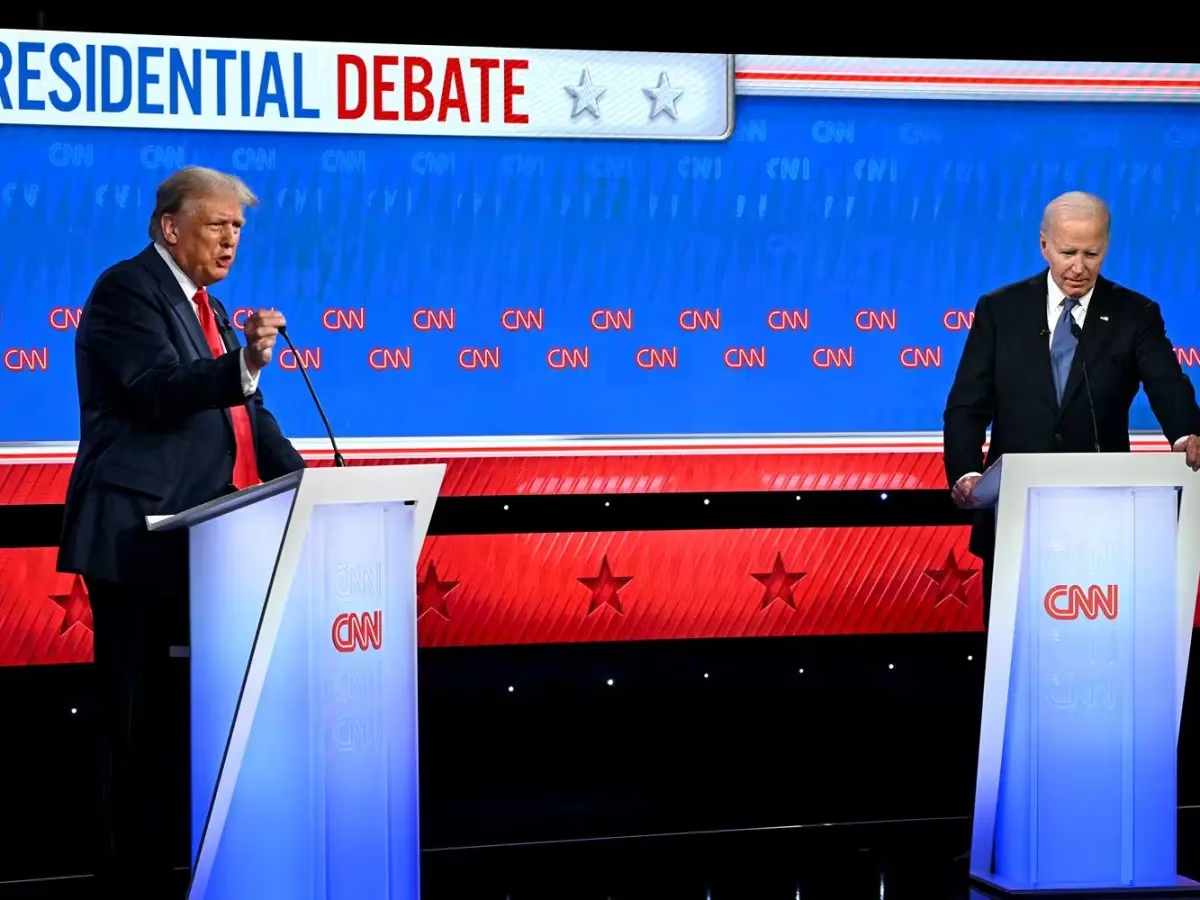
After a prolonged pause, Donald Trump has once again publicly accused the Ukrainian authorities of interfering in U.S. domestic politics. He claimed that “the United States intercepted communications of the Ukrainian government discussing a scheme to redirect funds toward Biden’s re-election” and shared a report by Just The News. The publication asserts that U.S. intelligence obtained the relevant information as early as 2022, and that the current Director of National Intelligence, Tulsi Gabbard, has allegedly ordered a further inquiry to clarify the details.
Given that confrontation with the Democratic Party remains one of Trump’s central political themes—even amid the war with Iran—such allegations, within his political logic, carry the highest level of gravity. The article refers to the alleged use of American taxpayers’ funds—originally earmarked for infrastructure projects—which, it claims, may have been redirected through various schemes to support the Democratic candidate’s election campaign.
Just The News itself was founded by journalist and publisher John Solomon, known for his proximity to Trump, making the appearance of such a report on this platform unsurprising. At the same time, the central question remains unresolved—whether U.S. intelligence agencies are in fact investigating the alleged scheme, which would give the story greater weight and continuity, or whether this is a publication initiated by the outlet itself without direct involvement from the White House.
Even if the latter proves to be the case, Trump’s decision to amplify the report points to growing irritation toward Kyiv, which has become increasingly evident in recent weeks. Its source is clear—the refusal of the Ukrainian authorities to withdraw troops from Donbas, which, in this framing, is seen as hindering the implementation of agreements on ending the war reached by Trump and Vladimir Putin in Anchorage.
On the eve of these developments, Volodymyr Zelensky confirmed that it is the United States that is pressing for the withdrawal of Ukrainian forces and is prepared to discuss security guarantees only after such a step. Against this backdrop, the key question remains whether Washington is ready to move from rhetorical pressure to practical measures aimed at compelling Kyiv.
If the information presented in the Just The News report proves accurate, a potential investigation could become one of the instruments of such pressure. At the same time, the United States retains other levers of influence—from restricting the sharing of intelligence to a complete halt in weapons supplies.
In parallel, pro-war Russian Telegram channels have intensified rhetoric expressing distrust toward American assurances in the context of negotiations over Iran, with calls emerging to abandon further dialogue with Washington. However, the situation surrounding Ukraine differs significantly. Within these talks, Trump is effectively operating in a framework aligned with Moscow’s interests, pressing Kyiv to make concessions.
If the proposed plan were to be implemented, Russia would secure its key outcomes immediately—the withdrawal of Ukrainian forces from Donbas, the lifting of sanctions, and recognition of its control over the occupied territories. Ukraine, by contrast, would be left to rely primarily on U.S. commitments on security and investment as codified in the agreements.
In this context, negotiations with Washington remain Russia’s only relatively swift path toward achieving its objectives, making a withdrawal from the process unlikely. At the same time, the implementation of the so-called “Anchorage plan” is possible only under conditions of substantial pressure on Kyiv—a step Trump has not yet taken, though the possibility remains. The current episode involving accusations against Ukraine may also be seen as a signal pointing in that direction.