Donald Trump announced a two-week pause in hostilities. On the night of April 8, as Washington’s final ultimatum to the Iranian leadership expired, he said the United States would halt strikes on Iran for two weeks on condition that the Strait of Hormuz be opened “fully, immediately, and safely.”
He said the United States had “achieved and exceeded” its military objectives and had also received a ten-point proposal from Tehran that “could serve as a working basis for negotiations.” Trump claimed that on most disputed issues between the two sides, “agreement has already been reached.”
A few hours later, he issued another statement, promising U.S. involvement in resolving the congestion of vessels in the Strait of Hormuz. “There will be a lot of positive action! A lot of money will be made. Iran will be able to begin the process of reconstruction,” he wrote, adding that the moment could usher in a “golden age” for the Middle East.
Shortly before that, the president’s rhetoric had been very different. He had warned that on the night of April 8, “an entire civilization” could perish—one that could “never be brought back.” “I do not want that to happen, but it probably will. However, now that we have a full and total regime change, in which other, smarter and less radical forces will prevail, perhaps something truly revolutionary will happen,” he wrote.
Tehran confirmed its readiness for a truce. Foreign Minister Abbas Araghchi said that a halt to the attacks would lead to the suspension of Iran’s “defensive operations.” He said safe passage for vessels through the Strait of Hormuz over the next two weeks would be ensured in coordination with the Iranian military. At the same time, according to the Associated Press, citing an informed source, the plan provides for shipping tolls to remain in place—they will continue to be collected by Iran and Oman.
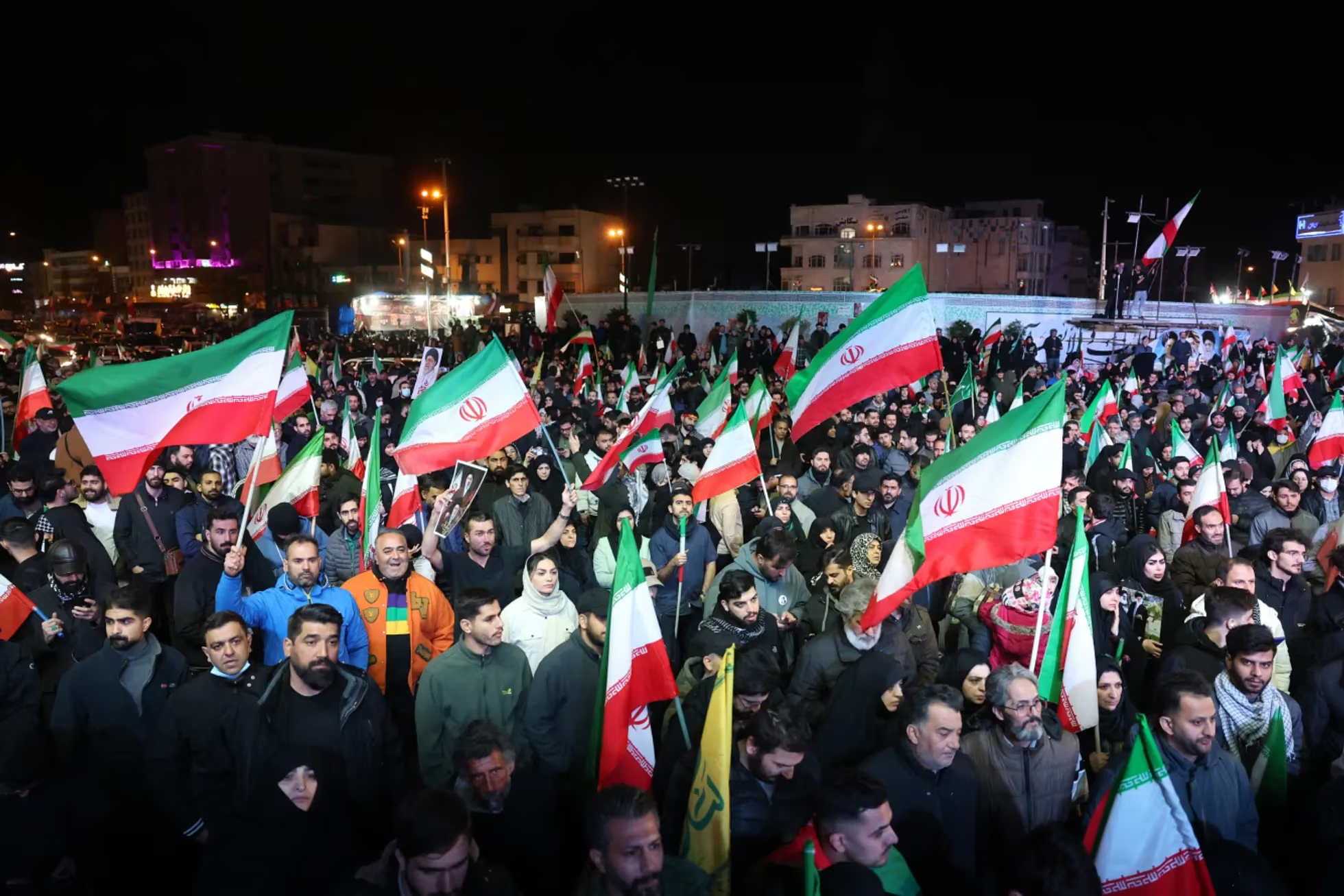
Iran’s Supreme National Security Council said that Trump, by accepting the Islamic republic’s terms, had “abandoned his desperate threats and bluffing,” while the country’s adversaries had suffered an “undeniable, historic, and crushing defeat.” The ten-point plan in question includes non-aggression guarantees, formal recognition of Iran’s control over the Strait of Hormuz, recognition of its right to enrich uranium, the lifting of sanctions, and compensation payments. Washington has not yet commented on those demands.
According to sources cited by The New York Times, Iran’s consent was the result of diplomatic efforts by Pakistan and intervention by China, which had urged Tehran to “show flexibility and reduce tensions.”
In Israel, the truce was welcomed. Prime Minister Benjamin Netanyahu’s office said the country supported U.S. actions aimed at eliminating the nuclear, missile, and terrorist threat posed by Iran to the United States, Israel, Arab states, and the international community. At the same time, it stressed that the ceasefire does not extend to Lebanon, where Israel is fighting on a second front.
A senior Israeli official said the United States had “coordinated” the parameters of the truce with Israel in advance. According to the official, during the negotiations Washington will seek the removal of nuclear materials from Iran, an end to uranium enrichment, and the elimination of the ballistic missile threat.
Despite the announced pause, air-raid sirens sounded again in Israel after Trump’s statement. In the town of Tel Sheva in the south of the country, two teenagers sustained minor injuries in the shelling.
In Islamabad. On the eve of the ultimatum’s expiration, Pakistani Prime Minister Shehbaz Sharif urged Trump to postpone the deadline by two weeks, and Tehran to open the Strait of Hormuz. Both leaders expressed their gratitude to him. Sharif himself welcomed the ceasefire agreement, noting that it also extends to Lebanon.
According to Iran’s Tasnim news agency, April 10 has been named as the preliminary date for the talks. Iran is prepared to engage in dialogue for two weeks, with the possibility of an extension. Axios also reports that the meeting could take place on Friday, April 10, and that the American delegation will likely be led by Vice President JD Vance.
Since the start of the conflict, Pakistan has emerged as one of the key mediators. On the eve of the announcement, Reuters reported on a two-stage settlement plan prepared by Islamabad, which provides for an immediate ceasefire and the opening of the Strait of Hormuz, to be followed by a comprehensive agreement.
Markets reacted with a drop in oil prices. After the ceasefire was announced, Brent fell below $100 a barrel—to $94.5—whereas in previous weeks it had hovered around $110. Even so, the current level remains well above the $67.02 a barrel recorded on February 27, before the war began. WTI fell by 19%.