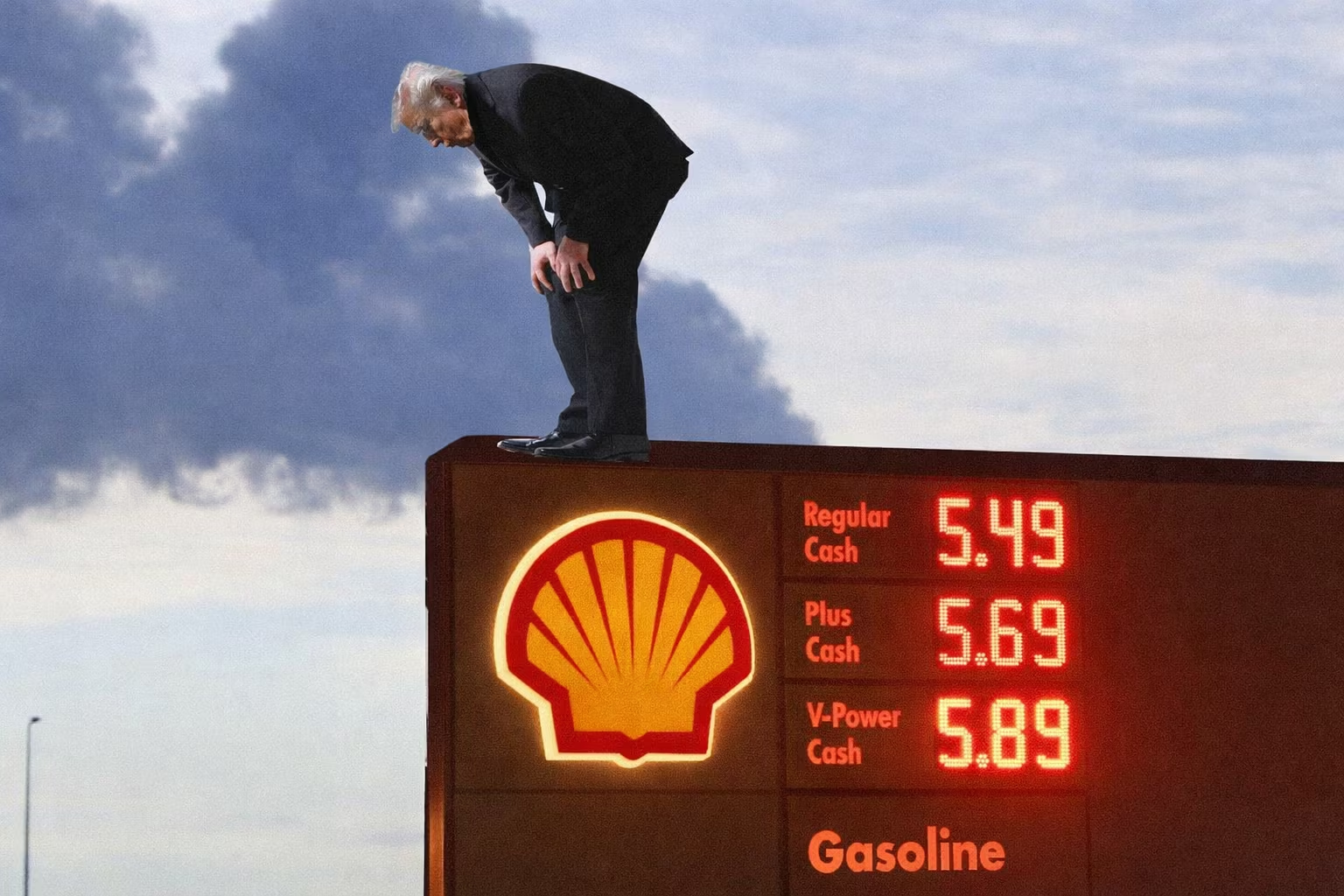
From Wall Street to the White House, the talk this week has been of the so-called “Persian Taco”—the formula Donald Trump reaches for when he pulls back from escalation against Iran.
Early on Monday morning, as oil prices climbed, stock futures fell and bond yields rose in response to his threats to strike Iran’s civilian energy infrastructure, the president hurried to soften his rhetoric. He announced that he was postponing the bombing, saying talks with Tehran were going well. After the bluster and threats came the Taco moment—“Trump Always Chickens Out”—a pattern that first emerged during the tariff crisis a year earlier.
Markets reacted instantly. Yields stabilized, and the price of Brent crude fell back below $100 a barrel from above $112 just seconds earlier. By 9:30 a.m. in New York, the S&P 500 had risen 1.5%, defying earlier futures signals that pointed to a possible 1% decline.
Perhaps Trump deserves some credit for halting American forces before they could commit what would have amounted to a war crime and set off an inevitable cycle of retaliatory strikes on civilian infrastructure across the Persian Gulf—with consequences for the global economy and financial markets.
Yet the events of the following hours suggested that the tactic may be losing its force. The president still retains the capacity to inflict serious damage on the region and the global economy. Sharp threats followed by retreat create an illusion of control. In reality, however, he no longer appears to command the trajectory of the conflict with Iran or to determine when it ends. Markets are beginning to price in the possibility that the decisive choices are being made in Tehran.
On Tuesday, oil prices rose again, while equities gave back part of Monday’s gains after Iranian officials rejected Trump’s claims of “productive talks” and a “complete and final settlement,” and at the same time launched missile strikes on Israel, Iraq and other American allies in the region.
Although markets later rallied on Tuesday in response to reports of a peace plan conveyed by Washington, the nervousness soon returned—as investors concluded that the president’s statements carried only limited weight.
This is not the first time markets have registered a weakening in his ability to shape events. On March 9, Trump again tried to restrain rising oil prices, saying the fighting would end “soon, very soon” because the war was supposedly “almost over.” The S&P rose that day, but soon resumed its decline.
In April of last year, on the so-called “Liberation Day,” when the Taco strategy acquired its name, Trump still retained a measure of control. He imposed “reciprocal” tariffs on imports from virtually the entire world—including islands inhabited solely by penguins. Markets reacted sharply, after which he partially retreated in an effort to steady the situation.
Serious damage to the economy was avoided at the time. In the months that followed, as tariffs were raised more gradually, market reactions were more restrained, since the effects on growth and inflation remained limited. The dollar weakened, but the stock market continued to rise.
The situation is now more complicated. Midterm elections loom in November, and the president’s standing in the polls is deteriorating. Americans did not support this war to begin with, and discontent has grown as gasoline prices have climbed to nearly $4 a gallon. The OECD forecasts that U.S. inflation will reach 4.2% this year. Trump’s problem is that his objectives pull in opposite directions: he needs both to end the conflict and bring the fleet home, while also restoring oil flows through the Strait of Hormuz, which Iran now controls.
Iran, by contrast, has time on its side. Its leadership has suffered losses, its armed forces have been weakened, yet the regime remains in control, and there is no sign of its imminent collapse. As recent events have shown, it is capable of inflicting substantial damage on the global economy by constraining flows through the strait—up to 12.5 million barrels of oil and 11.5 billion cubic feet of gas a day.
Tehran has little incentive to de-escalate. It likely believes that the only way to prevent further attacks is to demonstrate the scale of the damage it can inflict in return. The United States cannot effectively counter that without a ground operation, which would create additional political risks in Washington.
Reports suggest that, in response to the American proposals, Iran has put forward conditions of its own, including recognition of its sovereignty over the Strait of Hormuz and compensation for the damage caused by U.S. and Israeli strikes. State broadcaster Press TV quotes a senior official as saying: “Iran will end the war when it deems it necessary and when its conditions are met.”
Markets are beginning to absorb that reality. If the United States were fully in control of the situation, the president would not need to threaten strikes on civilian targets—acts that would qualify as a war crime. At best, that suggests he has exhausted his military options. At worst, it suggests he does not understand how to achieve them.
On Thursday, the S&P fell 1.78% and closed at its lowest level of the year. Brent crude held near $108 a barrel. Like Trump, investors have been forced to confront the fact that Iran, despite its losses, has proved more resilient and more willing to escalate further. A strategy built on threats followed by retreat may prove insufficient to stabilize the situation.