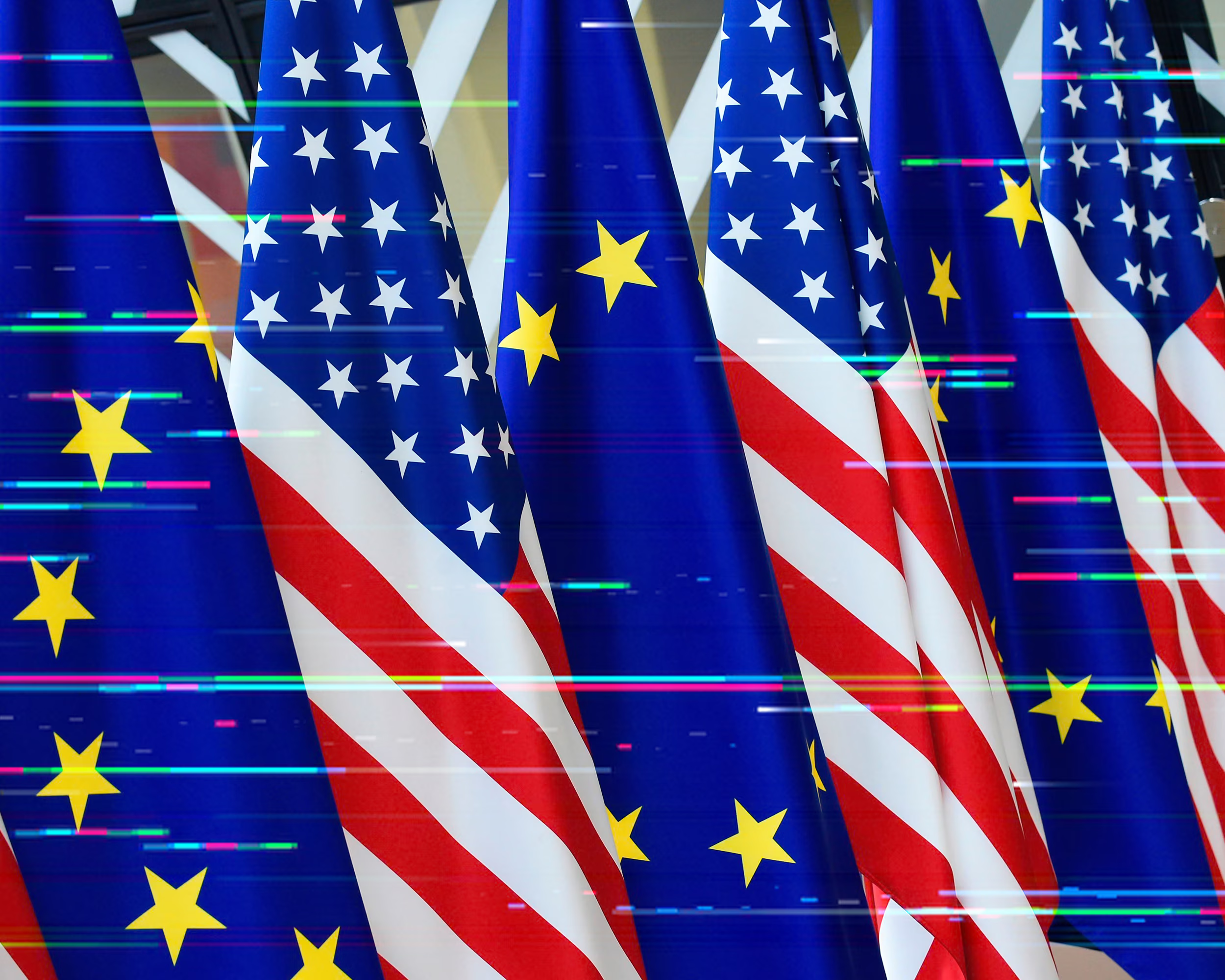
The Donald Trump administration has unveiled a new US National Security Strategy portraying Europe as facing a threat of “civilizational disappearance”. The document casts the European Union and migration as primary drivers of cultural erosion, while depicting Brussels as a structure that undermines political freedom and national sovereignty. Against this backdrop, the strategy forges an ideological link between the Maga movement and Europe’s far-right forces, effectively reframing Washington’s understanding of the very nature of transatlantic relations.
European Council president António Costa has warned the Donald Trump administration against interfering in Europe’s internal affairs. Analysts argue that the US national security strategy released on Friday indicates a fundamental reassessment of transatlantic relations. The document claims that Europe faces a threat of “civilization erasure” driven by migration, and that a censorious EU allegedly “undermines political freedom and sovereignty”. According to the text, the United States intends to “cultivate resistance” within the bloc to “correct its current trajectory”. Experts contend that the strategy reflects not only Trump’s hostility toward Europe but also a broader ambition to weaken it.
Costa called it unacceptable for Washington to signal its readiness to back nationalist forces across Europe. Speaking on Monday, December 8, he noted that disagreements with Trump on issues such as climate policy have long been evident, yet the new strategy goes “far beyond that”. “We cannot accept a threat of interference in European politics,” he said. “Allies do not threaten to meddle in their partners’ internal political choices.” He added that the United States has no right to shape Europe’s understanding of freedom of expression, and that “Europe must be sovereign”.
The strategy was welcomed in the Kremlin, which said it “largely aligns with our view”. Tensions between the EU and the United States have also deepened over a $120mn fine that Brussels imposed on Elon Musk’s social platform X. Musk said on Sunday that the EU should be “abolished, with sovereignty returned to individual nations”. US deputy secretary of state Christopher Landau described the EU as an “unelected, undemocratic and unrepresentative” body that undermines US security.
Analysts argue that the strategy formalises the approach JD Vance outlined at the Munich Security Conference, where he accused European leaders of suppressing free speech, failing to halt illegal migration and drifting away from the real mood of their electorates. “This doctrine has now been turned into an official state line,” said Nicolai von Ondarza, head of European research at the German Institute for International and Security Affairs. In his view, it signals a “fundamental shift in transatlantic relations”. He stressed that “the United States’ open support for regime change” in European countries makes it impossible to deny the scale of Washington’s transformation in its policy toward its allies.
Max Bergmann, director of the Europe, Russia and Eurasia program at the Center for Strategic and International Studies, argues that meddling in European politics to bolster the far right is becoming “a core element of US national strategy”. “This is not merely a speech by a rookie vice president weeks after the inauguration. This is state policy, and they will try to carry it out,” he said. Such a tactic, he noted, may prove effective: “In a fragmented political landscape, a shift of 1–2% can change an election outcome.” Bergmann warns that European leaders will have to “acknowledge that the Trump administration intends to exert political pressure on them”. He poses the question: “Will they accept that Trump is financing their political decline, or will it trigger a profound rupture?”
Mujtaba Rahman of the Eurasia Group consultancy shares this view. He argues that the United States has “formally joined Moscow” in seeking to influence European elections to advance nationalist and anti-EU parties. If the strategy indeed reflects Washington’s course, he says the first target will be next April’s parliamentary elections in Hungary, where nationalist and Moscow-friendly prime minister Viktor Orbán faces a serious challenge.
Minna Ålander of the Center for European Policy Analysis notes that the document “plainly codifies what has been obvious all year: Trump and his team are openly hostile toward Europe”. In her view, European leaders can no longer look away, and the hope of returning to a previous normalcy appears “increasingly absurd”. Europe, she argues, must stop wasting time trying to “manage Trump” and shift toward its own initiatives.
Nathalie Tocci, director of Italy’s Institute of International Affairs, argues that Europeans have “lulled themselves into believing” that Trump is unpredictable and contradictory yet “ultimately manageable”. “It sounds comforting, but it is wrong,” she said. According to her, the Trump administration has “a clear and consistent vision of Europe” that prioritises US relations with Russia and pursues a divide-and-rule strategy across the continent. Much of the work, she contends, is delegated to nationalist and far-right European forces that share the “nationalist and socially conservative views” championed by the Maga movement and seek to “weaken Europe from within”. Tocci believes that attempts to flatter Trump “will not save transatlantic relations”.
Jana Puglierin, a senior analyst at the European Council on Foreign Relations, stresses that although Trump remains unpredictable and the strategy may ultimately fail to materialise, the United States is clearly signalling its intention to “redefine what Europe means to Europeans”. The aim, she says, is to persuade Europeans that they have “strayed from their true values and heritage” and that “European greatness requires restoration” with the backing of “patriotic” forces. She urges Europeans to approach relations with the United States “far more pragmatically”, recognising that endless efforts to placate Trump—from pledges to spend 5% of GDP on defence to offers of breakfast with monarchs—“will not work”.
Von Ondarza notes that a policy of appeasement “has not worked in trade or security and will not stop US support for Europe’s far right”. He argues that the European Union must articulate its own clear strategy, grounded in the durable backing of a majority of its members.