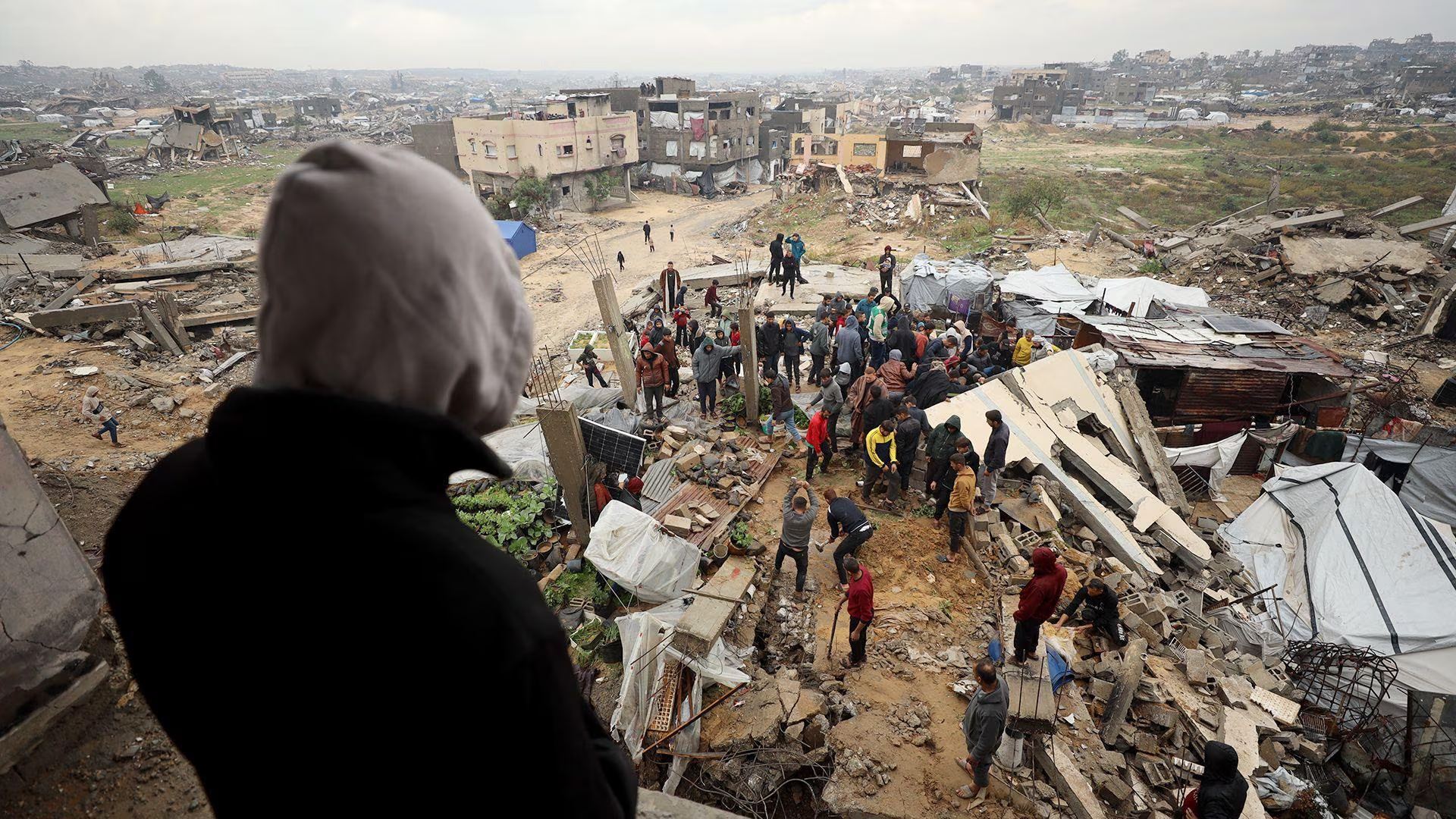
President Donald Trump is expected to announce Israel’s and Hamas’s transition to the second phase of his peace plan in early 2026. Yet for countries that have signed on to Gaza’s reconstruction, numerous complications and uncertainties remain. The ceasefire imposed in October has so far held, despite mutual accusations of violations and deadly military strikes by both Hamas and Israel. Hamas has handed over the remains of all deceased Israeli hostages except one, a key condition of the agreement’s first stage.
Pressure is now mounting to move to the plan’s more complex next phase. It envisages Hamas’s disarmament and the movement’s relinquishment of control over the enclave as Israeli forces continue to withdraw. U.S. officials say Trump intends to announce the start of this transition as early as this month. He is expected to meet Israeli Prime Minister Benjamin Netanyahu on December 29 to discuss the next steps.
At the same time, key partners to the peace plan enshrined in UN Security Council Resolution 2803, adopted last month, acknowledge that the path ahead remains unclear. “The plan says many of the right things, but it is not very clear what happens first and what follows,” Norway’s foreign minister, Espen Barth Eide, said at a forum in Doha last week. He warned that without progress this month, countries risk “a return to war or a slide into full chaos.”
On Wednesday, December 10, Trump said he would announce early next year the membership of a “Peace Council,” which is expected to oversee a not-yet-formed Palestinian technocratic government. That body is meant to provide basic services in Gaza, including infrastructure, water supply, education, and healthcare. Trump will assume the role of council chair and told reporters at the White House earlier this week that it would include “leaders of the most important countries.”
As these governance structures take shape, plans call for the deployment of an International Stabilization Force alongside Palestinian police to maintain security and public order.
Hamas’s Disarmament as the Central Condition of the Second Phase—and the Main Source of Discord
However, analysts warn that none of these steps is feasible if Hamas refuses to disarm and relinquish control over Gaza.
“The core problem that cuts across every dimension—political and security alike—is that Hamas must be disarmed and dismantled, and Gaza must be demilitarized,” said Kobi Michael, a senior research fellow at Israel’s Institute for National Security Studies and the Misgav Institute for National Security and Zionist Strategy. “If this does not happen, nothing will.”
Hamas’s position on disarmament remains ambiguous. Bassem Naim, a member of the movement’s senior political bureau based in Doha, told the Associated Press on Sunday that Hamas was prepared to discuss the “freezing or storage” of its weapons. However, in an interview with Al-Monitor published on Monday, Naim outlined two possible scenarios: either transferring the arms to a future Palestinian state, or beginning their withdrawal under a ceasefire lasting five to ten years, provided there were guarantees that Israel would not resume the war.
Daniel Shapiro, who previously served as U.S. deputy assistant secretary of defense for the Middle East in the Biden administration, argues that Trump should use his leverage over Turkey and Qatar to push Hamas toward relinquishing its weapons in line with a 20-point peace plan. “I think it is really the Qataris and the Turks who remain the key players capable of compelling Hamas to do this—whether immediately or through a moderately phased process,” said Shapiro, now a senior fellow at the Scowcroft Middle East Security Initiative at the Atlantic Council, speaking on the J Street podcast.
Israel, however, views with deep skepticism the idea that Qatar and Turkey would oversee the dismantling of Hamas, as Doha and Ankara are widely seen as among the group’s principal backers—an organization designated as terrorist by the United States. “This directly contradicts Israel’s interests,” Michael said. “Turkey and Qatar are Hamas’s largest patrons and supporters. They have no intention of facilitating its disarmament. On the contrary, they want Hamas to remain a significant and influential actor in Gaza and beyond.”
U.S. Ambassador to Israel Mike Waltz said in an interview with Israel’s Channel 12 on Thursday that “intensive” discussions are under way with Prime Minister Benjamin Netanyahu over the role Qatar and Turkey could play in the process.
A Divided Gaza Strip and Israel’s Pilot Scenario for Implementing the Plan
The ceasefire proposed by Trump has effectively split the Gaza Strip into two parts. Israel controls 53 percent of the territory—the eastern areas, the southern part of Rafah, and a portion of the north—while Hamas retains control over the remaining 47 percent. To demarcate these zones, Israel has drawn a so-called “yellow line,” laid out with colored concrete blocks, which has itself become one of the focal points of continuing violence.
UN High Commissioner for Human Rights Volker Turk told reporters in Geneva on Wednesday that Israel is shifting the boundary of the yellow line, creating additional uncertainty for Palestinians attempting to cross it. According to him, the clashes have killed 360 Palestinians and injured another 922, citing Gaza’s health authorities. The figures do not distinguish between militants and civilians among the dead and wounded. Israel, for its part, says it is responding to the actions of “terrorists” seeking to cross the line and posing a threat to Israeli forces.
As Michael explained, Israel’s preferred scenario is to use the portion of the Strip under its control as a testing ground for the second phase of Trump’s plan. In that zone, Israel would retain decisive control over security, while a Palestinian technocratic administration would be established under the oversight of the Peace Council. Maintaining order would be entrusted to an International Stabilization Force working alongside a newly trained Palestinian police force.
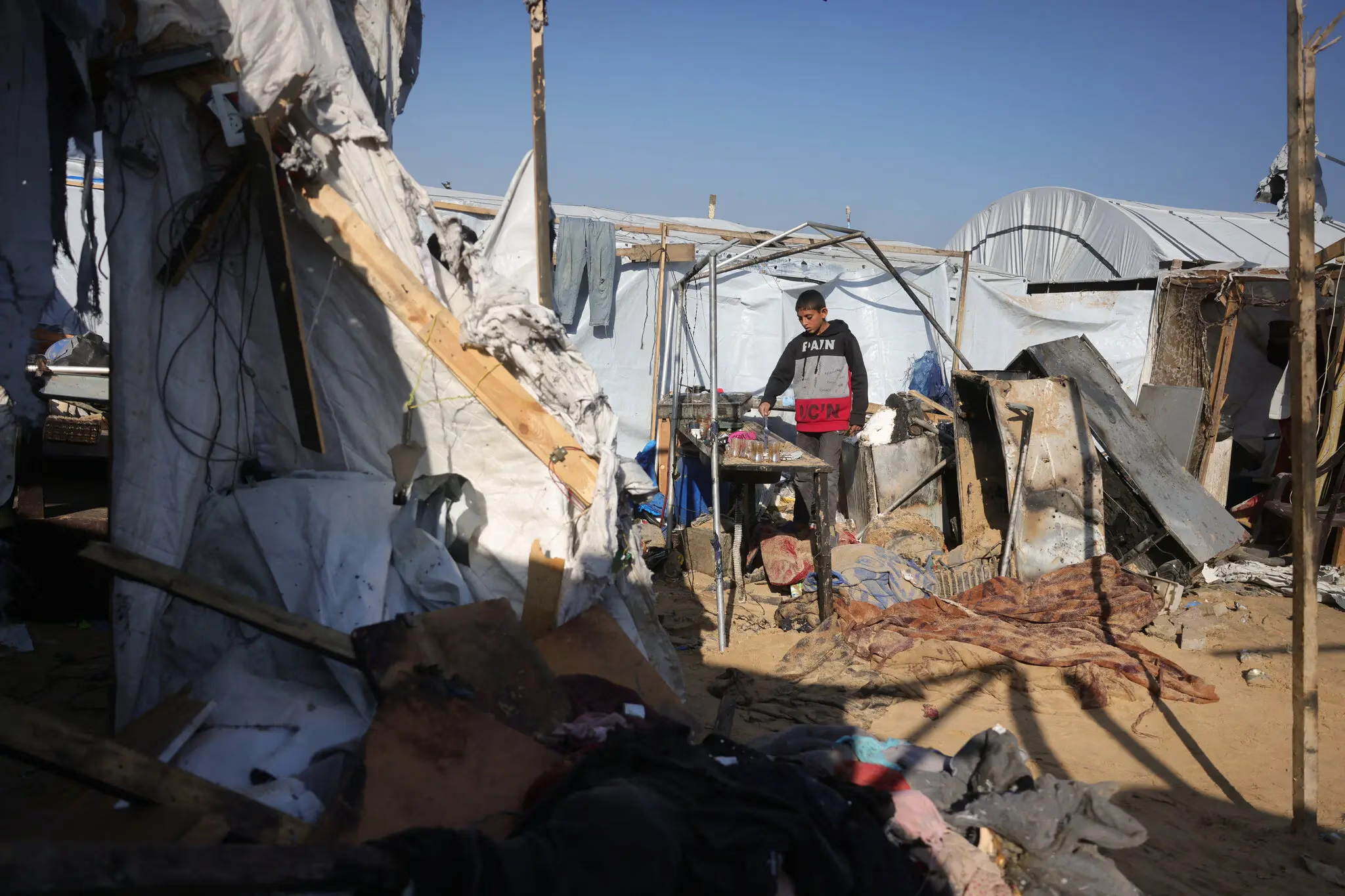
Israel Strikes Gaza After Hamas Attack Reported in Rafah
The New Episode of Violence Once Again Tests the Two-Month Ceasefire
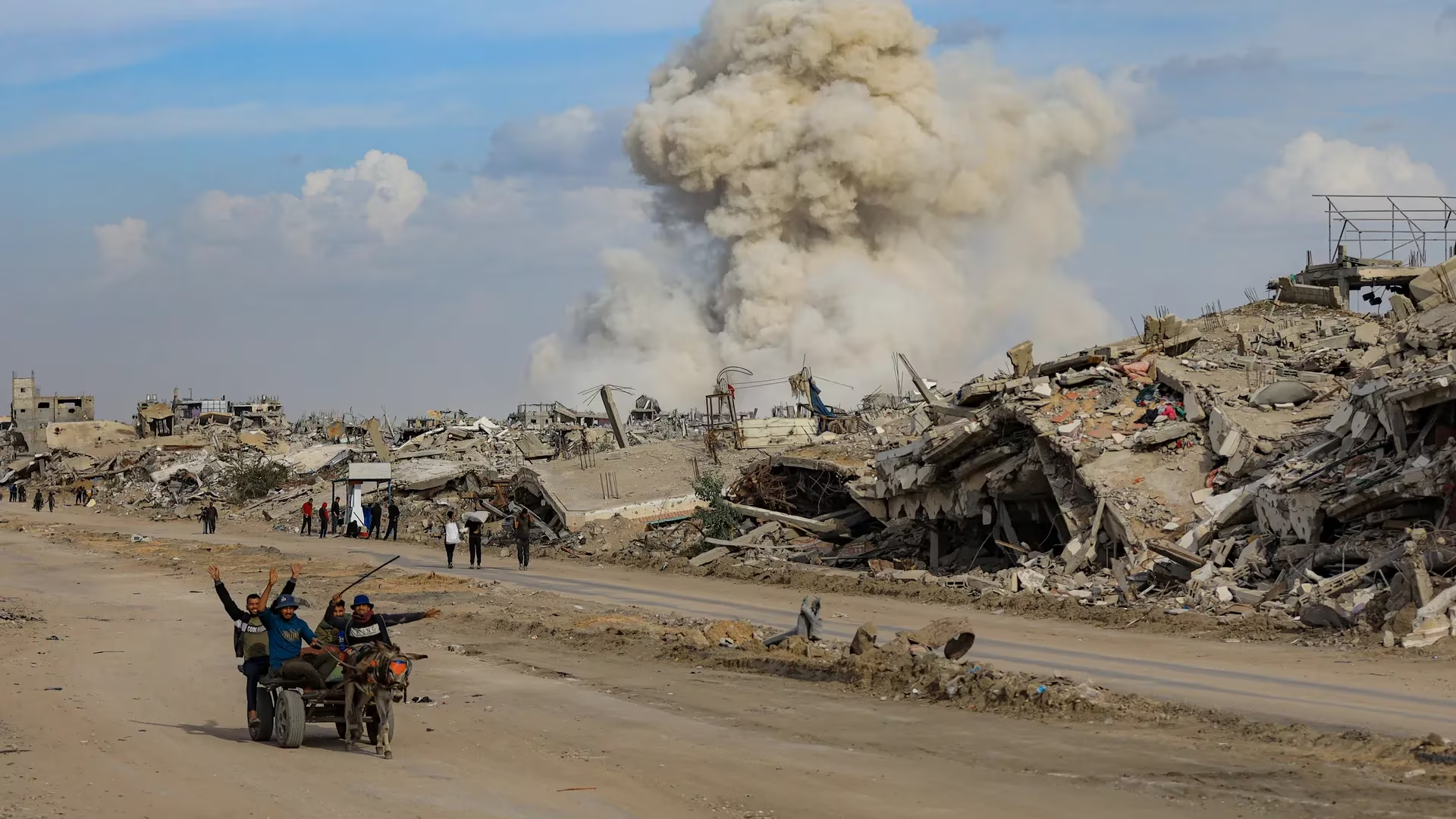
The United States Intends to Appoint Its Own General to Lead International Stabilization Forces in Gaza
The Trump Administration Tightens Control Over Security and Governance in the Strip as It Prepares to Launch the Peace Council
Last month, The Atlantic reported that the United States is planning to launch a pilot project of “alternative safe communities,” which would involve relocating selected Gaza residents to purpose-built settlements with housing, schools, and medical facilities. If stability can be established in the eastern part of the Strip, Michael argues, “Israel will gain legitimacy and the backing of the U.S. administration” to resume military operations against Hamas in the west, after which the governance model tested in the east could be extended further.
It remains unclear, however, how compatible Israel’s approach is with Trump’s plan—and how acceptable it is to its international backers, a consortium of European countries and Muslim-majority states that voiced their support at a ceremonial event held in late October in Sharm el-Sheikh, Egypt.
The International Stabilization Force: An Unclear Mandate and Cautious Commitments from Potential Contributors
A central element of the agreement’s second phase is the further withdrawal of Israeli forces from the Gaza Strip and the deployment of an International Stabilization Force. Trump is reportedly planning to appoint a two-star American general to lead the force, but potential contributors have been reluctant to commit without clear answers to a number of difficult questions.
In an interview with Channel 12, Waltz said the International Stabilization Force would be authorized to disarm Hamas “by all means necessary,” while the United States discusses such tasks separately with each country willing to take part. At the same time, Reuters reported on Friday, citing two unnamed U.S. officials, that Washington is not demanding that the force disarm Hamas and is seeking to deploy the contingent as early as January.
Countries that had earlier signaled a willingness to deploy troops are still awaiting further clarification. Rico Sirait, a spokesperson for Indonesia’s defense ministry, said that while the country is prepared to contribute up to 20,000 troops, its involvement would be focused primarily on medical and construction tasks in Gaza. “The project is still in the planning and preparation stages,” he told Reuters. “We are now putting together the organizational structure of the forces that could be deployed.”
Cyprus’s foreign minister, Constantinos Kombos, told Al-Monitor that the country is considering participation but is waiting for greater clarity on the force’s mandate and rules of engagement. A similar position was expressed by an unnamed senior Azerbaijani official, who told The Times of Israel that Baku has not yet decided whether to join the International Stabilization Force, despite having previously been cited as one of the early partners. Among the key concerns is the absence of a clearly defined pathway toward the establishment of a Palestinian state, which is endorsed by UN Security Council Resolution 2803 but not explicitly required by it.
Saudi Arabia, too, insists on the need to define a pathway to Palestinian statehood as the only way to secure a durable peace—and as a precondition for establishing diplomatic relations between Israel and Riyadh. “The ultimate goal is security for all and regional integration, which is impossible without the realization of a Palestinian state,” said Manal Radwan, head of the Saudi foreign ministry’s negotiating team, at the Doha Forum. In her words, “if this is not taken into account, no plan in the world will be able not only to carry us from one stage to the next, but also to prevent another spiral of violence.”