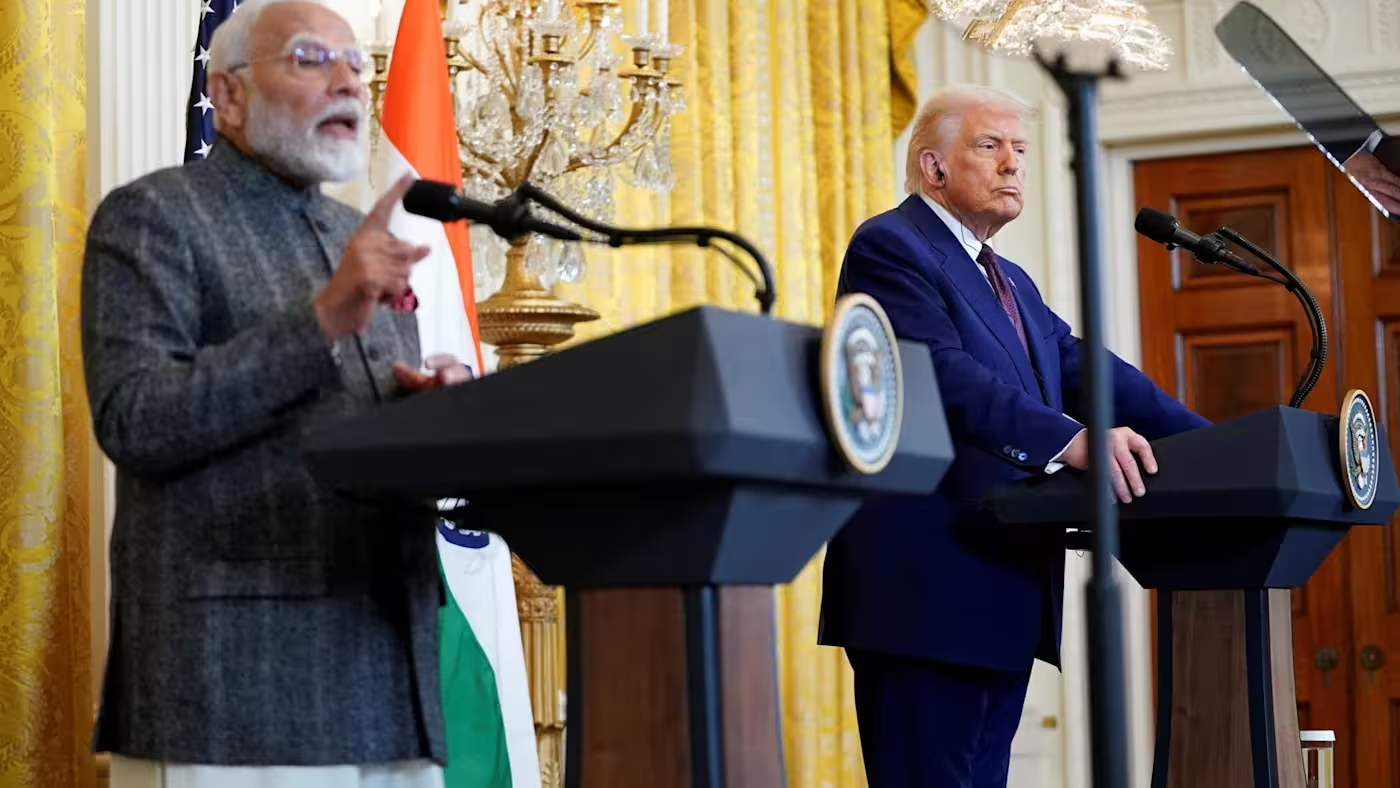
Donald Trump said the United States would lower tariffs for India to 18 percent after Prime Minister Narendra Modi, according to him, agreed to stop purchasing Russian oil. The move is intended to bring an end to a months-long trade dispute between the two countries.
The president said he spoke with Modi on Monday, during which the two discussed “many things,” including trade, ending the war in Ukraine, and the possibility that India would buy more oil from the United States and, potentially, from Venezuela.
“Out of friendship and respect for Prime Minister Modi, and at his request, starting today, we have agreed on a trade deal between the United States and India under which the United States will impose a reduced reciprocal tariff, lowering it from 25% to 18%,” Trump wrote on Monday on Truth Social.
Trump had previously accused India, which imports about 90 percent of the oil it consumes, of helping to finance Moscow’s war in Ukraine. In August, he imposed an additional punitive levy of 25 percent on India for purchases of Russian oil, on top of an existing 25 percent “reciprocal” tariff. As a result, the combined duty rose to 50 percent—one of the highest levels in the world.
On Monday, February 2, officials from the US administration, including the new US ambassador to New Delhi, Sergio Gora, signaled that after India agreed to halt purchases of Russian oil, the punitive 25 percent levy would be lifted. This would bring the overall tariff rate down from 50 percent to 18 percent.
Trade negotiations that began last year stalled precisely after the oil-related duties were introduced. The move dealt a blow to the world’s fastest-growing major economy and deepened rifts between Washington and New Delhi.
The impasse in the talks also strained the personal relationship between Trump and Modi, whom the US president had previously described as a “great friend.”
Trump also said that India had agreed to cut its “tariff and non-tariff barriers” for the United States to zero and to adopt a “Buy American” policy, committing to purchases of US goods worth “more than $500 BILLION,” including energy, technology, and agricultural products.
Shortly afterward, Modi wrote on X: “It was wonderful to speak today with my dear friend President Trump. I am pleased that Made in India goods will now be subject to a reduced tariff of 18%. Many thanks to President Trump on behalf of India’s 1.4 billion people for this remarkable announcement.”
Analysts, however, were skeptical of the figures, noting that total bilateral trade between the two countries amounted to $212 billion in 2024.
According to Pratik Dattani, founder of the Bridge India think tank, India purchased just $41.5 billion worth of goods from the United States last year. “So there is simply no way that figure rises to $500 billion, especially if Trump is talking only about trade in goods,” he said.
Dattani added that while India has already begun to scale back purchases of Russian oil, it is unlikely to abandon them entirely because of enduring ties with Moscow. After the start of Russia’s full-scale war in Ukraine in 2022, India became the largest buyer of discounted Russian seaborne crude.
Nicolas Koehler-Suzuki, an adviser on trade and economic security at the Jacques Delors Institute in Paris, also cast doubt on Trump’s claim that India was prepared to work toward cutting all tariffs to “ZERO.”
“It is extremely unlikely that India has agreed to reduce tariffs to zero, particularly on agricultural products, given its long-standing approach to trade negotiations, rooted as far back as the Doha Round,” he said, referring to the World Trade Organization talks launched at the start of this century.
Experts said that the conclusion of an agreement between the EU and India last month, along with a similar deal India struck with the United Kingdom, may have increased pressure on Trump and nudged him toward a compromise with New Delhi.
In his post, Trump claimed that Modi had agreed to stop purchasing Russian oil—one of Washington’s key irritants—and would instead “buy much more” from the United States “and, possibly, from Venezuela.”
“In the absence of the text of the agreement, caution is warranted, but the word ‘possibly’ here could prove very significant,” said Kevin Book of the consulting firm ClearView Energy Partners.
After US tariffs were imposed in August, the heaviest blow fell on labor-intensive sectors of India’s economy, including the gemstone industry, textiles, and shrimp exports.
At the same time, some of India’s key export industries were exempted from Trump’s tariffs, including pharmaceuticals—which account for nearly half of generic drug supplies to the United States, according to the Indian Pharmaceutical Alliance—as well as consumer electronics.
Although India is not among the world’s leading exporters, it runs one of the largest goods trade deficits with the United States, which exceeded $45 billion in 2024. Historically, the country has maintained high average tariffs to protect domestic industries, a stance that has long irritated the Trump administration.
“The agreement is expected to deliver meaningful tariff relief for New Delhi and mark an important trade diplomacy achievement for the Trump administration,” said Basanti Sangera, managing partner at the Asia Group.
“It will also provide a much-needed boost to the broader bilateral partnership after months of strain. India’s patience has paid off—at least for now,” she added.