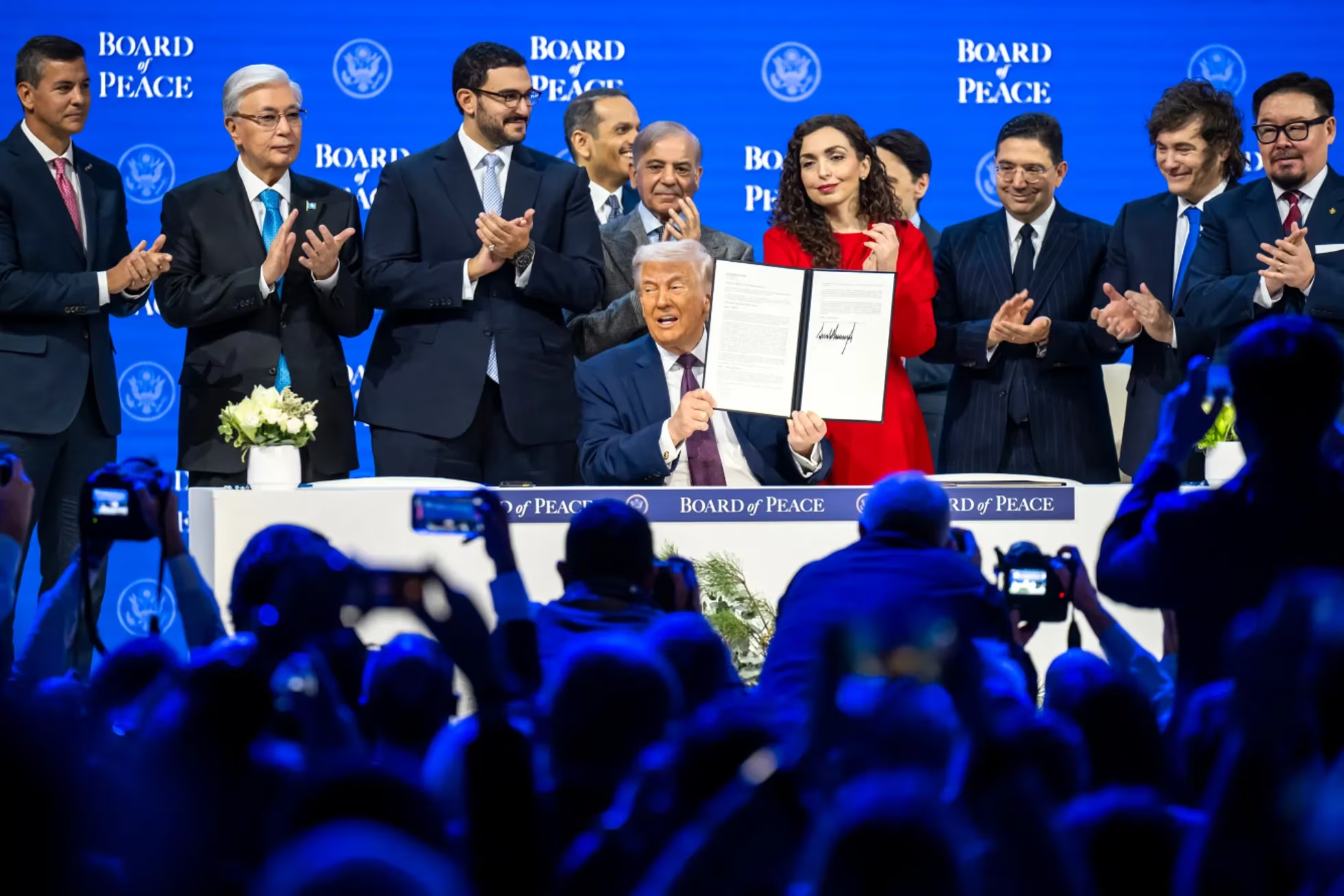
The initiative’s official name is the Board of Peace. The word council—common in political institutions—is deliberately absent. Instead, the term board is used—a concept drawn from corporate governance, as in board of directors. This choice underscores the body’s logic: it is designed not for deliberation, but for making concrete executive decisions.
Donald Trump made no secret of viewing the Peace Council as a potential replacement for the UN. “The UN just isn’t very useful,” he said. “I’m a big fan of the UN’s potential, but it has never lived up to that potential. The UN was supposed to end all those wars that I ended. I didn’t go to them. I didn’t even think about going to them.”
Where the Peace Council Came From
The idea of the Peace Council grew out of a plan to resolve the conflict in Gaza that the US president unveiled in September. Jared Kushner—Trump’s son-in-law and his adviser on the Middle East—is widely described as the key architect of the concept.
The process began in the summer of 2025. Several independent groups—including the Institute for Global Change, founded by former British prime minister Tony Blair, as well as experts brought in by Israeli businessmen Michael Eisenberg, now Israel’s special envoy to the US on Gaza, and Liran Tankman—were simultaneously developing their own scenarios for ending the war in the Gaza Strip. All these initiatives converged at a single point: their authors turned to Kushner, hoping he could secure Trump’s backing. In August—September, several separate projects were merged into a single document, which Trump then presented as his peace plan.
Among other things, it envisaged the temporary transfer of the Gaza Strip to international administration—through a specially created body, the initial Peace Council, which was to include world leaders and diplomats. This body was to be vested with the authority to make strategic decisions about Gaza’s future and to oversee a committee of Palestinian technocrats responsible for the day-to-day governance of the territory.
In its underlying logic, this model replicated a corporate system of governance. The Peace Council was conceived as an analogue of a board of directors—its seats were intended for those making the greatest contributions to the Gaza reconstruction project. The technocratic committee, in turn, played the role of an executive body, accountable to that board.
In October, a ceasefire came into effect in Gaza. In November, the UN Security Council approved Trump’s plan through a corresponding resolution. In January, new governing bodies for the territory were established.
By this point, Trump’s vision for the Peace Council appears to have extended well beyond Gaza. On January 17, the Financial Times reported that the Trump administration was discussing the possibility of creating a similar structure for Ukraine. The following day, The Times of Israel published the text of the Peace Council’s charter—and Gaza was not mentioned at all. The organization’s stated purpose was “to strengthen stability, restore durable and legitimate governance, and establish lasting peace in regions affected by or at risk of conflict.”
How the Peace Council Will Be Structured
In other words, this is an attempt to create a global board of directors. Its chair is Donald Trump, who simultaneously represents the United States on the Peace Council—and retains this seat even after leaving the presidency. The position of chair is not elective: removal is possible only in the event of voluntary resignation or incapacity, and the chair appoints his own successor. If the world is viewed as a joint-stock company, Trump in this framework acts as the controlling shareholder—and does so in a personal capacity, rather than as a representative of the United States.
Unlike the chair, members of the Peace Council are not individuals but states. Admission is possible exclusively by invitation from the chair—that is, from Trump. The term of membership is three years. Countries that, in the first year of the Peace Council charter—through January 22, 2027—contribute $1 billion to its budget receive permanent member status. The chair has the authority to expel any state unless two-thirds of Council members exercise their veto over that decision.
For a complete analogy with the board of directors of a joint-stock company, only the principle of “one share—one vote” is missing. The Peace Council’s charter enshrines a different approach—“one member—one vote.” In both structure and style, the document is far closer to a commercial contract than to an international treaty.
At the same time, the charter creates no international legal obligations. It does not even introduce mandatory contributions, limiting itself to voluntary funding. It explicitly states that the form and extent of each state’s participation are determined by its national legislation, meaning parliamentary ratification is not required. Formally, the Peace Council is an international non-profit organization.
Critics describe this arrangement as a “pay-to-play club”. Supporters respond that it is logical to grant the greatest influence over global processes to those countries willing to commit the most resources.
Who Joined the Peace Council
On the eve of the charter’s signing, several dozen states—including Russia and Belarus—received invitations to join the Peace Council. Trump himself made no effort to conceal this approach: “We need everyone. There are some controversial figures in there. But these are people who can get things done. These are people with enormous influence. If the council were made up entirely of kids, it wouldn’t make much sense.”
On January 22 in Davos, the Peace Council’s charter was signed alongside Donald Trump by representatives of nearly two dozen countries, including:
⋅ Bahrain’s prime minister, Salman bin Hamad Al Khalifa;
⋅ Morocco’s foreign minister, Nasser Bourita, and Argentina’s president, Javier Milei;
⋅ Armenia’s prime minister, Nikol Pashinyan;
⋅ Azerbaijan’s president, Ilham Aliyev;
⋅ Bulgaria’s prime minister, Rosen Zhelyazkov;
⋅ Hungary’s prime minister, Viktor Orban;
⋅ Indonesia’s president, Prabowo Subianto;
⋅ Jordan’s deputy prime minister and foreign minister, Ayman Safadi;
⋅ Kazakhstan’s president, Kassym-Jomart Tokayev;
⋅ Kosovo’s president, Vjosa Osmani;
⋅ Pakistan’s prime minister, Shehbaz Sharif;
⋅ Paraguay’s president, Santiago Peña;
⋅ Qatar’s prime minister, Mohammed bin Abdulrahman Al Thani;
⋅ Saudi Arabia’s foreign minister, Faisal bin Farhan Al Saud;
⋅ Turkey’s foreign minister, Hakan Fidan;
⋅ the head of Abu Dhabi’s Executive Affairs Authority, Khaldoon Al Mubarak;
⋅ Uzbekistan’s president, Shavkat Mirziyoyev;
⋅ Mongolia’s prime minister, Gombojavyn Zandanshatar.
⋅ Bahrain’s prime minister, Salman bin Hamad Al Khalifa;
⋅ Morocco’s foreign minister, Nasser Bourita, and Argentina’s president, Javier Milei;
⋅ Armenia’s prime minister, Nikol Pashinyan;
⋅ Azerbaijan’s president, Ilham Aliyev;
⋅ Bulgaria’s prime minister, Rosen Zhelyazkov;
⋅ Hungary’s prime minister, Viktor Orban;
⋅ Indonesia’s president, Prabowo Subianto;
⋅ Jordan’s deputy prime minister and foreign minister, Ayman Safadi;
⋅ Kazakhstan’s president, Kassym-Jomart Tokayev;
⋅ Kosovo’s president, Vjosa Osmani;
⋅ Pakistan’s prime minister, Shehbaz Sharif;
⋅ Paraguay’s president, Santiago Peña;
⋅ Qatar’s prime minister, Mohammed bin Abdulrahman Al Thani;
⋅ Saudi Arabia’s foreign minister, Faisal bin Farhan Al Saud;
⋅ Turkey’s foreign minister, Hakan Fidan;
⋅ the head of Abu Dhabi’s Executive Affairs Authority, Khaldoon Al Mubarak;
⋅ Uzbekistan’s president, Shavkat Mirziyoyev;
⋅ Mongolia’s prime minister, Gombojavyn Zandanshatar.
Earlier, Albania, Belarus, Egypt, Israel, Kuwait, and Vietnam had also indicated their willingness to accept the invitation.
Russia’s president, Vladimir Putin, said the invitation was still under consideration and added that $1 billion could be allocated from Russian assets frozen under US jurisdiction as part of sanctions imposed over the invasion of Ukraine. At the same time, he stressed that, “given Russia’s special relationship with the Palestinian people”, these funds could be transferred regardless of whether Russia joins the Peace Council. This suggested that Moscow likely continues to view the new structure primarily as a mechanism for governing the Gaza Strip. There is a certain logic to this: Gaza is where the Peace Council has a concrete project, while Trump’s other ambitions remain, for now, at the level of declarations.
Among the countries that had not given a final answer was China. For Trump, Beijing’s consent would have been a convenient diplomatic bonus and could have eased negotiations on other sensitive issues—from tariffs and export controls to Taiwan. All the more so given that the Peace Council’s charter allows for minimal, formally non-burdensome participation. Yet given Trump’s complete dominance of the organization, such membership sits uneasily with notions of national dignity that play a central role in Chinese diplomacy.
A number of Western countries—including the United Kingdom, France, Sweden, and Norway—openly declined the invitation. As of January 20, Canada was still considering it, but after prime minister Mark Carney delivered a sharply critical speech against Trump in Davos, its position appears to have shifted toward rejection as well.
As a result, the first members of the Peace Council were primarily those who expected to gain something from Trump. These include strategic US allies such as Israel and Saudi Arabia, for whom a rupture with the American president would carry serious risks. They also include countries such as Uzbekistan or Armenia, which are seeking Washington’s backing as a counterweight to Russian or Chinese influence. In some cases—such as Argentina or Hungary—the dynamic is less about state interests than about personal political alignment: both Javier Milei and Viktor Orban have demonstrated ideological affinity with Trump and are banking on his support.
Shortly after the ceremony, Ukraine’s president, Volodymyr Zelenskyy, flew to Davos and went straight to a meeting with Trump. Zelenskyy also received an invitation to join the Peace Council—and for him the choice was particularly difficult. On the one hand, Trump’s goodwill is now critically important for Ukraine. On the other, participation would have meant sitting in the same body as Belarus, and possibly Russia—an arrangement that is hard to imagine.
Following the meeting, Trump said that the issue of the Peace Council had not been discussed with Zelenskyy.