Donald Trump’s policies—from attempts to seize Venezuela’s president to pressure on European methane emissions standards—have created favorable conditions for his allies in the oil industry, allowing them to expand fossil fuel production and boost profits.
Yet the war with Iran, now in its fourth week, is beginning to undermine their long-term plans—even as higher oil and gas prices temporarily work in their favor.
The conflict—which has claimed more than 4,200 lives across the Middle East—has effectively paralyzed tanker traffic through the strategically vital Strait of Hormuz and curtailed oil and gas production, destabilizing a region that energy companies had hoped to open up to foreign investment with Trump’s backing. International projects are now burdened with heightened risks and costs—an issue set to dominate discussions among industry executives at S&P Global’s CERAWeek conference in Houston.
“Security will be priced into oil,” said Daniel Yergin, vice chairman of S&P Global and founder of the conference, in an interview. “I don’t think we will return to previous levels after this.”
Until recently, Donald Trump’s hardline foreign policy and his support for fossil fuels—including quiet backing for American energy companies in their overseas expansion—were seen as factors working in favor of the world’s largest oil and gas corporations.
Actions by his administration helped companies such as Exxon Mobil, Chevron, and Shell regain access to countries with the largest hydrocarbon reserves—including Venezuela, Iraq, and Libya. While many of these projects remain at an early stage, they have become a priority for industry executives: growth in U.S. shale oil production is slowing, while the International Energy Agency expects oil demand to continue rising through 2050.
After the war with Iran began, Trump administration officials held private meetings with executives from Exxon and Chevron to discuss measures to lower oil prices and increase supply, according to a White House representative. Some steps are already being implemented—including plans to tap U.S. strategic reserves and a temporary easing of a century-old maritime shipping law to reduce transport costs—while other measures are not yet under consideration.
Growth remains a central strategic priority for Exxon.
“We assume that global energy demand will continue to grow, and that oil and gas will remain critically important,” said Dan Ammann, president of the company’s upstream division, in an interview a month before the war began. “The task is to deliver that growth in a capital-efficient, responsible way, and in partnership with resource owners around the world.”
Yet the escalation of the conflict—which Trump has described as necessary for long-term stability in the Middle East—now calls these plans into question. Strikes on infrastructure and the shutdown of production at several key fields in Iraq, Kuwait, and Qatar have laid bare the risks of committing billions of dollars to new projects in the region. Although oil prices have risen by more than 50% since the war began, the market remains highly volatile.
“Oil companies think in terms of decades, but the risks in some of these countries today are higher than they were just a few weeks ago,” said Noah Barrett, an analyst at Janus Henderson, which manages roughly $493 billion in assets. “Sharp price swings, combined with a lack of clarity in the U.S. strategy for this war, do little to reassure investors.”
So far, industry executives have largely refrained from publicly commenting on how the war with Iran has affected their plans—likely wary of provoking Trump’s reaction. When Exxon CEO Darren Woods in January described Venezuela as “not suitable for investment,” Trump said he was prepared to shut the company out of that market entirely.
For much of the past 15 years, the oil industry’s focus has been on the United States, where a surge in production from shale basins turned the country into the world’s largest producer and effectively delivered energy independence for the first time since the 1950s. But as the most productive fields begin to deplete, companies are increasingly looking beyond the U.S. for new opportunities.
Despite a difficult start—marked by tariff policies and the administration’s efforts to keep oil prices low—Trump has become an important partner in that shift.
Potentially removing Venezuelan leader Nicolás Maduro would open the way to developing the world’s largest oil reserves. Opposition to EU initiatives aimed at limiting methane emissions—one of the most potent greenhouse gases—could eliminate a significant obstacle to U.S. gas exports. Financial and political backing from Washington is also helping to expand the use of hydraulic fracturing technologies beyond the United States.
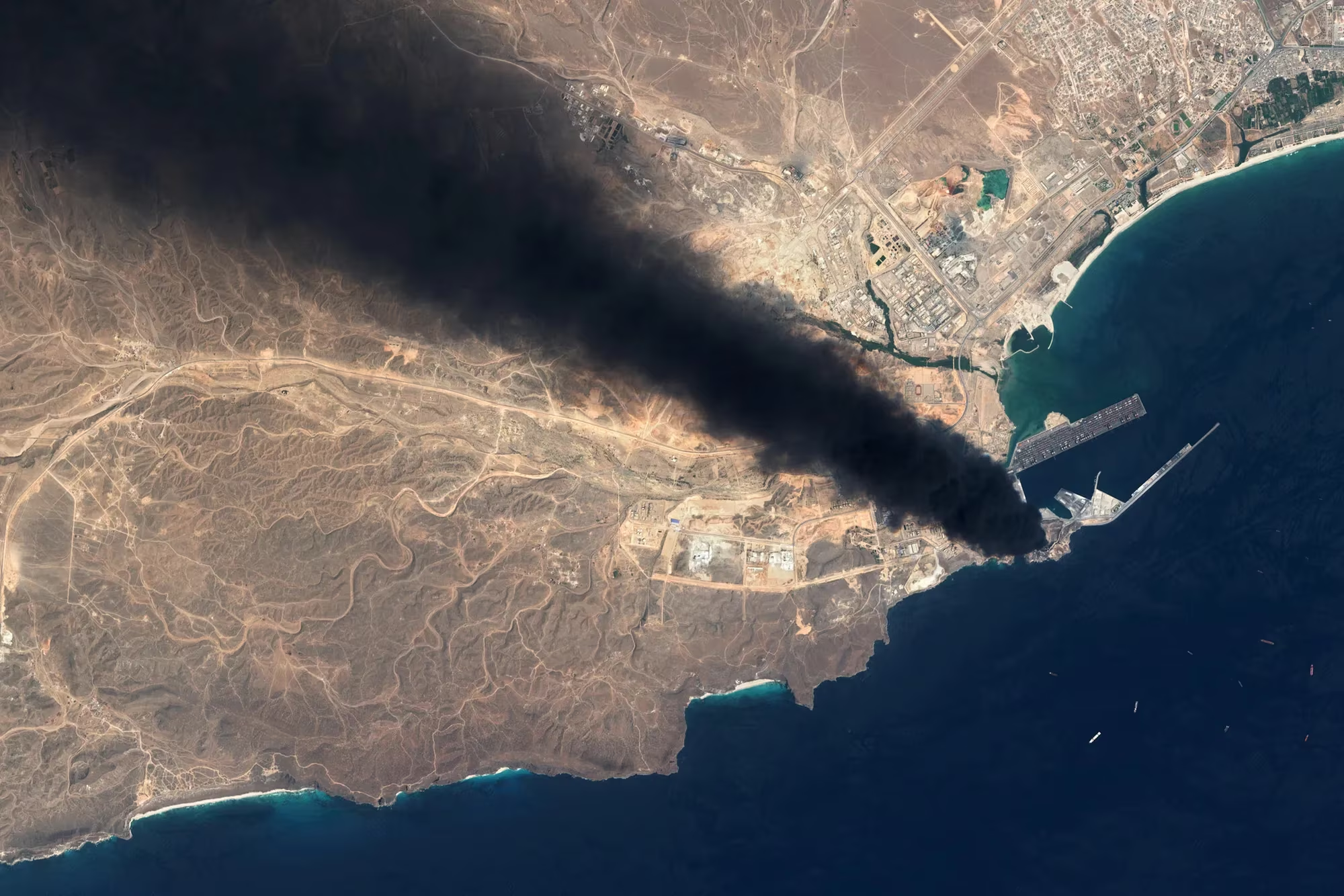
Smoke rises from a fire at an oil storage facility in Salalah, Oman, following an Iranian drone strike, in this satellite image. March 13, 2026.
U.S. officials have actively supported Exxon and Chevron in negotiations over exploration licenses in major oil-producing OPEC countries—Iraq, Libya, Algeria, Azerbaijan, and Kazakhstan—over the past year. As recently as last month, Chevron signed preliminary agreements with Iraq’s national oil company to potentially take control of the country’s second-largest oil complex, previously developed by Russian producer Lukoil, which has been hit by sanctions imposed by Trump.
Amid rising oil and liquefied natural gas prices, the energy sector has become the top performer in the S&P 500 Index since the start of the year. Shares of Exxon, Chevron, and Shell have reached record highs, gaining more than 25%, while the broader market has declined by about 4%.
Risks, however, remain substantial. According to analysts at TD Cowen, about 10% of the operating cash flow of Exxon and France’s TotalEnergies is tied to projects affected by curtailed production in the Middle East—primarily liquefied natural gas output in Qatar. The Ras Laffan complex in Qatar, in which Exxon is a partner, has suffered significant damage from Iranian missile strikes, and repairs could take up to five years, Qatar Energy said. Shell’s gas-to-liquids plant at the same complex has also been affected.
At the same time, the conflict has affected five of OPEC’s largest producers and disrupted the transport of roughly 20% of global oil and LNG output. Under these conditions, the stability and free trade required for multi-billion-dollar investments are becoming increasingly difficult to secure.
“The risk premium for production in this region will be higher,” said Arjun Murti, a partner at Veriten. “Even if the Strait of Hormuz reopens soon, this will favor the next phase of shale development, Canadian oil sands, and projects outside the Middle East.”
Trump’s tendency to push companies toward investments in complex jurisdictions—as seen in the case of Venezuela—also complicates long-term planning, as it limits the ability to rely solely on market signals, said Karen Young, a senior fellow at Columbia University’s Center on Global Energy Policy.
“This effectively complicates market logic and undermines the very principle of capitalist efficiency,” she said.
The war with Iran will be one of the central themes at CERAWeek, where executives from Shell, ConocoPhillips, Kuwait Petroleum Corp., and other companies are expected to speak. U.S. Energy Secretary Wright is scheduled to deliver one of the opening remarks on Monday, followed by Chevron CEO Mike Wirth.
The White House, which insists that the Strait of Hormuz will soon reopen, is for now rejecting claims of long-term damage to the U.S. energy sector.
“Ultimately, the energy industry will benefit from the president’s actions toward Iran, as Iran will no longer control the Strait of Hormuz and restrict the free flow of energy resources,” administration spokesperson Karoline Leavitt said earlier this month.
The longer Brent crude remains above $100 per barrel amid the effective blockade of the strait, the greater investors’ concerns will be over the reliability of Middle Eastern supplies.
“Disruptions of this scale and intensity have not been seen before,” said S&P Global’s Daniel Yergin. “The question is who ultimately pays—producers, consumers, or governments.”