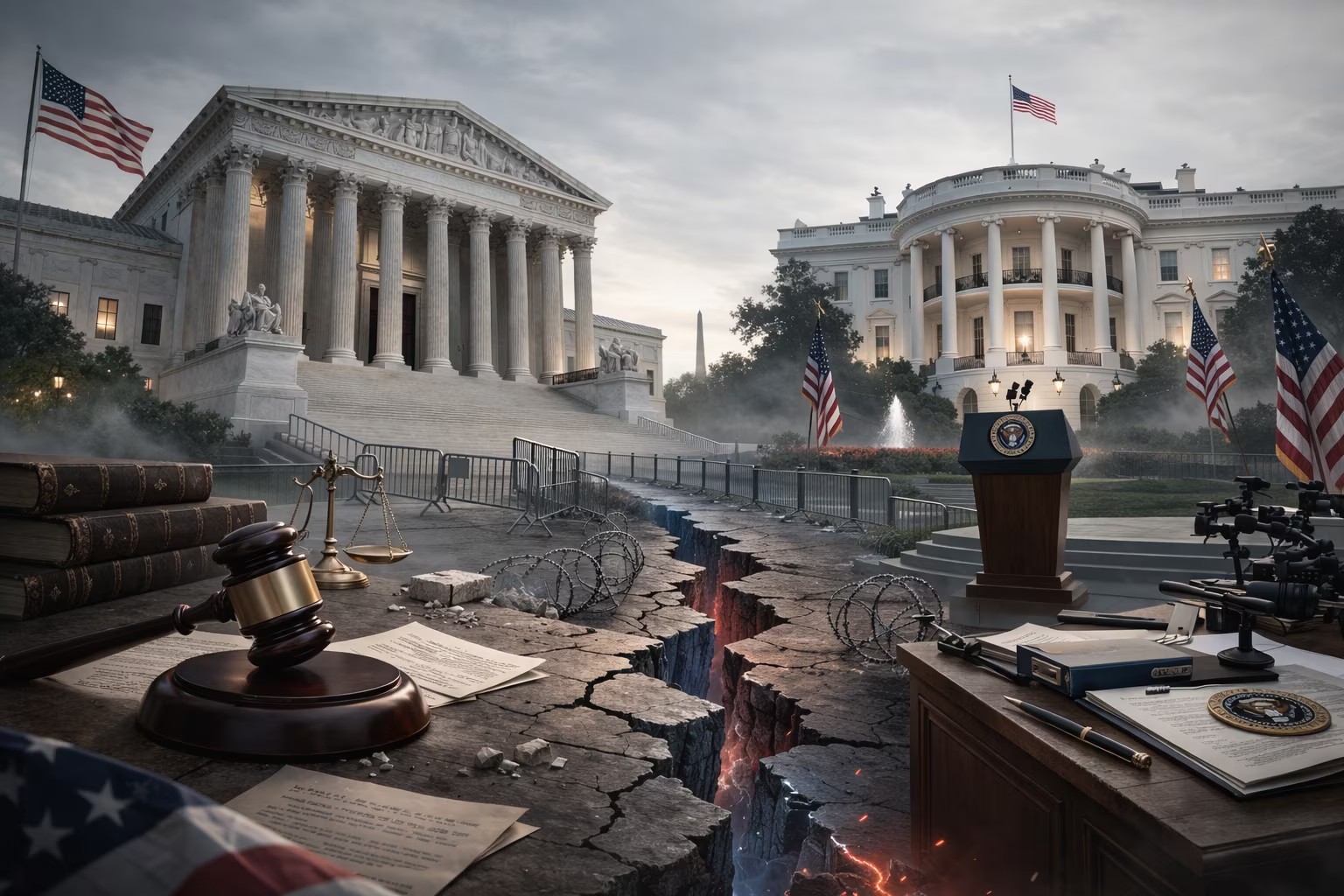
On Friday, February 20, Donald Trump moved swiftly to reinstate sweeping trade tariffs and sidestep a painful defeat at the Supreme Court. He ordered the introduction of a new 10% levy on all imports and announced additional trade measures, seeking to preserve a key instrument of economic pressure on other countries.
Speaking at a press conference in a defiant tone after the legal blow, Trump said he was not backing away from the global trade war that has become one of the defining features of his second presidential term. On the contrary, he suggested that the new tariffs could prove even more painful and longer-lasting than those the court had ruled unlawful.
“I can charge much more than I did before,” Trump said, pointing to the trade powers he still retains and insisting that, if he chooses, he remains capable of “destroying foreign countries” by other means.
According to Trump, he intends to restore the tariffs by relying on several provisions of the Trade Act of 1974. The first steps were taken late on Friday night, when he invoked Section 122 of the law to impose a 10% duty starting February 24. No previous president has ever made use of this provision.
Trump also said he would activate another mechanism—Section 301—which allows the government to launch investigations into unfair trade practices by other countries and would most likely lead to additional tariffs. It was unclear whether this process had actually been set in motion and which countries might become its targets.
Taken together, Trump presented these measures as an almost full-fledged replacement for the scrapped emergency duties, many of which he had imposed on an unprecedented scale during the high-profile and destabilizing tariff rollout last spring, branded “Liberation Day.”
Some experts agreed with that assessment. According to their estimates, if the president follows through and keeps the new tariffs in place, the average tax burden on imports could reach 15.4%. That is only slightly below the 16.9% level that applied before the court ruling, according to an analysis by the nonpartisan Yale Budget Lab. In practical terms, this means that for American consumers and companies—who bear most of the cost of import taxes—the economic reality may change very little.
The president’s actions only underscored how central tariffs have become to Trump’s second term. His strategy rested on the ability to raise or lower punitive duties at will in pursuit of economic and foreign-policy objectives. The scope went far beyond trade—from boosting federal revenues and combating illegal drug trafficking to intervening in overseas conflicts and protecting political allies abroad.
Under this ambitious and legally risky approach, Trump applied equal pressure to allies and rivals alike, including Canada, China, and the European Union. High tariffs against them were eased only after countries agreed to deals, opened their markets, and invested in the U.S. economy.
Now, however, his room for maneuver is constrained by law, and he has likely lost the freedom he once had to act swiftly and impose his agenda on a global scale. The defeat is particularly ill-timed—next week Trump is due to deliver his State of the Union address, before traveling to China for another round of difficult trade talks with Xi Jinping.
Even so, on Friday Trump repeatedly insisted that he had no intention of backing down and even sought to portray elements of the defeat as a victory. “While I am confident they did not intend this, the Supreme Court’s decision has made the president’s ability to regulate trade and impose tariffs more powerful and more clearly defined, not less,” he told reporters.
For a long time, Trump had boasted of his ability to impose duties instantly and without congressional approval, relying on an old statute that did not explicitly list tariffs among the powers it granted. That practice unnerved consumers, businesses, foreign governments, and global markets, and within the United States led to two court challenges in which the president consistently lost.
In the aftermath of the Supreme Court ruling, significant uncertainty remained, including the fate of billions of dollars in tariffs already collected and the future of dozens of trade agreements struck under the International Emergency Economic Powers Act. Many of those deals contain termination clauses, and some countries have yet to take formal steps to meet their commitments. The agreements also included substantial—if preliminary—pledges of foreign investment in the United States, which may now be at risk, undermining one of the central motivations behind the tariff pressure.
Trump himself acknowledged on Friday that previously struck deals could change. “Some of them will remain, many will remain, some will not—and they will be replaced by other tariffs,” he said.
At the same time, the judges did not strip the president of all tools in their ruling. He can still turn to a number of other, more narrowly defined authorities or seek congressional backing to entrench his tariff policy in law.
Nick Iacovella, executive vice president of the Coalition for a Prosperous America, which supports the president’s trade agenda, said the judges had merely “narrowed” Trump’s available options. “Going forward,” he noted, “tariffs will remain a central element of the administration’s agenda.”
The 10% duty imposed late Friday night is global in scope, but the White House provided for a number of exemptions. These include beef and other agricultural products, for which tariffs had previously been eased to contain price increases. Exemptions were also made for goods already subject to other duties and for imports covered by the existing trade agreement between the United States, Canada, and Mexico.
The measures may be limited to 150 days unless lawmakers approve an extension. Their practical application remains largely untested, as the mechanism has never been used or challenged in court. Still, it allows the president to impose duties to address issues such as a growing trade deficit.
The law permits tariffs of up to 15%. Patrick Childress, a partner at the law firm Holland & Knight, said this meant the White House had “left itself room to raise tariffs if it needs to increase pressure on a specific trading partner.”
Investigations into unfair trade practices that the administration has pledged to launch could also take time, delaying the return of steep import taxes. This route is more established from a legal standpoint, and Trump relied heavily on Section 301 during his first term, particularly against China.
But the initiation of these procedures comes at a politically sensitive moment—the United States is heading into midterm elections in November. In many polls, a majority of voters express concern about the state of the economy and rising prices, forcing the president to balance those anxieties against his push to raise tariffs again, potentially to even higher levels.
“It is important for them to make sure they are not taking steps with serious unintended consequences right before the midterms,” said Penelope Naas, senior vice president at the German Marshall Fund of the United States.
At the same time, the Supreme Court’s decision did not affect a number of other tariffs Trump imposed during his second term under the banner of national security. This means that high duties on a broad range of imports—including foreign automobiles, steel, copper, and other goods—will remain in place, while additional investigations that could lead to new tariffs are still under way.
“There is an entire toolbox of other statutes the president can use to achieve the same objective,” said Ted Murphy, a leading trade lawyer at Sidley Austin.
As he put it, the core of the court’s ruling is not whether the president can impose tariffs at all, but whether he is entitled to do so “without any constraints and entirely at his own discretion.”