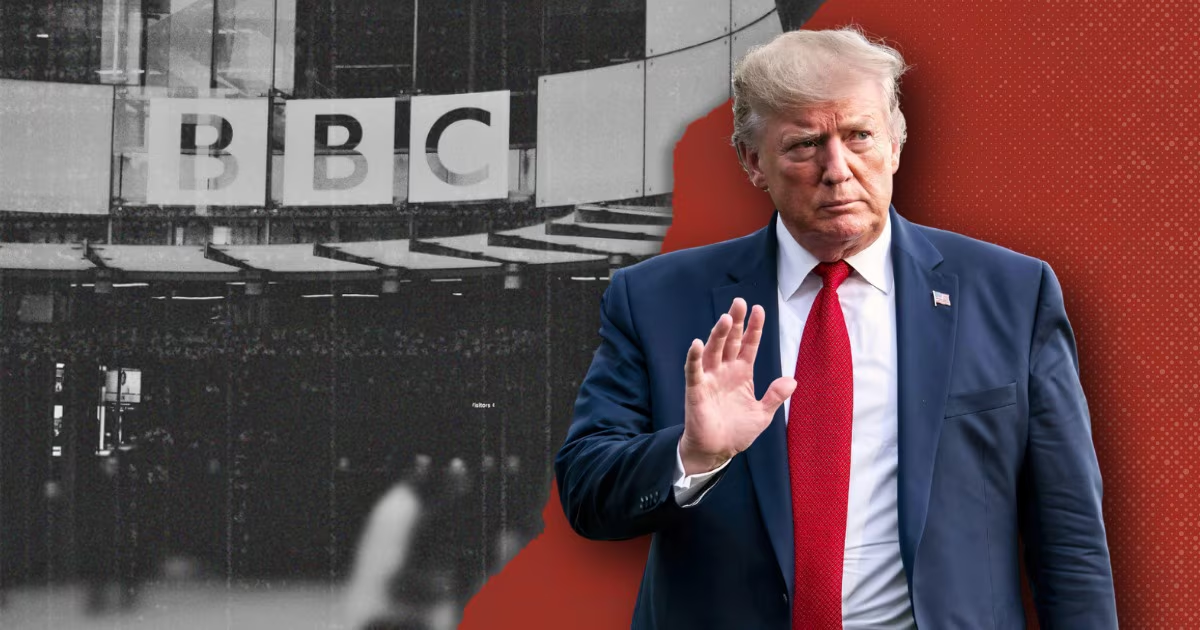
On Monday, December 16, President Donald Trump filed a lawsuit against the British Broadcasting Corporation, seeking more than $5 billion from one of the world’s oldest media institutions. He claims the broadcaster deliberately edited his January 6, 2021 speech to create a false impression—that he had urged supporters to engage in violence at the moment the assault on the US Capitol was beginning.
The lawsuit was filed in federal court in Miami. It alleges that the BBC “maliciously” spliced together two segments of Trump’s speech delivered more than 54 minutes apart, presenting them as a single continuous statement. According to the plaintiffs, the edit was intended to lead viewers to believe that Trump was inciting aggressive action as Congress moved forward with the certification of Electoral College votes.
“It would have been impossible for BBC journalists and producers to stitch together two separate portions of the speech, nearly 55 minutes apart, without acting intentionally,” the complaint states. — “Such a blatant distortion could not have occurred by accident.”
Last month, the BBC apologized to Trump over the editing, but said the incident did not amount to grounds for a defamation lawsuit. On Monday, a spokesperson for the broadcaster did not respond to a request for comment. According to a Trump spokesperson, the suit seeks more than $10 billion in damages—at least $5 billion for defamation and an additional $5 billion or more for alleged violations of Florida’s Deceptive and Unfair Trade Practices Act. In the formal court filings submitted by Trump’s lawyers, however, the total amount sought is listed as $5 billion.
The new lawsuit marks yet another attempt by Trump to extract large financial settlements from media organizations he routinely attacks. A recent suit against CNN, in which Trump sought damages over the network’s use of the term “the Big Lie” to describe his unfounded claims of fraud in the 2020 election, was dismissed by a federal appeals court. At the same time, Trump has already reached multimillion-dollar settlements with ABC and CBS over claims of inaccurate reporting or misleading editing. His lawsuits against The New York Times and The Wall Street Journal remain pending.
In parallel, Trump remains a defendant in a Washington case stemming from his January 6 speech. Lawmakers and police officers injured that day argue that his remarks incited violence at the Capitol and endangered the peaceful transfer of presidential power. The judge overseeing the case has noted that, despite Trump’s call to proceed “peacefully” to the Capitol, many rally participants had already left the site by the time those words were spoken, and the speech itself was steeped in incendiary rhetoric. In the court’s view, the belated invocation of “peaceful” conduct may have been insufficient to defuse the crowd.
Lawyers expect the BBC to challenge the federal court’s jurisdiction, arguing that the documentary was not broadcast in the United States and that its digital version was unavailable to American audiences. In response, Trump notes in the lawsuit that at least two websites published instructions on how to watch the film in the US via a virtual private network—VPN—although one of those posts appeared only in recent months. Trump’s attorneys also stress that a substantial portion of the BBC’s reporting was carried out in Florida, including on and around the Mar-a-Lago estate in Palm Beach. The complaint further notes that the BBC maintains an office in Coral Gables, south of Miami.