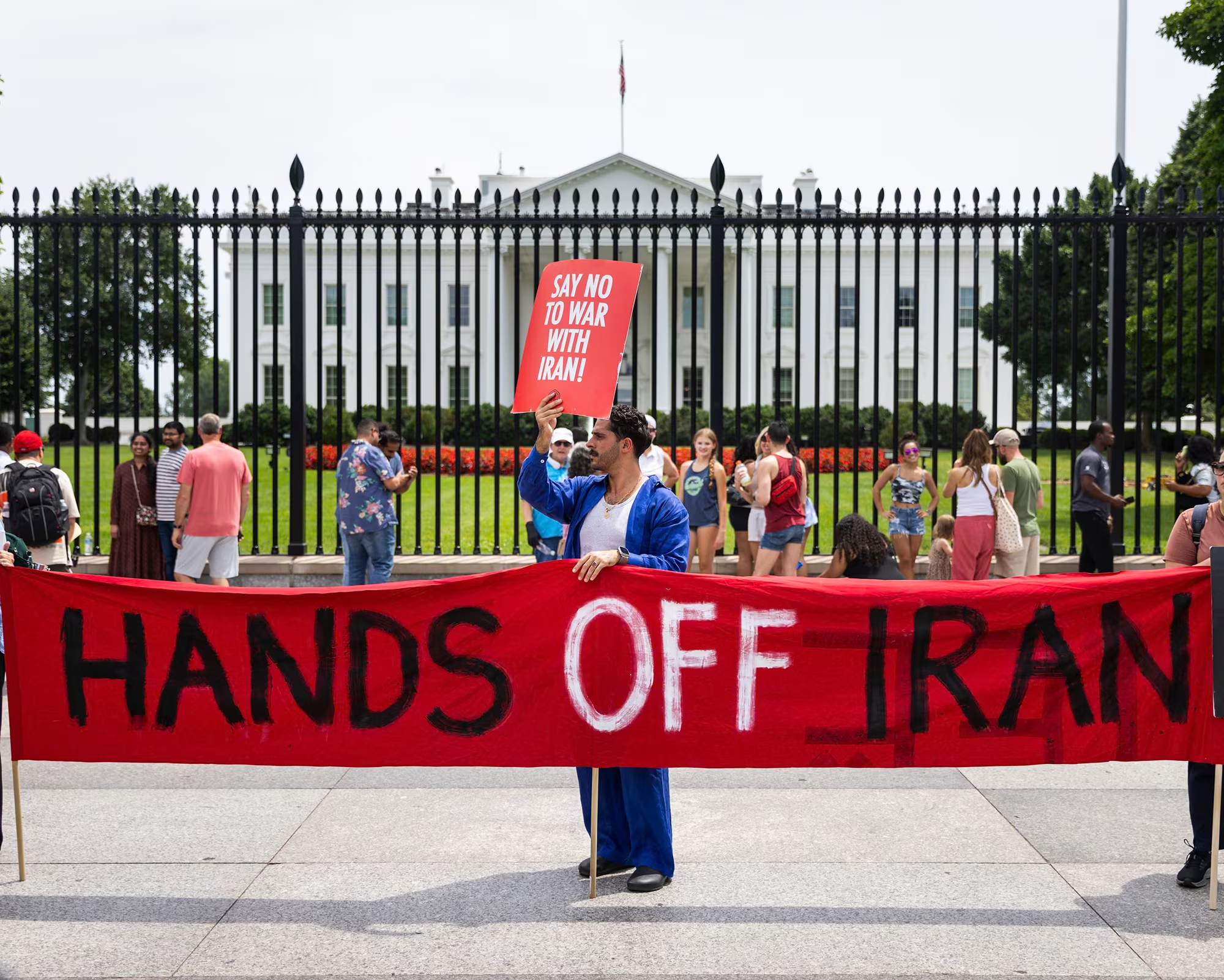
Donald Trump’s decision to strike Iran has already created significant political pressure for him—and as the conflict drags on, that pressure is likely to intensify.
Domestically, the greatest threat to the president comes from the economic fallout of tensions in the Middle East. Gasoline prices in the United States have surged—largely due to the effective blockade of the strategically vital Strait of Hormuz off Iran’s southern coast. Under normal conditions, about 20 percent of the world’s oil trade passes through this narrow maritime corridor.
According to the website GasBuddy, the national average price of gasoline rose from about $2.90 per gallon in the week before the first U.S. and Israeli strikes on Iran to roughly $3.61 on Thursday, March 12.
The rise in fuel prices reflects the extreme volatility of the oil market. Oil prices have often swung following Trump’s public remarks—falling when he signaled he might try to end the conflict and rising when the prospect of an end to hostilities appeared more distant.
As of 4:00 p.m. Eastern Time on Thursday, Brent crude had again climbed above $100—an increase of more than 9 percent in a single day. Over the past five days, prices have fluctuated within a range of roughly $84 to $116.
In a morning social media post on Thursday, Trump sought to cast the trend in a favorable light. He wrote: “The United States is the largest producer of oil in the world, by far, so when oil prices go up, we make a lot of money.”
It is difficult, however, to imagine that this argument will resonate with an American audience already concerned about the state of the economy, rising prices, and unconvinced of the need for war with Iran.
“The way the administration has handled the political and diplomatic dimensions of this war falls far short of what is required,” said former congressman Charlie Dent, a moderate Republican from Pennsylvania and a longtime critic of Trump.
According to Dent, the U.S. military has been operating effectively—“as expected”—but the president has yet to offer a convincing public explanation of why the use of force was necessary in the first place.
“He has not explained his position, and that is reflected in the fact that this war clearly lacks the support of a majority of the public. So every Republican running for office understands that this will become a politically vulnerable issue for them in November.”
A poll by Economist/YouGov, published earlier this week, found no sign of the so-called “rally around the flag” effect that typically emerges at the start of military conflicts. Instead, 39 percent of adults surveyed approve of Trump’s handling of Iran, while 52 percent do not.
These findings broadly align with other polls. Politically, the situation is especially risky against the backdrop of existing dissatisfaction with Trump’s handling of the economy—above all because of rising prices.
In the same Economist poll, his handling of inflation carried a nearly 30-point negative balance: only 33 percent of respondents approve of his policy, while 62 percent do not. Notably, one in four of those who said they voted for Trump in the 2024 election also expressed dissatisfaction with his performance in this area.
Of course, a swift and favorable end to the war could quickly alter the political dynamics.
If, for example, the power structure of the Islamic Republic were to collapse, Trump would no doubt declare it a historic victory—and some voters might forget their doubts about an operation the president himself described as a “limited sortie.”
Such a scenario cannot be ruled out. Few doubt that the combined military power of the United States and Israel far exceeds Iran’s capabilities. Tehran is being bombed daily, and rigid political regimes sometimes conceal signs of their own disintegration until the moment they are on the brink of collapse.
Supporters of the war, by contrast, praise Trump as a commander in chief willing to act where others might have shown excessive caution.
Senator Lindsey Graham, one of the most vocal advocates of military action, wrote on social media earlier this week that the United States is “destroying Iran’s nuclear and ballistic missile capabilities and weakening the regime’s ability to threaten the world with terror.”
According to Graham, none of this would have been possible without Trump.
A significant and sustained decline in oil and gasoline prices appears unlikely as long as the threat of Iranian drone and missile strikes against energy-producing countries in the Persian Gulf persists and the Strait of Hormuz remains closed.
The longer energy prices remain elevated, the greater the risk of inflationary pressure spreading across the economy. Fertilizers and the operation of agricultural machinery, for example, will become more expensive—almost inevitably pushing up food prices in grocery stores.
Trump himself is known to be highly sensitive to the political consequences of fluctuations in financial markets.
On Thursday, the main U.S. stock indexes once again closed lower: the Dow Jones Industrial Average and the broad S&P 500 each fell by about 1.5 percent, while the technology-heavy Nasdaq Composite dropped nearly 1.8 percent.
Since the start of the year, the three indexes have lost roughly 3.5, 2.7, and 4 percent respectively.
All of this is unfolding under the shadow of the upcoming midterm elections for Congress—now less than eight months away.
Republicans do not hide that they would prefer to build their campaign around the tax cuts enshrined in last year’s One Big Beautiful Bill Act, as well as around confronting what Republican strategist Dan Judy described as “putting the brakes on the cultural ‘woke agenda.’”
Judy believes that media discussion suggesting the war with Iran could fracture Trump’s electoral base is, for now, “premature.”
Nevertheless, speaking about domestic politics, he acknowledges the particular sensitivity of gasoline prices.
According to him, if the war drags on, fuel costs will almost inevitably rise sharply—and even if the conflict ends quickly, prices could remain elevated for some time.
“This is certainly not the kind of issue Republicans would want to be dealing with,” he said.