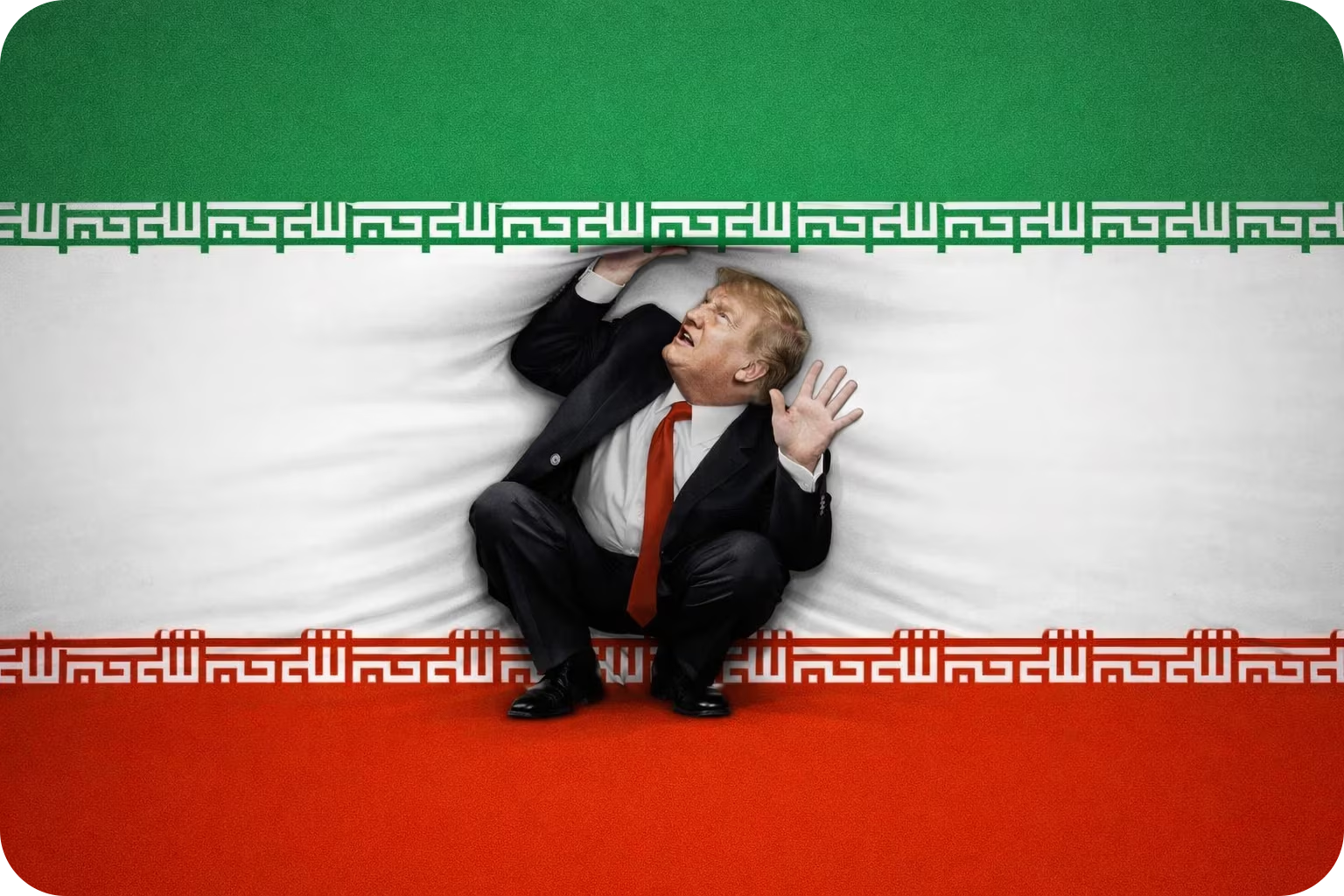
For five years in office, Donald Trump has governed in his characteristic manner—relying on instinct, impulse and improvisation.
The war with Iran, now entering its third week, has become the first crisis in which that style has deprived him of the ability to simply talk his way out or maneuver toward an exit. There is a risk that Trump could find himself trapped between his own unpredictability and the hard logic of war. The president expects a swift and unmistakable victory. Yet unlike tariffs—which can be imposed quickly and just as easily lifted—the outcome of a military conflict cannot be controlled unilaterally and rarely allows for simple solutions. Iran, too, has a say.
Trump is attempting to help unblock the flow of oil from the Persian Gulf. But such efforts could draw him into what analysts describe as an “escalation trap,” in which the stronger side feels compelled to keep striking to demonstrate dominance—even whenесмотря на снижающуюся отдачу.
A senior Trump administration official effectively acknowledged this logic: “The Iranians are f*cking around with the Strait of Hormuz—and that only makes him dig in even more.”
Meanwhile, the positions of the parties are diverging. Israel is seeking regime change in Iran and more extensive military destruction, while also weighing the possibility of an invasion of Lebanon. Benjamin Netanyahu has repeatedly shown that on matters related to Iran, he is capable of persuading Trump to support his line.
For Iran, survival remains the overriding priority—along with demonstrating an ability to inflict damage, both military and economic, in order to deter future attacks. Other states, for their part, are primarily interested in preserving the free flow of oil and commerce through the waters and airspace of the Middle East.
If one averages the timelines mentioned by Trump and his aides, it suggests the administration expected an intensive military operation lasting roughly four to six weeks. That makes April 1—the 33rd day of the war—an important moment to test those expectations.
In Washington and other world capitals, however, officials are preparing for a much longer crisis. As journalist Barak Ravid reported, citing three different sources in the administration and allied countries, instability in the Middle East and U.S. involvement could continue until September—even if the conflict eventually shifts into a lower-intensity phase.
Israel told journalists it plans at least three more weeks of strikes against thousands of additional targets across Iran.
In a phone conversation with Ed Luce of the Financial Times on Sunday, the president said: “We have basically destroyed Iran… They have no navy, no air defenses, no air force—it’s all gone. The only thing they can do is cause a little trouble, like putting a mine in the water. It’s a minor nuisance, but even that can create problems.”
White House Principal Deputy Press Secretary Anna Kelly stressed that Operation Epic Fury was the result of “many months of careful planning.” According to her, the president was presented with “a wide range of options,” and he made the final decision after hearing the views of all key officials.
Trump could, in theory, walk away from the war tomorrow. But Iran retains the ability to keep the Strait of Hormuz blocked and trigger such a surge in oil prices that the United States would be forced to intervene again.
Iranian officials have signaled both publicly and in private contacts that even if Trump decides to end the war, they may continue missile and artillery strikes until they receive guarantees that this would mean the end of the conflict rather than a temporary ceasefire.
Behind the scenes, unease is growing within the administration. Trump is accustomed to acting on instinct and improvising if circumstances turn unfavorable. Now, however, some in his orbit are experiencing what one official described as “buyer’s remorse”—a rising concern that striking Iran may have been a mistake.
A source close to the administration said several key officials around the president had urged caution or asked for more time. “In the end he said, ‘I just want to do this,’” the source recounted. In his view, Trump “greatly overestimated his ability to topple the regime without deploying ground troops.”
The same source noted that the president “became intoxicated with his own success” after rapid strikes on Iran last summer and the January abduction of Venezuelan President Nicolás Maduro. “He saw several swift and decisive victories that demonstrated exceptional military effectiveness.”
So far, the war launched at Trump’s initiative does indeed appear to be a military success. The number of Iranian missile and drone launches has dropped sharply—suggesting either that its arsenal is being depleted or that its ability to use it has been significantly degraded.
U.S. and Israeli aircraft now fully control the airspace and can carry out strikes with virtually no constraints. A significant portion of Iran’s navy has been destroyed. The ayatollah and several senior leaders have been killed. American military casualties—at least 13 service members—could have been far higher given the scale of the operations.
Trump may now face the need to decide on a serious military escalation—a step that would represent an entirely new experience for him as president.
Some of his supporters had hoped he would quickly produce tangible results and declare victory. It is now unclear how that could be done convincingly.
As Barak Ravid previously reported, the United States lacks sufficiently reliable channels of communication with the Iranian regime to negotiate an agreement that would be guaranteed to hold. On Friday evening Trump wrote on Truth Social that Iran is “totally defeated and wants a deal—but not the kind of deal I would accept!”
For the Iranian regime to declare victory, only one thing is required—to continue existing.