
The confrontation in Minnesota has evolved into a serious political challenge for US President Donald Trump and his administration. The state is undergoing a large-scale operation to identify and deport immigrants without legal status, accompanied by street protests and frequent clashes between local residents and federal authorities—Immigration and Customs Enforcement (ICE) and the Border Patrol.
In January, these confrontations resulted in the deaths of two US citizens—Rene Good and Alex Pretti. In both cases, federal authorities claimed that those killed were left-wing radicals and even “terrorists” who had obstructed the lawful actions of ICE and the Border Patrol and posed a threat to agents. Video footage of the incidents, however, calls these accounts into question and contradicts official statements.
Minnesota Governor Tim Walz—a Democrat and Kamala Harris’s running mate in the 2024 presidential election—described the actions of federal agencies as an encroachment on state sovereignty and a de facto occupation. He likened ICE to the Gestapo. Walz and Minneapolis Mayor Jacob Frey ordered local law enforcement not to assist the ICE and Border Patrol operation.
At the same time, state authorities filed a lawsuit seeking to halt the operation and withdraw federal agents from Minnesota.
In response, the US Department of Justice initiated an investigation into Walz, Frey, and several other state officials, suspecting them of conspiring to obstruct the work of federal agencies.
Nevertheless, on January 25, signs emerged of a possible softening of the White House’s position. In an interview with The Wall Street Journal, Trump said he was not prepared to assess the actions of the agent who shot Alex Pretti. This stood in clear contrast to his response after the death of Rene Good, when he immediately and without qualification sided with the ICE officer.
In the same conversation, the president indicated that ICE and the Border Patrol would eventually be withdrawn from Minneapolis, without specifying a timeline.
On January 26, Trump said on the Truth social network that he had held a phone call with Walz and Frey—the tone of the post was clearly conciliatory. The same day, it became known that Gregory Bovino, the commander of the Border Patrol, had been recalled from Minnesota. In his place, the president dispatched Tom Homan, his so-called “border czar,” to the state. As notes The Wall Street Journal, Bovino is associated with an extremely hard-line approach to deportations, while Homan has a reputation as a more moderate manager. It is assumed that he will be tasked with establishing dialogue with local authorities and preparing the conditions for the withdrawal of most federal agents from the state.
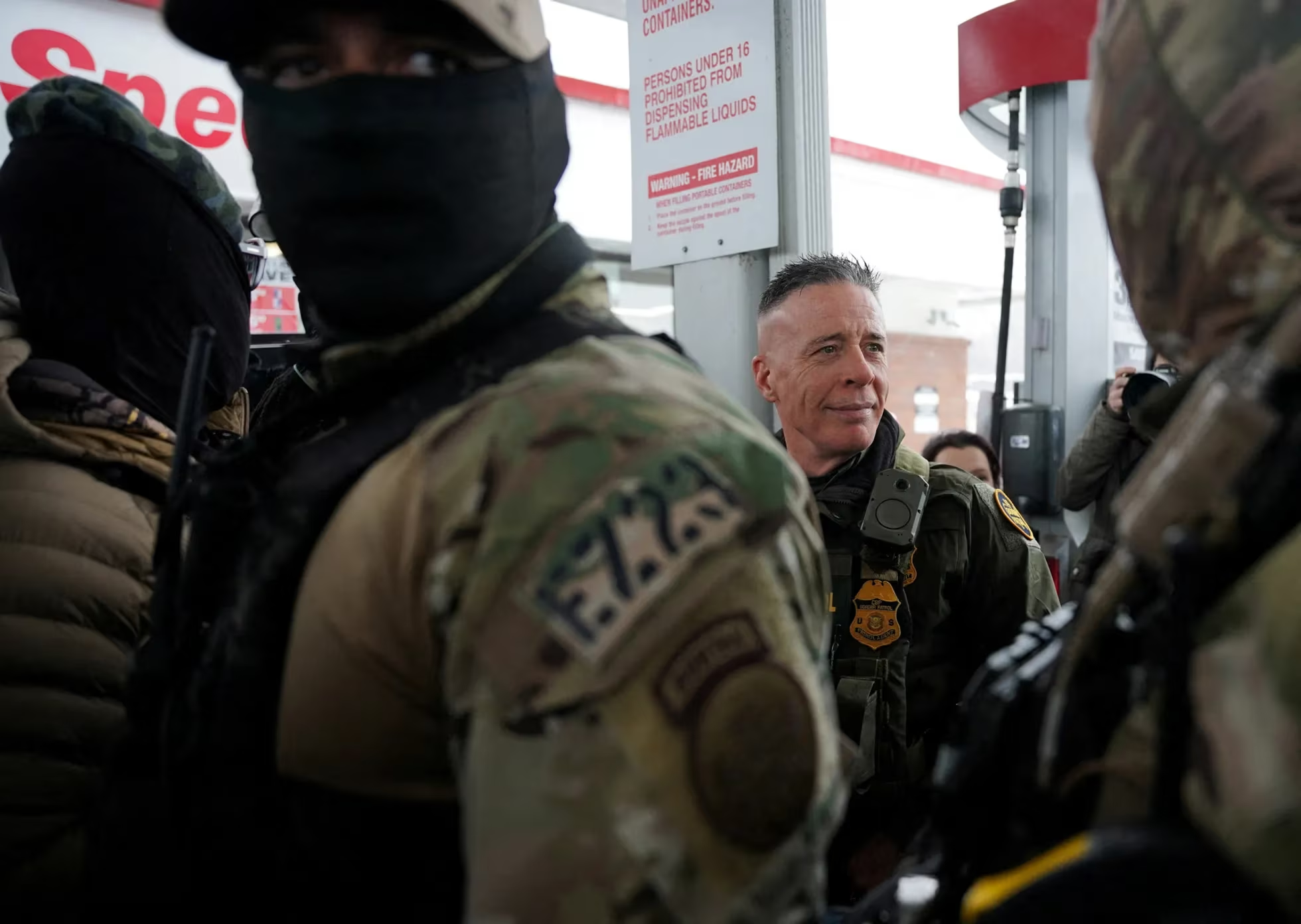
Gregory Bovino.
According to sources at the White House cited by The Wall Street Journal, internal discussions within the administration over the events in Minnesota had already been intense, but after the death of Alex Pretti they moved into an even harsher phase. This is the second fatal incident in the span of a month.
A growing number of officials and lawmakers—and not only those representing Minnesota—have been telling Trump and his circle in private meetings and phone calls that the ultra-hard-line course of mass deportations is rapidly losing public support. Among those who directly urged the president to adjust his approach was Senator Lindsey Graham, a close ally, who discussed the issue with Trump by phone.
On January 26, Chris Meidel, who had been considered the leading contender for the Republican nomination for governor of Minnesota, announced that he was ending his campaign. He said that under the current circumstances a Republican had virtually no chance of winning. At the same time, Meidel stressed that he continued to support Trump’s policies, while placing responsibility for the situation in Minnesota spiraling out of control on “federal Republicans.”
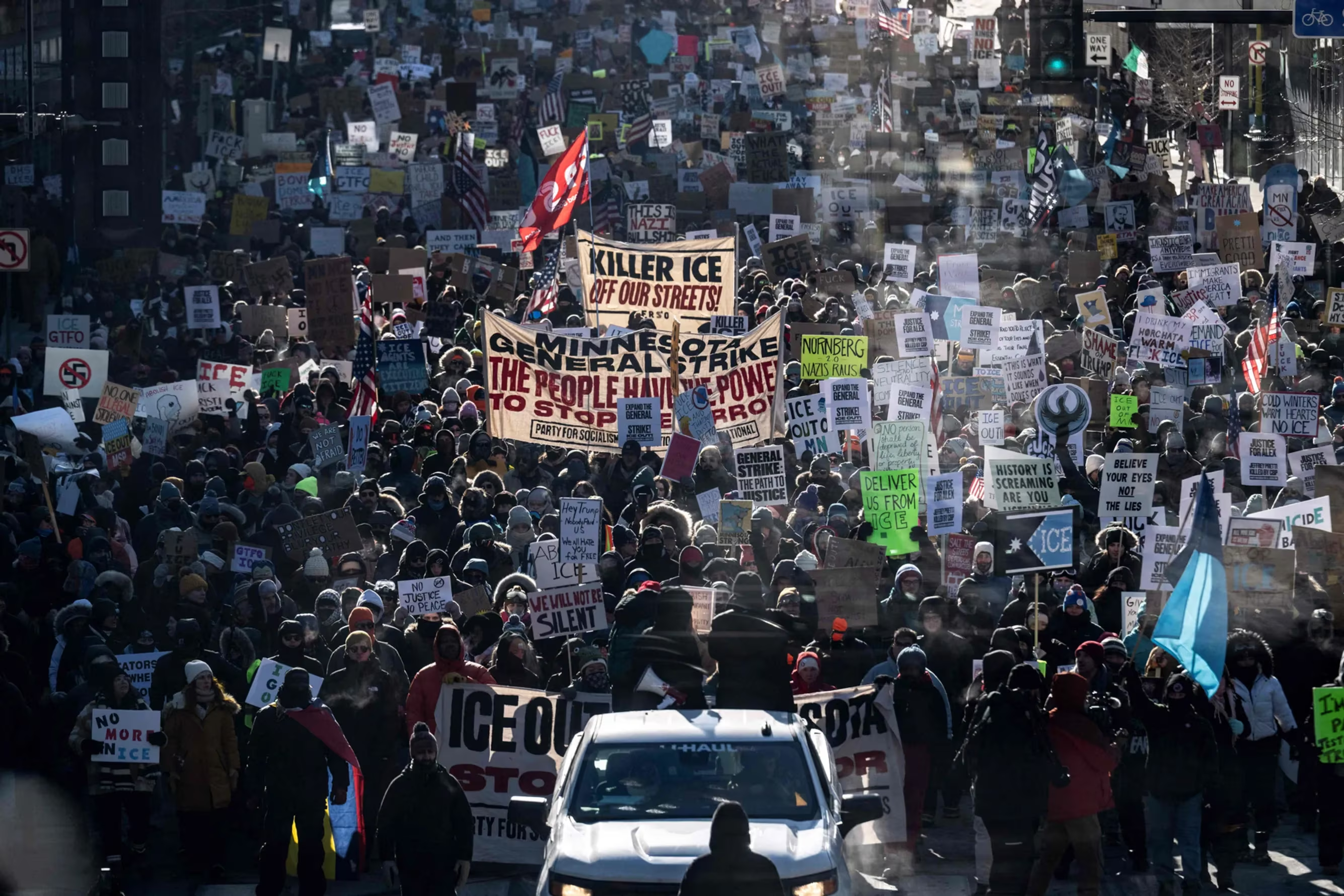
A protest against ICE in Minneapolis on January 25, 2026, the day after the killing of Alex Pretti.
According to a new poll by Reuters/Ipsos, public support for Donald Trump’s immigration policy continues to decline. Thirty-nine percent of respondents approve of his actions in this area, while 53% view them negatively. By comparison, immediately after Trump’s inauguration in January 2025 the balance was reversed: 50% supported his approach, and 41% disapproved.
The poll also showed that most Americans consider the actions of Immigration and Customs Enforcement to be excessive. According to 58% of respondents, ICE agents have “gone too far.” Only 12% believe the measures are, on the contrary, not tough enough, while 26% consider them “about right.” The partisan divide is particularly stark: around 90% of Democratic Party supporters are convinced that immigration agencies are acting with excessive force, whereas only about 20% of Republicans agree. Among independent voters, roughly 60% share this assessment.
Against this backdrop, the president’s overall approval rating is also declining. According to the same Reuters/Ipsos poll, Trump’s overall support has fallen to 38%—the lowest level of his current presidential term.