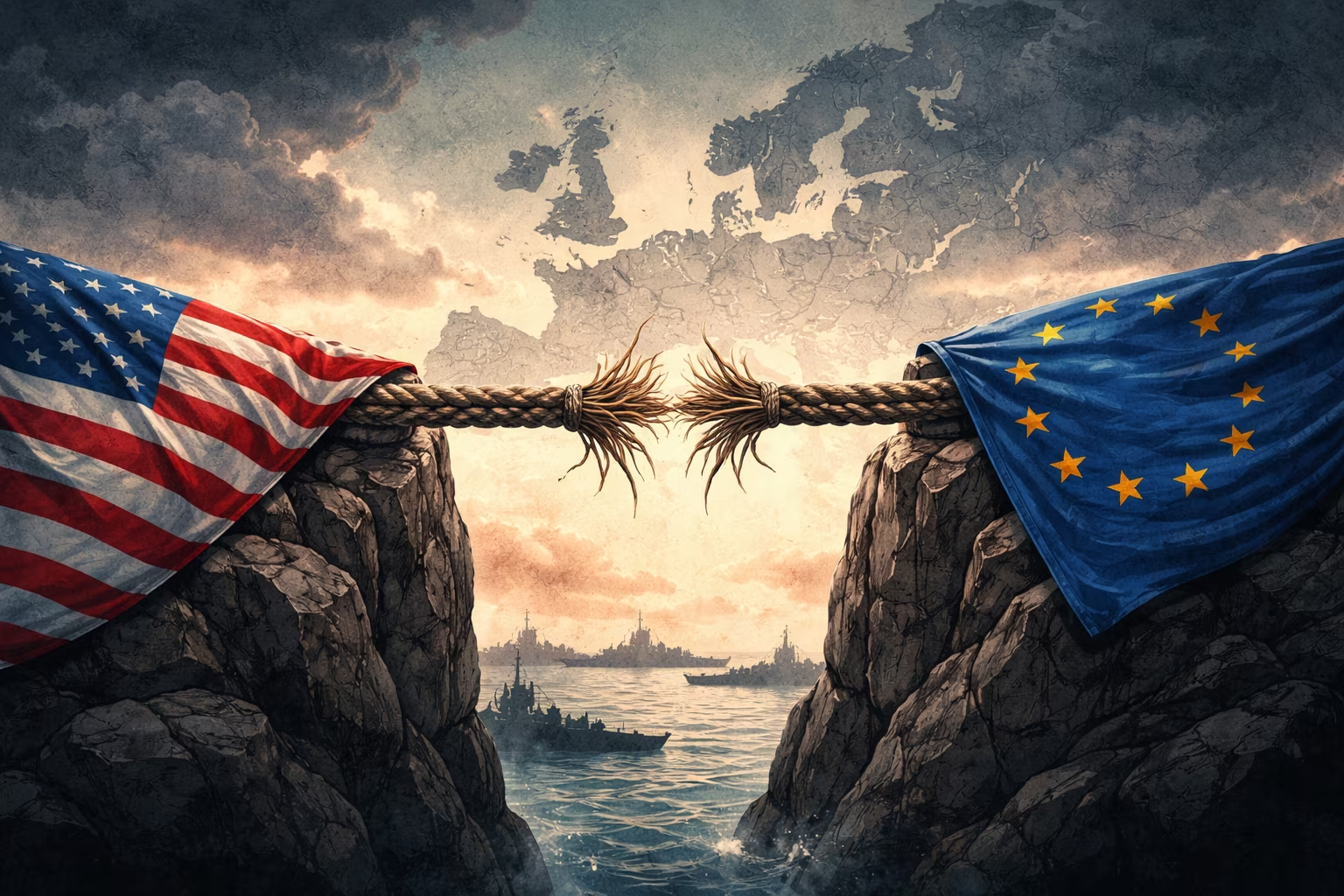
Donald Trump’s first year after returning to the White House has definitively shattered the remaining illusions among European leaders that he can be constrained or managed. His overtly hostile posture toward the European Union has sharpened tensions within the transatlantic alliance that has existed since the Second World War and deepened fractures both among Europe’s national leaders and within the bloc itself. The result has been a weakening of the EU’s capacity to respond to Trump’s threats and provocations with the unity and firmness he has traditionally respected.
Against this backdrop, Ukraine’s fate has been left hanging on the eve of 2026, along with the fundamental questions of European security. In many capitals, there is growing concern that Vladimir Putin’s territorial ambitions may not stop at Ukraine and could extend further west. And yet, paradoxically, Europe as a whole has so far withstood this political roller coaster—at least for now.
“Europeans cannot afford to sever ties and file for divorce, because they remain too dependent, especially when it comes to security and America’s military commitments to defend Europe,” notes Jana Puglierin, a senior policy fellow at the European Council on Foreign Relations. At the same time, she stresses, European leaders’ efforts to preserve working relations with the United States based on short-term interests do not negate the obvious conclusion of the past year: over the long term, the interests of the two sides no longer align. “We need to look at reality soberly,” Puglierin says. “There used to be a clear mainstream understanding of transatlantic relations, rooted in Western values, norms, and principles, and in a rules-based international order. Now, it seems to me, we are witnessing the emergence of a competing project.”
The Trump administration, too, is entering the new year without illusions. Inside the White House, the prevailing view is that Europe is losing its own identity and values, becoming captive to liberal ideals that, in their assessment, inflict greater damage on European security than any signals coming from Washington. From the White House’s perspective, true friendship means the need to “bring Europe to its senses” by insisting on higher defense spending, tighter migration controls, and an end to the war in Ukraine.
“President Trump has excellent relationships with many European leaders, but he never shies away from speaking uncomfortable truths,” said White House spokesperson Anna Kelly. In her words, “the destructive consequences of uncontrolled migration and migrants’ failure to integrate are a problem not only for President Trump but for Europeans themselves, who increasingly cite immigration as one of their primary concerns. Open-border policies have led to numerous incidents of violence, rising crime, and other effects that undermine the financial sustainability of social-support systems.”
After a turbulent start to the year—when Vice President J.D. Vance lectured Europe on free speech in Munich and then, together with Trump, engaged in a tense exchange with Ukrainian President Volodymyr Zelensky in the Oval Office—Europeans began to adjust to Trump’s worldview. This shift, as Bucharest mayor Nicușor Dan put it, marks a move “from a moral way of conducting affairs to a highly pragmatic and economic one.” That adaptation has allowed Europe, on several fronts, to reengage the White House in joint efforts.
Concessions by the European Union in trade negotiations, including acceptance of a new 15 percent tariff, helped contain short-term economic damage. NATO, for its part, managed to placate Trump with a pledge to raise defense spending to 5 percent over the next decade—a decision formalized at the alliance’s June summit and made largely possible by allowing existing non-military expenditures totaling 1.5 percent to count toward the new commitments.
Nor was support for Ukraine abandoned. In July, Trump agreed to provide Kyiv with additional defensive assistance in its war with Russia, on the condition that Europe foot the bill. European capitals also weathered Trump’s August meeting with Vladimir Putin in Alaska, as well as the administration’s announcement of a 28-point peace plan secretly developed in coordination with the Kremlin—a document that was later revised with the participation of the United States, Ukraine, and European partners.
In an early-month interview with Politico, Trump sharply criticized European leaders, calling them “weak” and saying they “do not know what to do,” particularly on migration. He questioned the wisdom of maintaining alliance ties with Europe, stressing that “everything depends” on policy choices, and made clear that he would not hesitate, if he deemed it necessary, to intervene in European elections to back far-right forces challenging the very coalitions and leaders with whom he is currently working.
These remarks coincided with the release of a new U.S. National Security Strategy. The document calls for “cultivating resistance” to European centrism, which its authors argue leads to “civilizational suicide,” and expresses open contempt for the European Union, described by the administration as “hostile” to the economic interests of the United States.
Constanze Stelzenmüller, a senior fellow at the Center on the United States and Europe at the Brookings Institution, described the Europe sections of the new National Security Strategy as a “turning point” for leaders on both sides of the Atlantic, stressing that they have “permanently changed” the long-term approach to relations with the United States. The scale of the shock for European politicians and societies, she said, is difficult to overstate: they were confronted, in an official document, with the reality that this administration views Europe—or Europe’s political centrists—as unreliable allies and adopts an openly confrontational stance toward them. “By 2026, we need to buckle up and prepare for the worst on all fronts. We have clear vulnerabilities, and they will be exploited,” she noted.
As the year drew to a close, Trump once again reminded Europe of his overt desire to assert control over Greenland, which is part of Denmark—a reliable NATO ally whose per capita defense spending ranks among the highest in the alliance. He raised these plans during his first term and repeated them shortly before his second inauguration. On Saturday, Trump appointed Louisiana Governor Jeff Landry as special envoy to Greenland—Landry said his mission would focus on efforts to “make Greenland part of the United States.”
“For many countries, this is deeply destabilizing—for those who believed there was nothing more reliable than their bilateral relationship with the United States,” Stelzenmüller said.
Alongside its overt threats toward Denmark, the administration took steps to fracture the European Union, hinting that individual states could secure more favorable trade deals if they distanced themselves from the bloc of 27 and negotiated directly with the White House.
“By the end of the year, Europeans are confronted with a fundamental question—do they believe that tactical victories are enough to win the strategic war, the aim of which is to preserve a transatlantic alliance that has endured for eight decades,” said Ivo Daalder, the former U.S. ambassador to NATO during Barack Obama’s presidency.
Europe Is Expected to Show Strength and Act
Why It Should Respond to External Criticism With Decisions, Not Resentment
Trump’s Strategy Reshapes Washington’s View of Europe’s Place
The New U.S. Course Undermines the Old Partnership Model and Increases Political Pressure on the EU
German Chancellor Friedrich Merz, who earlier this month declared “Pax Americana” a thing of the past, has shown a willingness to contemplate such a prospect. Last week, he said it had become “abundantly clear” that Trump is “incapable of building relationships” with the European Union as a unified entity and that “at the very least, individual member states remain—above all, of course, Germany—with which such cooperation can continue.”
Merz led an unsuccessful effort in Brussels to channel $200 billion in frozen Russian assets into a loan for Ukraine—an initiative blocked by Belgium, Italy, and several other countries. In the end, however, he secured a compromise: the European Union approved a $90 billion loan intended to sustain support for the Ukrainian military for two more years of fighting. Three leaders seen as loyal to Trump—those of Hungary, Slovakia, and the Czech Republic—refused to participate in the program but did not stand in the way of its adoption.
Despite Trump’s tacit opposition to Europe’s push to expand financial support for Ukraine, most European capitals broadly backed his diplomatic efforts to end the war, while simultaneously pressing for tougher security guarantees deemed essential for the country’s long-term survival. On Sunday, Finnish President Alexander Stubb appeared on Fox News, saying that Trump’s efforts had brought negotiations “closer to a peace agreement than at any point during this war.” The remark appeared aimed above all at an audience of one and reflected only in the broadest terms what many European leaders actually believe.