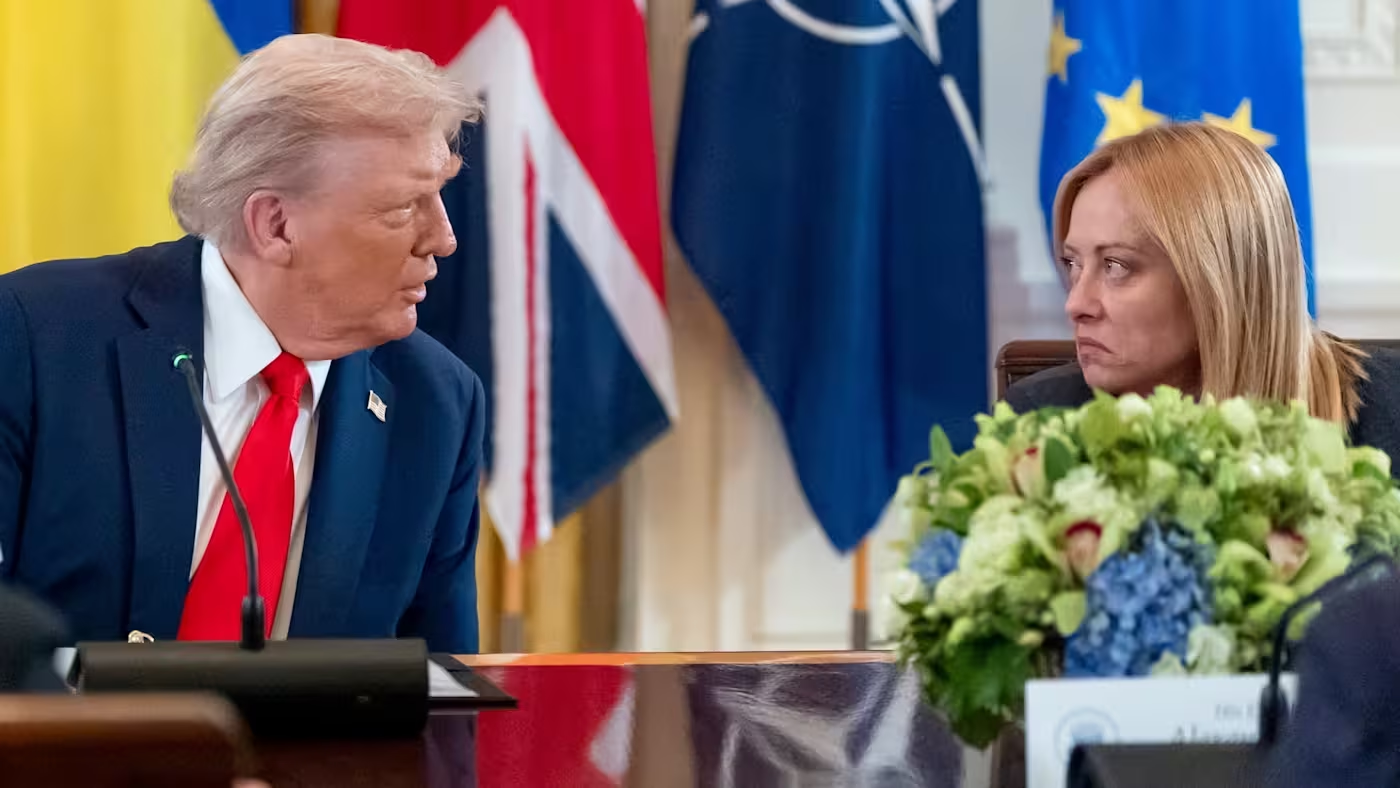
Donald Trump sharply criticized his former ally Giorgia Meloni, condemning her support for Pope Leo and Rome’s refusal to allow American military aircraft involved in strikes on Iran to refuel at a base in Sicily.
In a telephone interview with Corriere della Sera, the US president accused the Italian prime minister of cowardice—as his standing in Europe weakens after Viktor Orban’s defeat in Hungary’s recent election.
“Your prime minister is doing nothing to get oil,” Trump said. “I’m shocked by her. I thought she had courage, but I was wrong.”
Those remarks sharply diverge from his recent assessment. Just a month ago, after the campaign of strikes on Iran had already begun, Trump called Meloni “a great leader and a friend of mine” in an interview with the same newspaper.
Trump’s criticism came less than 24 hours after Meloni described his attacks on Pope Leo as “unacceptable.” On Sunday evening, Trump lashed out at the pontiff, calling him “weak” and “terrible” after he condemned the American leader’s threat to “wipe out Iran’s civilization.”
Responding to Meloni’s reaction, Trump said that “she is what’s unacceptable.”
“Meloni’s reaction was, in a sense, inevitable,” said Lorenzo Pregliasco, co-founder and head of the polling firm Youtrend. In his words, “Trump has become politically toxic for European governments and public opinion,” including right-wing politicians and their voters.
He added that within Meloni’s circle, there had been a growing recognition that excessive closeness to Trump could come at a heavy cost in terms of public support.
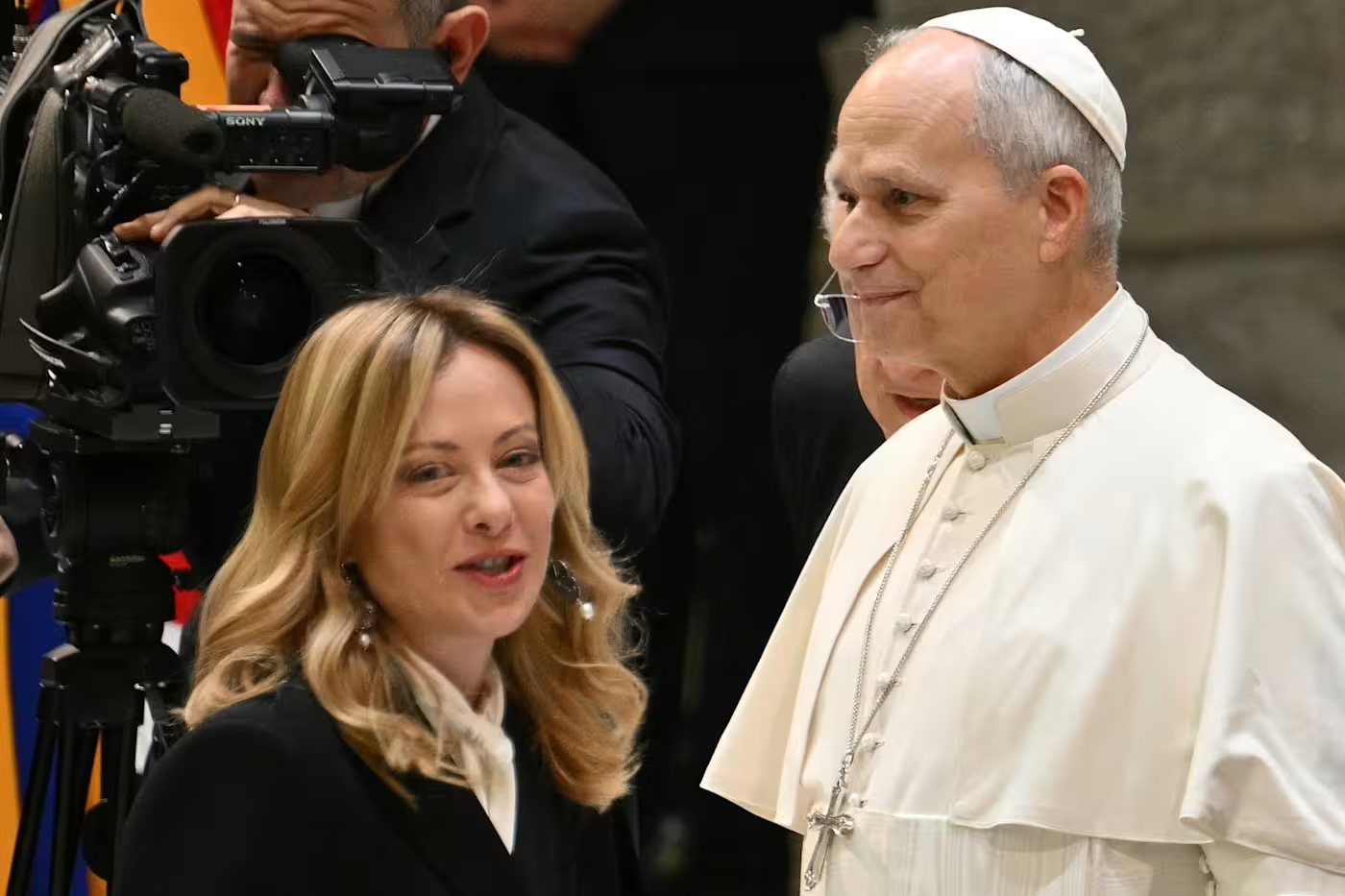
Giorgia Meloni once openly admired Trump and sought to present herself as a bridge between Europe and the United States. Last year, she called it “childish” and “superficial” even to frame the question as though she would somehow have to choose between America and Europe.
In recent months, however, Meloni has tried to distance herself from Trump cautiously—without provoking the kind of fury he has already unleashed on other former allies in the United States and beyond.
When Trump threatened to take Greenland from Denmark, a NATO ally, Meloni cast his remarks as a misunderstanding, suggesting that he was really only trying to draw attention to security in the Arctic.
She also refrained from directly criticizing the US-Israeli strikes on Iran, telling an Italian audience that she did not have the necessary intelligence to either support or condemn Trump’s decision.
But the war with Iran is deeply unpopular in Italy, where it has already driven up energy prices and worsened economic strain. According to a recent Ipsos poll, only 14 percent of respondents supported Trump’s campaign.
Rome recently denied several American military aircraft bound for the Middle East permission to refuel at a joint military base in Sicily.
Meloni’s government later said it would not send warships to help secure the Strait of Hormuz unless there was a full ceasefire and a UN mandate for such a mission.
It was precisely that position that irritated Trump, who is demanding more active support for the war from NATO countries.
“Even though Italy gets oil from there, even though America is very important to Italy, she does not think Italy should take part,” Trump said in the Corriere interview. “She thinks America should do that job for her.”
“She doesn’t want to help us with NATO, she doesn’t want to help us get rid of nuclear weapons,” he said. “That’s not at all what I thought of her.”
Trump’s harsh broadside against a former ally galvanized Italy’s political scene, where the US president was already viewed with deep hostility.
Opposition leader Elly Schlein said in parliament that “Italy is a free and sovereign country, and our constitution is clear: Italy rejects war.”
Carlo Calenda, the former industry minister, said: “Meloni found the courage to do what should have been done long ago: to say, ‘Enough of this madman.’”
Foreign Minister Antonio Tajani stressed that Italians would remain “sincere supporters of Western unity and reliable allies of the United States, but that unity is built on mutual loyalty, respect, and candor.”
“Until now, President Trump considered Giorgia Meloni a courageous person,” he wrote on social media. “And he was not wrong, because she is a woman who is never afraid to say what she thinks. And on Pope Leo XIV, she said exactly what all of us, the citizens of Italy, think.”
Former prime minister Matteo Renzi, however, saw Trump’s attack as yet another blow to Meloni’s standing after she recently lost the constitutional reform referendum she had initiated.
“Even her own people are abandoning Giorgia Meloni—her mentor and her leader,” Renzi wrote on social media. “Since the referendum, every day has brought her a new problem. There are 15 months of steady decline ahead before the election, and this collapse is only beginning.”