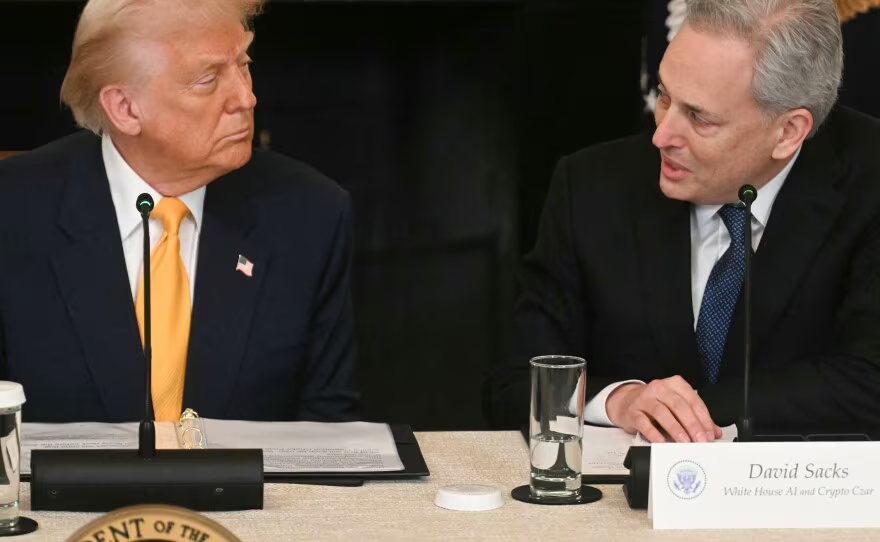
On Thursday, December 11, President Donald Trump signed an executive order aimed at effectively overriding state-level laws governing artificial intelligence. The move sets off a sweeping confrontation with the states and sharpens divisions within the Republican Party itself.
Trump and his AI adviser David Sacks are acting in the interests of the industry, seeking to sharply curtail states’ ability to regulate technology. The order envisions legal challenges to regional laws and ties access to federal grants to their alignment with the federal approach. At the last minute, MAGA populists attempted to influence the document’s final shape, submitting two alternative drafts to the White House—but without success.
“In the end, there will be only one winner here—and that is likely to be the United States or China. And right now, we are winning by a wide margin,” Trump said. Companies, he added, want to operate in the United States, but “if they have to obtain 50 different permits in 50 different states, you can forget about it—it’s simply impossible.” Trump also said the initiative enjoys “broad Republican support” and will “likely” find backing among Democrats as well.
As explained by White House staff secretary Will Scharf, the order is intended to take “decisive action to ensure that AI operates within a single national framework, rather than a patchwork of state-level regulation capable of paralyzing the industry.” The document instructs federal agencies to review the “most burdensome and excessive” regional rules and replace them with a “minimally intrusive, unified national policy.”
The order instructs the attorney general to establish a dedicated AI litigation task force within 30 days, charged with challenging state laws, including on the grounds that they unconstitutionally regulate interstate commerce. The commerce secretary is required to identify and assess existing regional rules that conflict with the order. This includes, in particular, requirements that compel AI models to alter truthful responses, or provisions that lead to the disclosure of information “in ways that violate the First Amendment or other provisions of the Constitution.”
The same cabinet secretary must, within 90 days, publish a policy notice setting out the conditions under which states may qualify for remaining funding under the Broadband Equity, Access, and Deployment program to expand internet access. In addition, the White House is to prepare legislative recommendations for Congress on the creation of a federal framework for AI regulation that would take precedence over state laws.
The text of the order states that the administration and Congress should develop a system that bars state-level rules conflicting with federal policy, while simultaneously ensuring “the protection of children, the prevention of censorship, respect for copyright, and the safety of communities.” “However, until such a national standard is established, it is imperative that my administration take steps to rein in the most burdensome and excessive state laws that threaten to choke off innovation,” the document says.
Steve Bannon, a former Trump adviser and a leading figure within the MAGA wing, said that “after two failed attempts to push AI amnesty into must-pass legislation, David Sacks is now fully misleading the president on the question of federal pre-emption.”
The White House had previously suffered a major setback when Congress refused to include federal pre-emption provisions in the annual defense policy bill, despite pressure from the administration and technology companies. This marked the second significant defeat this year: senators voted almost unanimously, 99–1, to strike a similar provision from a budget bill. The idea of such an executive order was first floated in November, after Trump publicly endorsed a ban on state-level initiatives.
Some MAGA conservatives and Republican governors view the White House approach as overly sweeping, seeing it as a concession to AI companies at the expense of states’ rights. Lawsuits from the states now loom, alongside a further escalation of intra-party conflicts.