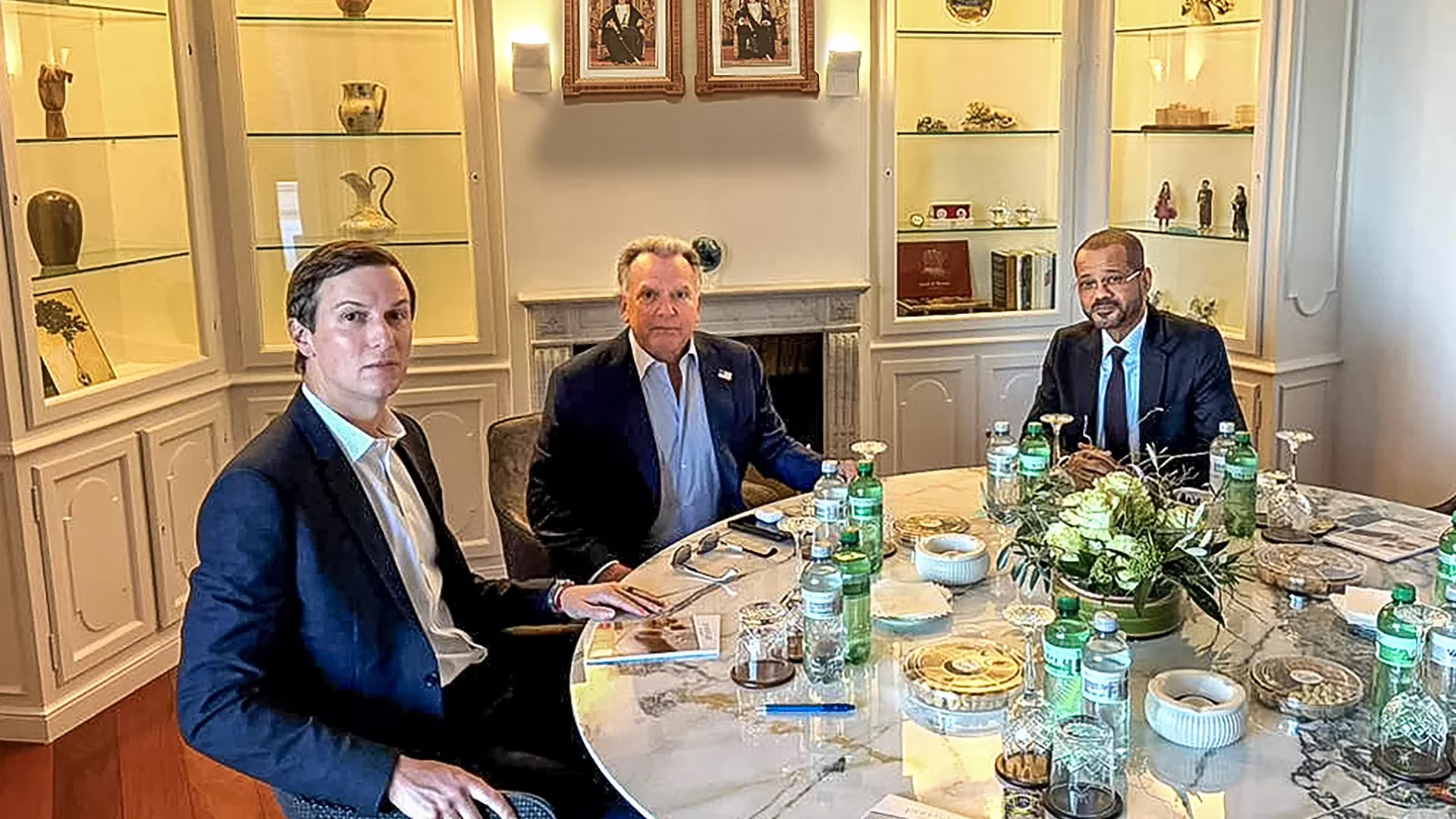
On Thursday, US President Donald Trump’s special envoys Steve Witkoff and Jared Kushner held more than three hours of talks in Geneva with Iranian Foreign Minister Abbas Araghchi, seeking a breakthrough in negotiations over the nuclear deal. According to Oman’s foreign minister, after a pause the talks are expected to resume later the same day.
The Geneva talks are being viewed as a possible last chance for a diplomatic settlement before Trump opts for a military scenario. The assessments and signals that Kushner and Witkoff convey to the president following the meeting could have a significant bearing on his decision. On Tuesday, in his State of the Union address, Trump said he favored a diplomatic path, while at the same time laying out an argument that leaves open the option of war.
The third round of talks was conducted in two formats—an indirect channel, in which Oman’s foreign minister Badr al-Busaidi relayed messages between the sides, and direct discussions involving American and Iranian negotiators, according to a source familiar with the deliberations. The Iranian side presented a long-awaited draft agreement on the nuclear program. Al-Busaidi and Rafael Grossi, director general of the International Atomic Energy Agency, also took part in the discussions. During a pause in the talks, al-Busaidi said the parties were “exchanging creative and positive ideas” and “hoping to achieve further progress.”
The United States entered the talks demanding that any future agreement with Iran be of unlimited duration. Another key condition was the requirement that Iran relinquish its stockpile of 10,000 kilograms of enriched uranium. Washington signaled a willingness to show limited flexibility on Iran’s insistence on retaining the right to enrich uranium—but only if Tehran could convincingly demonstrate that there was no pathway to the development of a nuclear weapon.
In his address to Congress, Trump stressed that Iran must state clearly that it has no intention of acquiring nuclear weapons—a position Tehran has publicly maintained for many years. Against this backdrop, Ali Shamkhani, a senior adviser to Iran’s supreme leader Ali Khamenei, wrote on X on Thursday that if this is indeed the central issue for the United States, it “aligns” with Khamenei’s fatwa and Iran’s defense doctrine, meaning that an “immediate agreement is entirely achievable.” According to Shamkhani, “Araghchi has sufficient backing and authority to conclude this deal.”