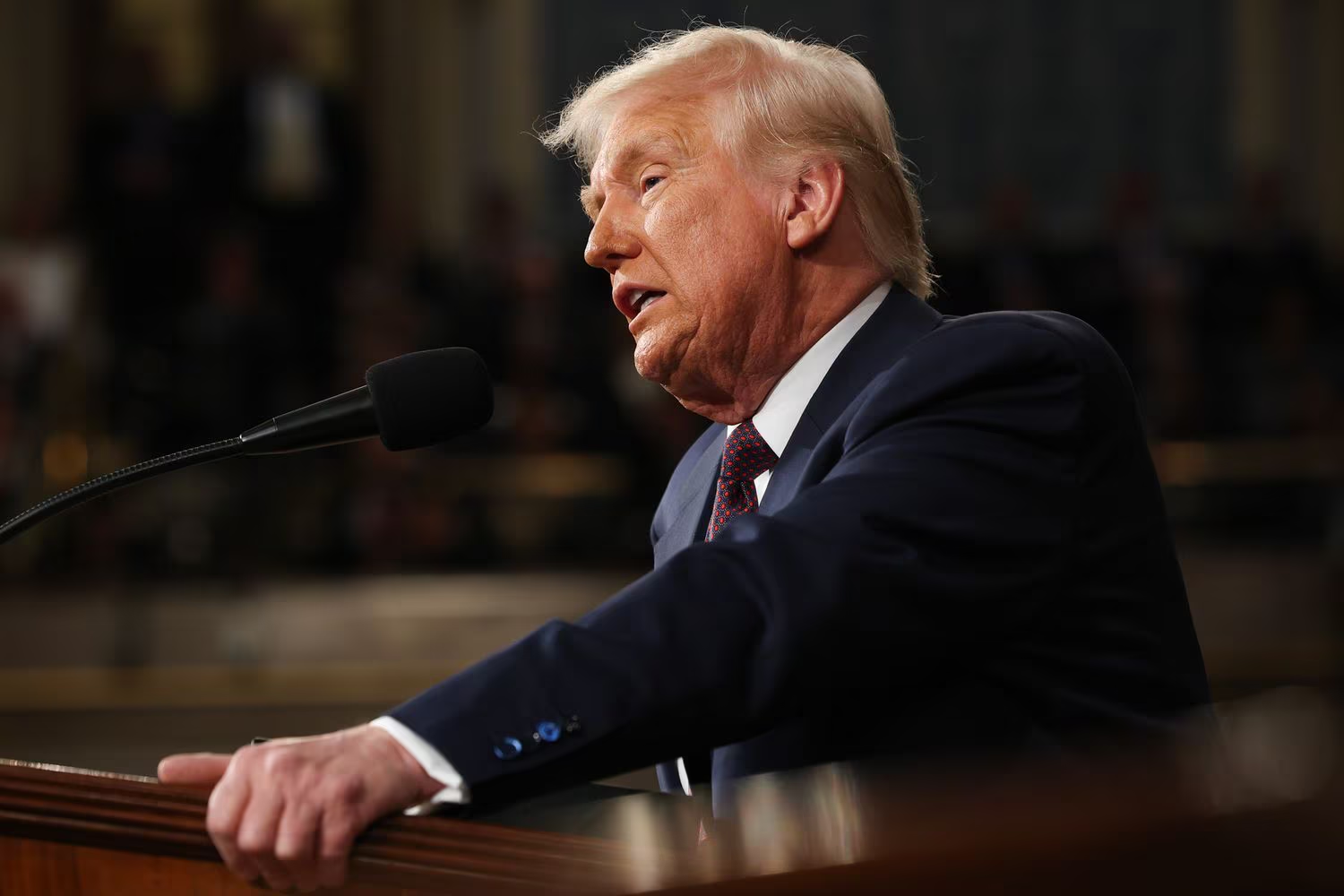
U.S. President Donald Trump on Friday demanded “UNCONDITIONAL SURRENDER” from Iran’s leadership—his most direct and unequivocal statement of war aims since the operation began seven days ago.
The demand leaves little room for an exit from the conflict. If Tehran refuses to capitulate—and there is no indication so far that it will—the fighting could continue until Iran’s ruling regime collapses or until Trump himself changes course.
Hours before the U.S. president’s statement, Iran’s leader Masoud Pezeshkian wrote on X that “some countries have begun mediation efforts” in an attempt to halt the war.
“Let’s be clear: we seek lasting peace in the region, yet we do not hesitate when it comes to defending our nation’s dignity and sovereignty. Mediation should be directed at those who underestimated the Iranian people and ignited this conflict,” he wrote.
Trump responded Friday morning on Truth Social: “There will be no deal with Iran except UNCONDITIONAL SURRENDER!”
He added that after the current regime capitulates, “GREAT & ACCEPTABLE leader(s)” must be chosen.
Trump also pledged that the United States and its allies would help rebuild the country after the war and ensure its prosperity. “IRAN WILL HAVE A GREAT FUTURE. MAKE IRAN GREAT AGAIN (MIGA!),” he wrote.
A day earlier, on Thursday, Trump told Axios that he wants to take part personally in choosing Iran’s next supreme leader, to ensure that the successor does not pursue policies that would lead to another war.
“If this is the official position of the U.S. administration, and if the current regime in Iran has no intention of capitulating, then the campaign must continue until that regime collapses,” said Danny Citrinowicz, an Iran expert at Israel’s Institute for National Security Studies and the Atlantic Council.
“Any other outcome would effectively be regarded as a failure, despite all the operational successes of the campaign,” he added.
According to sources familiar with the conversations, U.S. Secretary of State Marco Rubio told several Arab foreign ministers in a series of phone calls on Thursday that the war is likely to continue for several more weeks.
Rubio said the current military strategy is focused on destroying Iran’s launchers, stockpiles, and missile production facilities.
At the same time, he told his counterparts that regime change is not the official objective of the United States—while making clear that Washington would prefer to see different people in power in Iran.
According to the sources, Rubio also stressed that no negotiations are currently taking place between the United States and Iran’s leadership and that any contacts at this stage would undermine the military objectives of the operation.
Trump himself said on Thursday that Iran had sought to begin negotiations, but he told them they were “too late.”
Meanwhile, U.S. and Israeli strikes entered their seventh day on Friday and continue to intensify. Iran and its allied forces—Hezbollah in Lebanon and Shiite militias in Iraq—continue launching missiles and drones at U.S. bases, Israel, and countries across the Persian Gulf.
However, the intensity and scale of Iranian attacks have declined markedly. Adm. Brad Cooper, commander of U.S. Central Command, said the number of Iranian missile strikes has fallen by 90% compared with the first day of the war.
U.S. and Israeli officials said on Thursday that about 60% of Iran’s launchers and missile stockpiles have been destroyed.
On Friday, Israeli fighter jets struck a heavily fortified bunker beneath the residence of the late Supreme Leader Ali Khamenei—his emergency command center.
IDF spokesperson Brig. Gen. Effie Defrin said Israeli assessments indicate that senior Iranian officials may have been using the bunker in recent days. The military is now trying to determine whether anyone was inside at the moment of the strike.