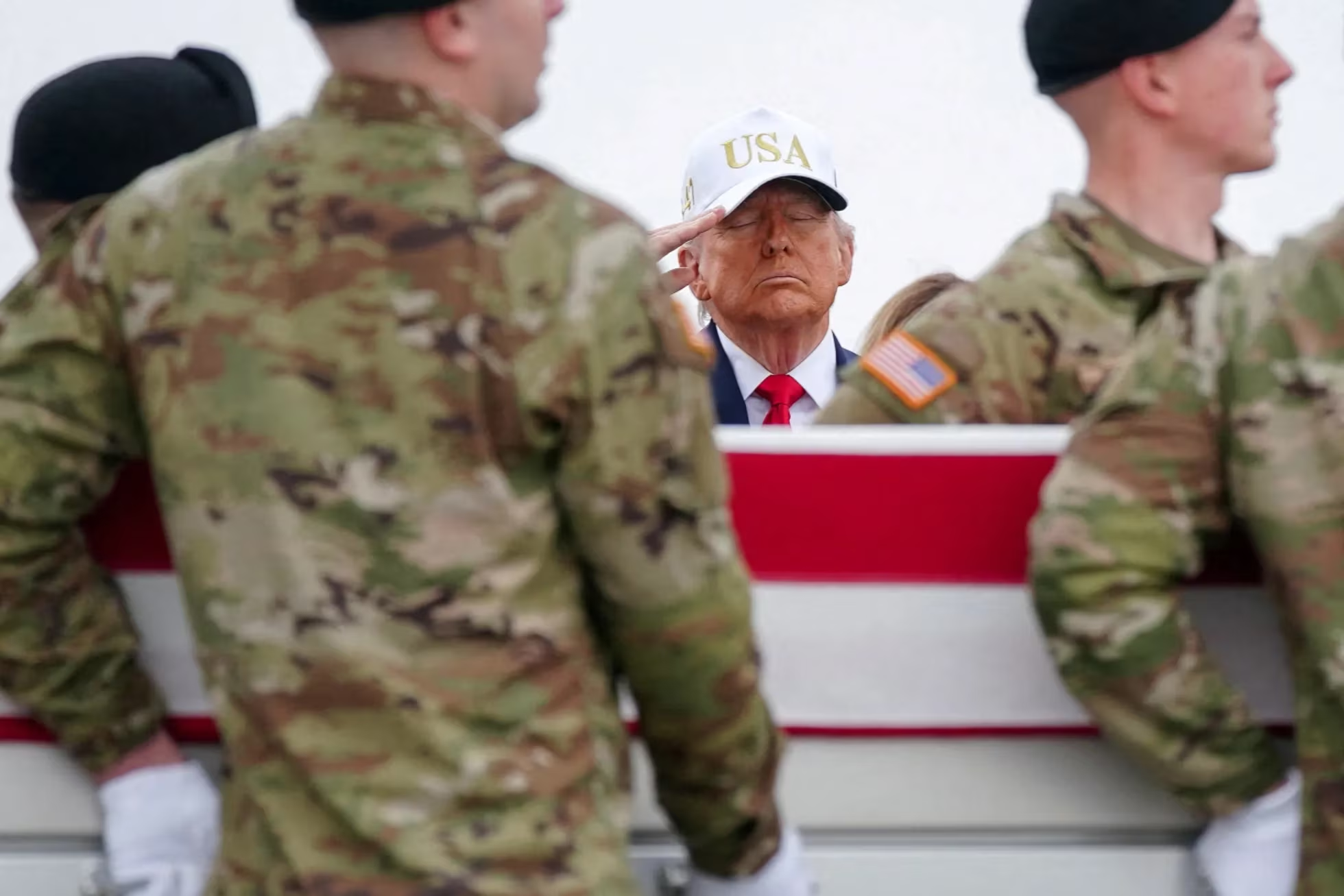
The administration of Donald Trump and its allies among Republicans have been careful to avoid the word “war” when describing the confrontation with Iran, favoring more ambiguous language—such as “operation” or “mission.” In official statements and comments, strikes on Iranian facilities are framed as a “very specific operation” with limited objectives.
The Speaker of the House of Representatives, Mike Johnson, for example, emphasized that the United States is “not currently in a state of war,” but is carrying out a “critically important mission to keep everyone safe.”
This choice of wording is driven above all by legal considerations. Under the U.S. Constitution, the authority to declare war rests exclusively with Congress—not the president. The last time this procedure was used was in 1942, during the Second World War, when the United States declared war on Nazi Germany’s allies—Bulgaria, Hungary, and Romania. Since then, for every armed conflict involving the United States—including the wars in Korea, Vietnam, Iraq, and Afghanistan—administrations have relied on alternative terminology, at times resorting even to the formulation “kinetic military action.”
Each time, such euphemisms have sparked political disputes. In 1973, amid the Vietnam War, Congress passed the War Powers Resolution. Under this act, the president may use armed force abroad only with the consent of Congress—or, at the very least, must notify lawmakers of extraordinary circumstances that make it impossible to wait for such authorization. In the case of the strike on Iran, the Trump administration did not submit even such a notification—a situation that is not unprecedented, but relatively rare.
As The Atlantic notes, beyond legal constraints there are also political reasons to avoid the word “war.” For a significant part of American society, the term is associated above all with the events of recent decades—prolonged conflicts in Iraq and Afghanistan marked by heavy casualties and uncertain outcomes. In public perception, “war” has come to signify not so much resolve as a drawn-out crisis, disorder, and domestic discontent.
The last time military intervention enjoyed broad support in the United States was in the early 1990s, when American troops as part of an international coalition liberated Kuwait from Iraqi occupation—during the first Gulf War, Operation Desert Storm. Since then, a generation of Americans has grown up with no memory of that period.
In some respects, the current rhetoric of U.S. officials echoes the language used by the Russian authorities at the start of the full-scale invasion of Ukraine in 2022. At the time, the word “war” was effectively banned—what was happening had to be described as a “special military operation” (SMO). Using the word “war” could lead to administrative or even criminal prosecution under laws against spreading “fake news” or “discrediting” the armed forces. In the United States, there is no penalty for using the term—the reluctance to employ it is simply part of political rhetoric and a kind of signal of loyalty.
Media outlets have also noted that, when explaining the strikes on Iran, Donald Trump has used arguments that resemble the logic Vladimir Putin invoked to justify the invasion of Ukraine.
One such argument was the claim that Ukraine was allegedly preparing an offensive in Donbas, prompting Moscow to launch a “preemptive strike”—although Kyiv denied preparing any such operation.
A similar line of reasoning now appears in Trump’s own statements. The U.S. president claims that Iran had been preparing an attack on the United States in the near future.
“If we hadn’t gone in, they would have come after us. They were ready, they had all those missiles—far more than anyone thought—and they were going to attack us,” he said, adding that Iran had supposedly been planning a strike “within a week.”