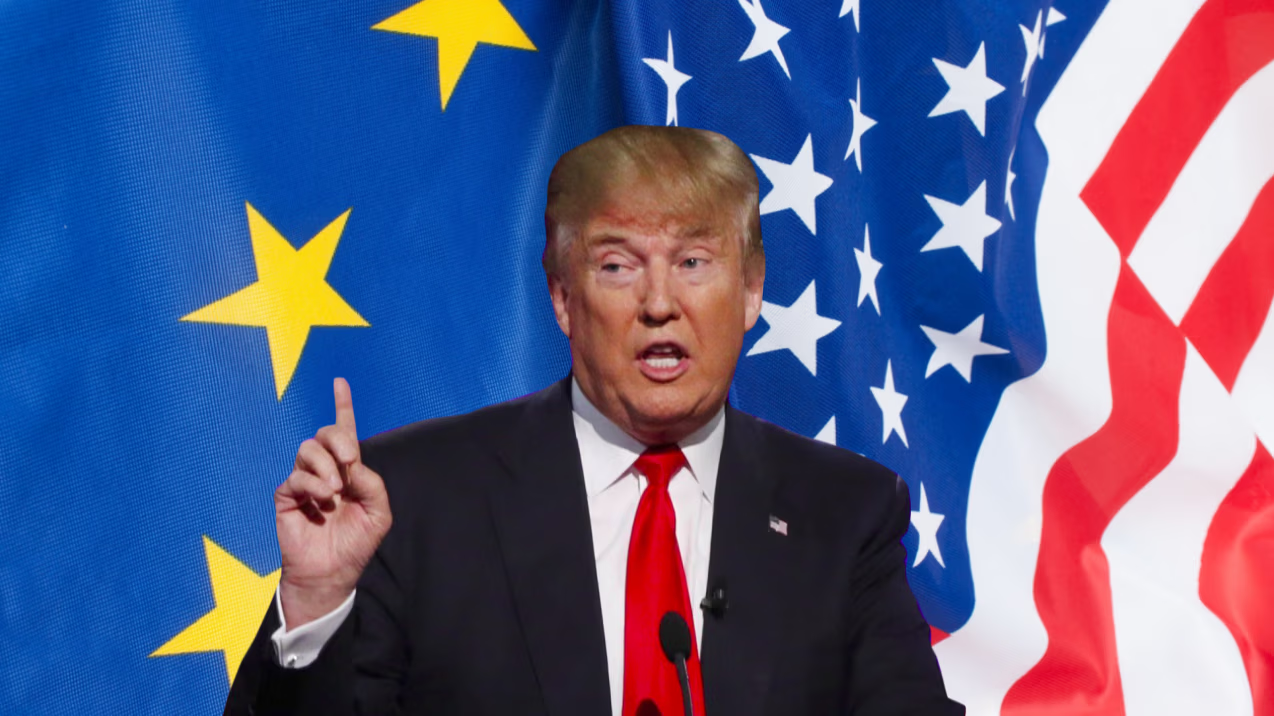
Donald Trump’s administration places the blame on the European Union and migration for what it claims is the impending and near-total cultural collapse of Europe. These stark accusations appear in the new US National Security Strategy, which acknowledges Europe’s economic difficulties but argues that they are “eclipsed by the far more tangible and much darker prospect of civilizational disappearance” within the next two decades. The document states: “Europe’s most pressing challenges include the actions of the European Union and other supranational bodies that erode political freedom and sovereignty, migration policies that are reshaping the continent and generating conflict, censorship of free expression and suppression of political opposition, declining birth rates, and the loss of national identity and self-confidence”.
Such rhetoric will almost certainly resonate with most of Europe’s far-right movements, whose platforms revolve around criticism of the EU, demands to curb migration from Muslim-majority and non-European countries, and the ambition to restore what they see as their nations’ lost standing. The new strategy outlines a clear ideological alignment that brings Donald Trump’s populist MAGA movement closer to Europe’s nationalist parties. The US administration, which has recently strengthened its contacts with right-wing parties in Germany and Spain, effectively signals that it is prepared to support political forces that share its worldview. The document notes: “America calls on its political allies in Europe to advance this revival of spirit, and the growing influence of patriotic European parties indeed gives ample reason for great optimism”.

Far-Right Parties Take the Lead in Polls Across Europe’s Largest Countries
This Could Mean Revisiting Sanctions on Russia, Tougher Migration Policies, and Reduced Support for Ukraine

Trump’s Adviser Meets with AfD Leaders in Berlin
Contacts with the MAGA Circle Help German Far-Right Figures Strengthen Their Political Legitimacy
The strategy offers a rare official articulation of Trump’s foreign-policy worldview. Such documents, typically issued once per presidential term, can shape budget allocations and set priorities across the US government. In the preface, Trump describes it as “a roadmap designed to ensure that America remains the greatest and most successful nation in human history and a bastion of liberty on Earth”. At the same time, the White House acknowledges that “Europe remains strategically and culturally vital to the United States”, even though its assessment of the continent echoes the administration’s earlier public statements. In February, Vice President J.D. Vance shocked much of Europe’s political establishment at the Munich Security Conference with an address attacking Europe over its migration policies and constraints on free expression.
The document also echoes the racist “great replacement” conspiracy theory, which claims that elites are deliberately seeking to dilute the influence of white Europeans through migration from Africa, particularly from Muslim-majority countries. The strategy asserts: “Over the long term, it is more than likely that within a few decades, at the latest, some NATO members will become predominantly non-European”. The war in Ukraine is mentioned only in passing, as a digression from the broader theme of Europe’s supposed “civilizational disappearance”. The United States stresses that ending the war serves Washington’s interests, including the restoration of “strategic stability” in relations with Russia.
At the same time, the administration blames “unstable governing minorities” in Europe for holding “unrealistic expectations about the war” and suggests they are slowing progress toward peace. These assertions come as European leaders, in private conversations, warn of the risk that Washington might “betray” Ukraine in negotiations with Moscow. And in open contradiction to NATO’s long-standing open-door policy, the US administration declares its intention to “end the perception, and prevent the reality, of NATO as a perpetually expanding alliance”. Trump’s reluctance to see Ukraine join NATO is not new—Joe Biden’s administration held a broadly similar position.