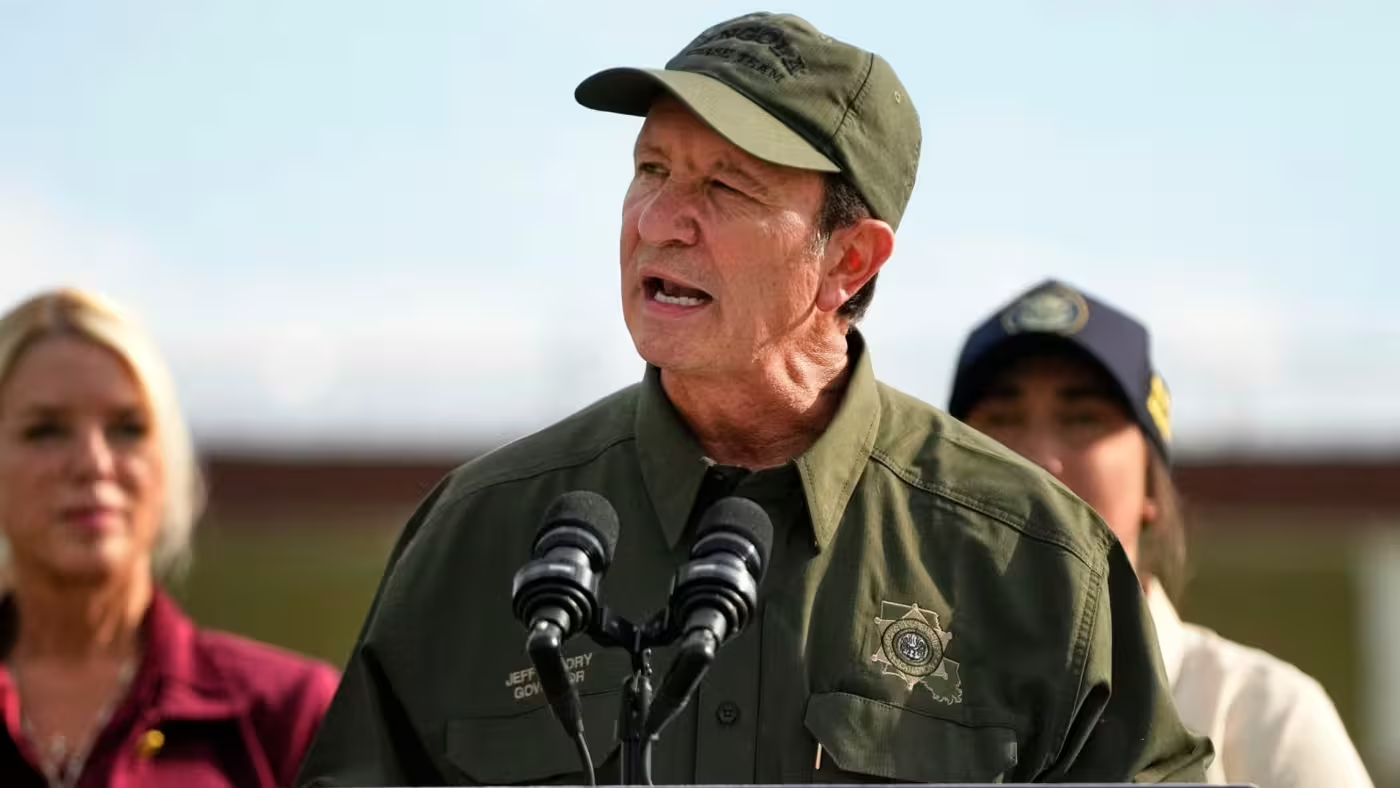
US President Donald Trump has appointed Louisiana governor Jeff Landry as his special envoy for Greenland, once again underscoring his intention to assert control over the vast Arctic island under Danish jurisdiction.
On Sunday, Trump wrote on social media that Landry “understands how vital Greenland is to our national security and will forcefully advance our country’s interests in the name of the safety, security, and survival of our allies—and, ultimately, the entire world.”
Landry, for his part, said it was an honour to take on the role voluntarily “to make Greenland part of the United States,” stressing that the appointment would not affect his work as governor of the southern state of Louisiana.
Trump’s rhetoric has already caused alarm and irritation both in Greenland itself and in Denmark, its NATO ally. The president has repeatedly insisted that the United States will take control of the island, home to about 57 000 people, including by declaring his willingness to buy it.
Greenland’s authorities, which enjoy broad autonomy within the Kingdom of Denmark, along with Copenhagen, have consistently stated that the island is not for sale. At the same time, both sides stress their interest in cooperating with the Trump administration on security matters and economic projects, including mineral extraction.
Greenland’s foreign minister, Vivian Motzfeldt, met earlier this month with the new US ambassador to Denmark, Ken Howery, and said that Trump’s statements had created “uncertainty.” In an interview with the Financial Times in October, she said: “We understand how important cooperation with the United States is for us. From the outset, we have said that we recognize the geopolitical significance of our position for the defence of Europe as well as for US security. But, of course, if you want good, solid cooperation built on trust, it has to be developed with respect.”
According to Danish officials, Trump initially sought to use hard pressure to force Copenhagen to relinquish its key Arctic asset. In January, he held a sharp telephone call with Denmark’s prime minister, Mette Frederiksen, during which he insisted that Greenland should come under US control.
Denmark subsequently began responding more forcefully to statements from what is formally its closest security ally. In Copenhagen’s view, this prompted a shift in Washington’s tactics, moving from pressure to a softer line of engagement directly with Greenland.
In addition to appointing Landry as special envoy for Greenland, Trump recently approved investor and Russia specialist Thomas Dans as head of the US Arctic Research Commission. It was Dans who organized the visit to Greenland by Donald Trump Jr., the president’s son.
Trump and those around him are advancing the concept of “hemispheric defence,” which holds that the United States must control large parts of the Americas—potentially including Greenland, Canada, and the Panama Canal—to guarantee its own security.
Greenland is seeking to accelerate economic development by attracting US and other foreign investors to sectors such as tourism and mineral extraction. The aim is to raise prosperity and create the conditions for possible independence from Denmark. Yet Trump’s pressure has, contrary to expectations, led to closer coordination between Nuuk and Copenhagen, with a growing number of Greenlanders arguing that deeper ties with Denmark may be the more rational choice.
Greenlandic politicians also acknowledge that the island’s indigenous population is not in a position to provide for the defence of the world’s second-largest island on its own.
Even before Trump renewed his efforts to assert control over the territory, voices in Greenland said that the United States—which has sharply reduced its military presence on the island over recent decades—could, if it chose, expand the Pituffik space base in the far north of the island.