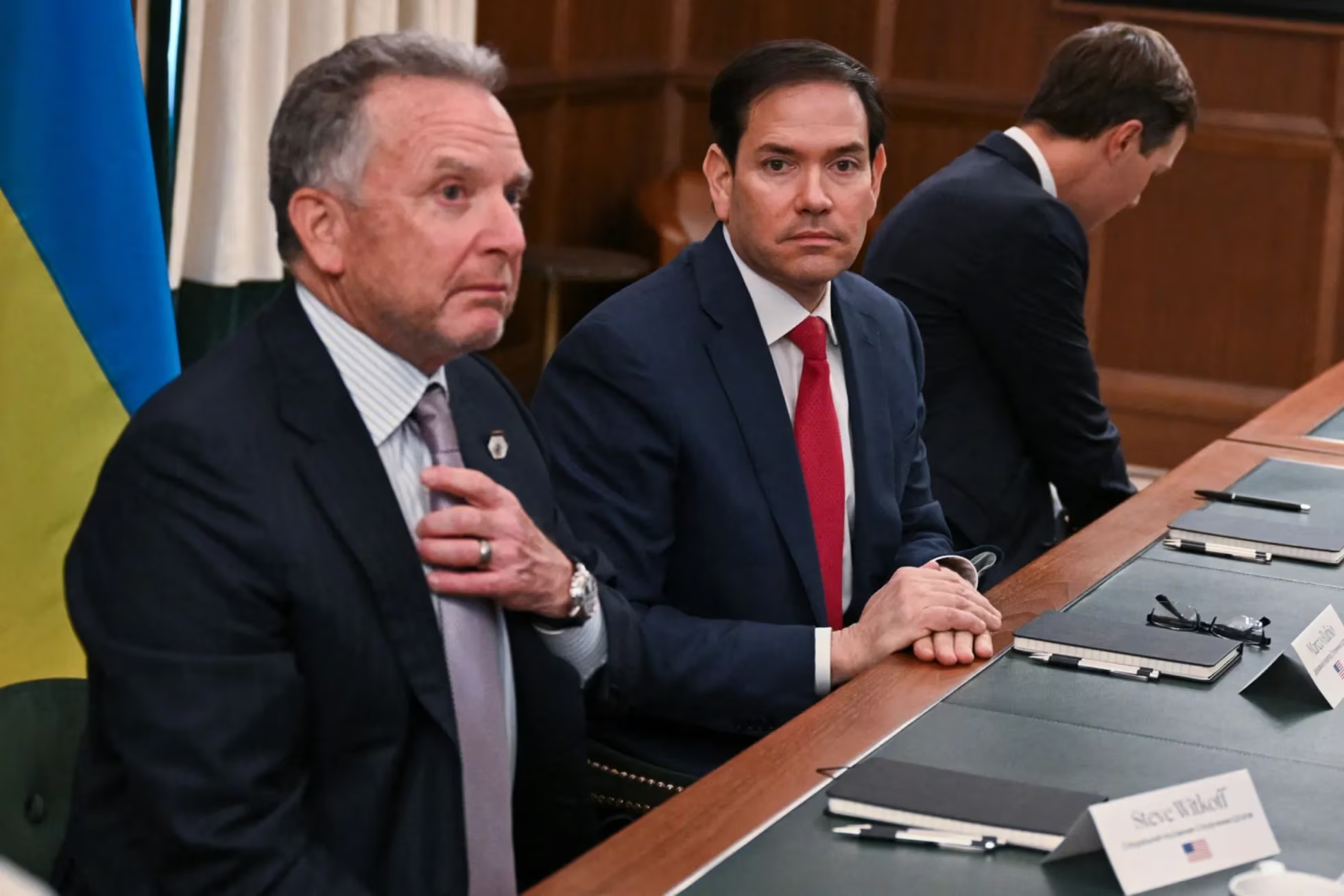
Washington’s efforts to develop a strategy for a negotiated settlement of the war between Russia and Ukraine are unfolding amid internal confrontation within Donald Trump’s administration. As reported by NBC News, citing current and former American and European officials, the central role in the talks is effectively being contested by President Trump’s special envoy Steve Witkoff and Secretary of State Marco Rubio. Their rivalry extends well beyond bureaucratic turf battles and reflects a deeper divide over the nature of the negotiations, the level of trust toward Moscow, and the scope of concessions deemed acceptable from Kyiv.
President Trump’s special envoy Steve Witkoff and Secretary of State Marco Rubio are effectively competing for the status of Washington’s chief negotiator, including in efforts to bring the Russia-Ukraine war to an end, NBC News reports. The outlet has published an article describing a growing rift and escalating disagreements among members of Donald Trump’s administration. The reporting is based on conversations with around ten current and former American and European officials.
NBC’s sources note that rivalry and the emergence of competing factions within presidential administrations are hardly unprecedented. However, they say it is exceedingly rare for a secretary of state to be relegated to a secondary role, ceding a central diplomatic position to someone without substantial foreign policy experience while addressing one of the world’s most complex international crises. Such an arrangement, the sources emphasize, has triggered palpable concern.
While Trump himself is convinced that Witkoff is an “excellent dealmaker,” his critics in Congress, in Europe, and even within the administration regard the special envoy as diplomatically unprofessional and as someone who “too readily takes Russia’s assertions at face value.” “He is a gift to the Russians,” one congressman said, speaking on condition of anonymity.
American officials, NBC News sources say, have repeatedly witnessed Steve Witkoff attempting to operate around Marco Rubio, including on negotiations aimed at ending the war between Russia and Ukraine. According to these accounts, there were several previously undisclosed episodes in which Donald Trump’s adviser arranged international contacts without informing the head of the State Department, during which the issue of a negotiated settlement was discussed.
One such incident occurred in April 2025, when the secretary of state was planning a visit to Paris for talks on Ukraine. On the eve of the trip, Rubio’s team learned that Witkoff had arranged a one-on-one meeting with French President Emmanuel Macron. Rubio sought to join the discussions, but the French side suggested that consent first be obtained from Witkoff himself.
As the network notes, for the secretary of state this amounted to a “humiliating turn of events.” His aides spent an extended period unsuccessfully trying to reach the special envoy. Ultimately, Rubio managed to speak directly with Witkoff, after which the envoy agreed to allow him to attend the meeting with Macron, NBC’s sources said. Rubio’s official schedule indicates that during that trip he ultimately held a separate one-on-one meeting with the French president.
Another incident, according to the sources, occurred in November, when the head of the State Department had talks scheduled with Ukrainian officials in Switzerland. Witkoff arrived in Geneva ahead of time without informing the foreign policy establishment. The move was perceived as an attempt to preempt Rubio and to shape a dialogue with Kyiv on his own terms—without coordination with colleagues in the White House. According to the network’s interlocutors, Rubio nevertheless traveled to Geneva, preventing the meeting from taking place without his participation.
A few days after the Swiss contacts, another similar episode followed. Witkoff arranged talks with the Ukrainian side in Florida, which Rubio learned about directly from Ukrainian negotiators. “It was perfectly clear that Rubio had been sidelined. He is the one who should have been running all of this,” a senior administration official told NBC.
In the network’s assessment, the root of the tensions between Witkoff and Rubio lies in fundamentally different views on how the war should be brought to an end and how much Washington should trust Moscow’s promises.
Witkoff, according to the report, is seeking to carry out Trump’s directives as precisely as possible, bound to the president by a long-standing personal friendship, and to secure a deal as quickly as he can. He has promoted a plan that would require Ukraine to make concessions, including territorial ones, NBC reports. Rubio and a number of other administration officials, by contrast, argue for intensifying economic and military pressure on Russia to force Vladimir Putin into compromise. European allies of the United States hold a similar position.
Publicly, the State Department denies the existence of any rift. “There are no disagreements between them, and there never have been. Secretary Rubio and Special Envoy Witkoff have a close working relationship, and they are friends. Both fully share the president’s objectives, and each is carrying out Trump’s vision of how to end the war and achieve peace in full cooperation,” State Department spokesperson Tommy Pigott told NBC.
Rubio himself said at a December 19 press conference that the U.S. side is conducting peace talks under conditions of tight coordination. At the same time, he described Witkoff as a “phenomenal, talented, and very smart person,” noting that he “is not being paid for this work.”
Additional grievances voiced by State Department staff relate to accusations that Witkoff has shown a lax approach to security and confidentiality, including during trips to Russia. In particular, the concerns focus on his use of unsecured communication channels.

Peace Talks on Ukraine and Gaza Have Shifted From Capitals to a Private Club in Florida
Trump’s Team Is Holding Parallel Consultations With Ukraine, Europe, and Russia at the Private Venue of Its Key Negotiator
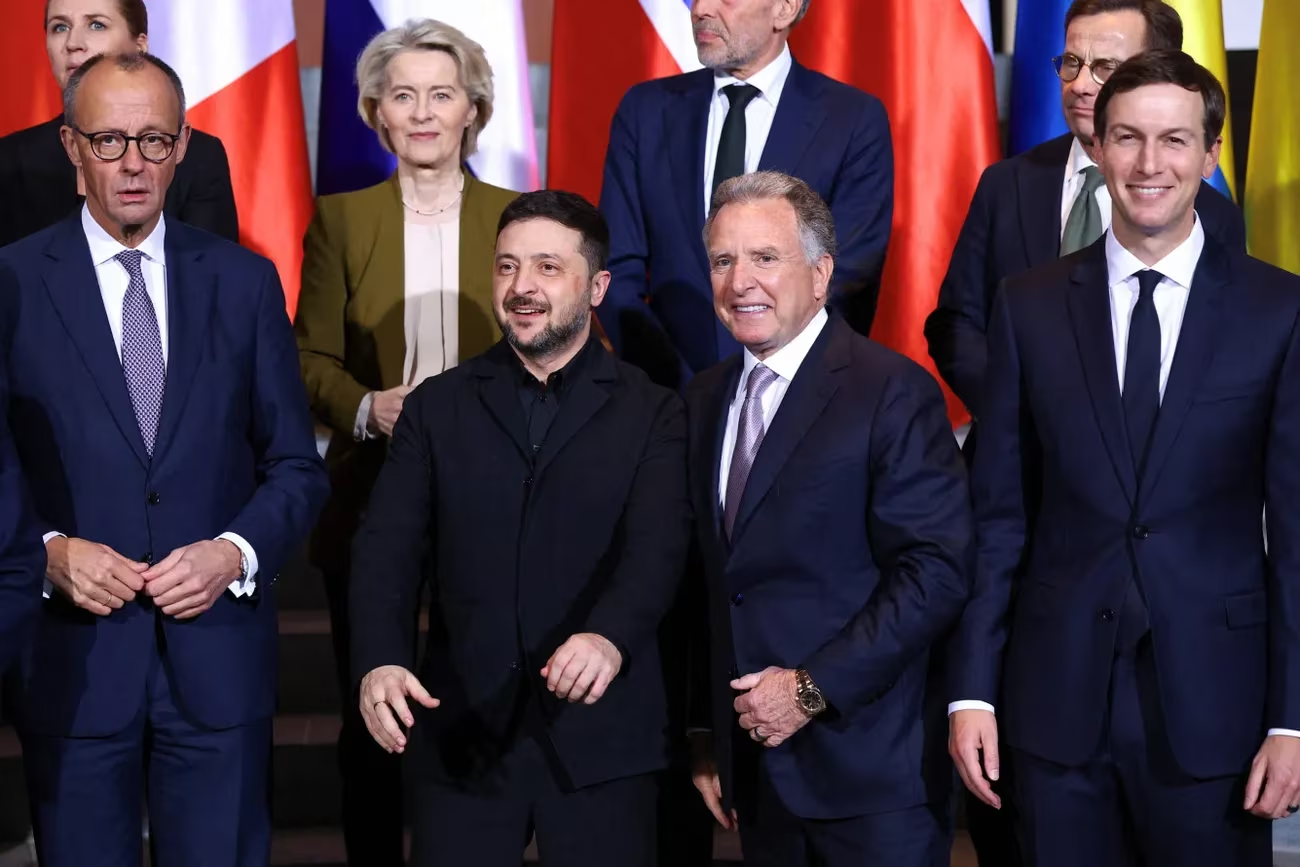
Talks Between Ukraine and the United States in Berlin Exposed Differences Over Territory and Progress on Security Guarantees
Washington Confirmed Its Willingness to Provide Ukraine With Guarantees Comparable to NATO Commitments
NBC’s sources say that from the very beginning of Witkoff’s work in the Trump administration, tensions emerged between him and State Department officials over the arrangement of secure communications on his private jet and the provision of aircraft security. Some interlocutors questioned the decision itself for the special envoy to travel abroad on his own plane rather than on government aircraft.
In May, at the initiative of the State Department, a review was conducted, after which Witkoff was provided with additional security and a secure mobile communications system aboard his aircraft. Despite this, officials say they remain concerned that the special envoy does not always use government-secured communication channels.
These concerns intensified after a transcript of a conversation between Witkoff and Russian presidential aide Yuri Ushakov was leaked. Bloomberg published the transcript without identifying the source of the leak. Commenting on the publication, Ushakov said, among other things, that he sometimes communicates with Witkoff via WhatsApp.
Donald Trump’s special envoy declined to answer the network’s questions, referring journalists to the White House. There, officials said that Steve Witkoff complies with all security requirements and that a secure communications system had been installed on board his aircraft from the outset.
In addition, NBC reports that Marco Rubio had to step in to defuse a growing diplomatic crisis after the first version of a 28-point U.S. peace plan was leaked. The document was widely perceived as pro-Russian. It was reported that during its preparation, U.S. representatives—including Witkoff, who was described as the agreement’s “architect”—had consulted with the Russian side.
The plan was subsequently revised following consultations with Ukrainian representatives, and work on the agreement is ongoing. Over the past weekend, a U.S. delegation held a meeting with Ukrainian officials in Miami. Witkoff was among those representing Washington. Rubio’s participation in the talks was not reported.