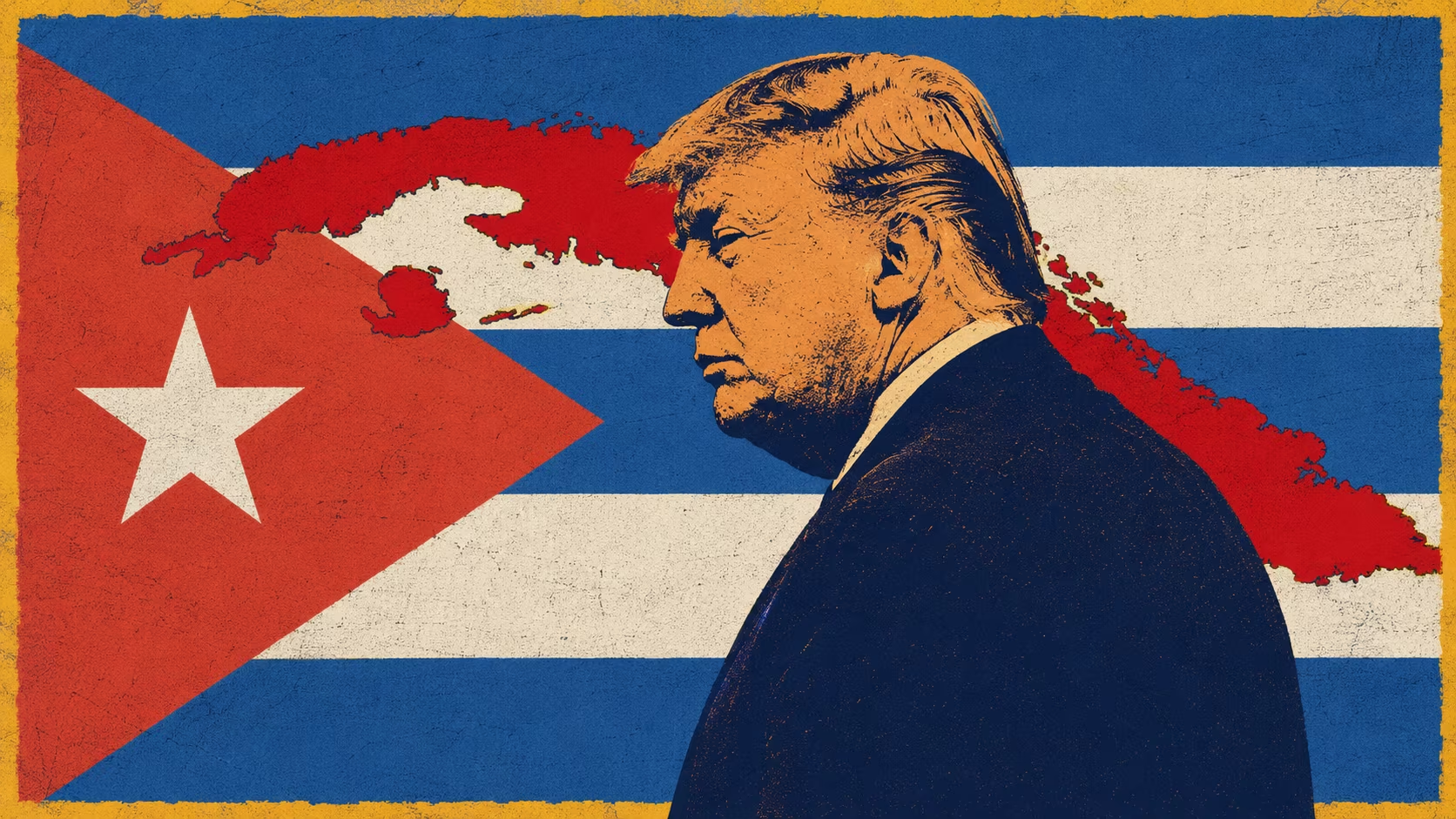
The Donald Trump administration is preparing for the possible collapse of Cuba’s regime as early as this summer and is developing military response options in case the island descends into instability.
Trump has not authorized military intervention and would prefer to achieve political change through non-military means. The White House is instead seeking to intensify economic pressure on Havana in an effort to gradually undermine the stability of the Cuban system. One senior administration official described the strategy as “accelerationism”—a policy aimed at hastening an internal crisis.
“But we are not yet trying to completely destroy the regime. There is a sequence to this. Everything is happening in stages,” the official said.
The current strategy also allows Trump to remain focused on negotiations with Iran without abandoning his broader goal of changing the situation in Cuba. “The Iran issue is not finished, and the president is not in a rush. Trump wants to use every lever available. Although there are fewer levers now than before,” another administration official said.
According to another source, the White House is still preparing additional sanctions measures: “We still have a fairly broad toolbox left, especially in sanctions and enforcement. More steps are coming.”
The administration views Cuba as the main center of anti-American and Marxist activity in Latin America since the 1959 revolution led by Fidel and Raul Castro.
The first stage of the pressure campaign targeted Venezuela, which for years supplied Cuba with oil and helped sustain its economy. After Venezuelan leader Nicolas Maduro was detained during a US operation on January 3, free oil shipments stopped, worsening the island’s economic crisis in Washington’s view. Caracas and Havana, meanwhile, blame US sanctions policy for their economic problems.
Last month, US Southern Command—which oversees military operations in the Caribbean—conducted interagency exercises built around possible scenarios in Cuba. One source said discussions included unrest, potential drone use, and responses to a deteriorating humanitarian situation during the summer.
“All options remain on the table, but no invasion is planned or being prepared in the near term. If the president gives the order, we are ready for any scenario,” one official said.
Another source pointed to the July 2022 protests in Cuba, which were harshly suppressed by authorities. According to the source, the current situation on the island appears even more volatile.
“It’s going to be hot. People will not have electricity. Food spoils without refrigerators. That creates anger, and people may go into the streets. Then the question becomes—what next? I don’t think the president will stay inactive if there is repression,” the source said.
At the same time, part of Trump’s inner circle opposes any prolonged military presence on the island. One presidential adviser said Trump “does not want to see American troops on the ground for more than 48 hours,” warning that the operation could quickly turn into a drawn-out crisis.
On May 1, Trump signed an executive order imposing secondary sanctions on companies cooperating with the Cuban military conglomerate GAESA. Afterward, Canadian mining company Sherritt International, along with shipping operators CMA CGM and Hapag-Lloyd, announced plans to scale back operations in Cuba. Financial and hotel companies from Spain, Panama, and Mexico may follow with similar decisions.
Max Meizlish, a former US Treasury official who worked on Cuba sanctions, said Havana had never before faced pressure on this scale. “This is an entirely new situation,” he said.
Secretary of State Marco Rubio plays a central role in shaping Washington’s Cuba policy. He oversees the campaign against GAESA and has become the public face of the sanctions push.
On May 7, Rubio announced new restrictions targeting the conglomerate, and on May 20 he delivered a message to the Cuban people on Independence Day focused on the issue. That same day, the US Justice Department unveiled charges against Raul Castro over the 1996 deaths of members of the Brothers to the Rescue organization, while US Southern Command announced the arrival of the Nimitz carrier strike group in the region.
The following day, Rubio announced the arrest of the sister of GAESA’s director after her green card was revoked. Two days later, Fox News reported that the US Treasury Department was examining whether left-wing streamer Hasan Piker and the activist group Code Pink violated sanctions rules during a recent trip to Cuba.
At the same time, Trump administration officials acknowledge that Cuba differs significantly from the scenario previously pursued in Venezuela.
First, Washington has not identified members of the Cuban elite capable of leading a transitional government if the regime collapses. Second, removing Raul Castro would not quickly reorient the country toward the United States, since Cuba’s political system is no longer built around a single individual.
In addition, the US embargo against Cuba is codified in federal law and cannot be lifted by presidential decree without meeting a number of conditions, including the release of political prisoners, free elections, and respect for civil rights.
Washington is attempting to combine pressure with humanitarian support. In May, the United States announced $100 million in aid for Cuba on the condition that the funds be distributed through the Catholic Church and charitable organizations rather than state institutions.
“If we truly wanted to accelerate the collapse of the system at any cost, we would not be sending any aid,” one administration official said, describing US policy as “a campaign designed to show Cubans that their lives could be better without the current regime.”
Cuban Foreign Minister Bruno Rodriguez Parrilla told Fox News that Washington—and Marco Rubio personally—were manipulating public opinion to justify possible military intervention.
“The political situation is complicated on both sides of the Florida Strait,” one American official said. “But we have time. The regime does not.”