Russia’s return to the global sporting arena after years of suspension—first over large-scale doping schemes, then over its invasion of Ukraine—has received influential backing from Donald Trump’s administration.
News that a Russian team will take part in the Paralympic Games as early as next month was met across Europe with clear disappointment. Yet Paolo Zampolli, President Trump’s special envoy for global partnerships, publicly endorsed Russia’s readmission, writing in a text message: “I believe sport is for everyone.”
This stance stood in sharp contrast to statements from European leaders and Ukraine, where officials announced that the national team would boycott the opening ceremony. Italy, which is hosting the Paralympics, expressed its “absolute disagreement with the decision of the International Paralympic Committee.”
And although Russia remains barred from fielding a team at the Winter Games in Italy, which conclude on Sunday, a broader push to end its isolation is gradually gaining momentum within the global sports community.
The president of FIFA, world football’s governing body, said this month that he would like to see Russia readmitted to international competitions. The head of the International Olympic Committee, Kirsty Coventry, for her part, stressed that sport should remain “neutral ground” and “a space where every athlete can compete freely.”
These formulations closely echoed the remarks of Zampolli, who met Russia’s sports minister in January during talks organized by the Olympic Council of Asia—a regional association of sports organizations. Zampolli also attended the opening ceremony of the Olympic Games alongside Vice President J.D. Vance and Secretary of State Marco Rubio.
The United States, meanwhile, was not among the 35 countries that signed a statement condemning the Paralympic Committee’s initial decision to lift sanctions on Russia in September.
This week, the International Paralympic Committee said that six Russian athletes and four from Belarus—barred for supporting Russia’s 2022 invasion of Ukraine—had received the equivalent of so-called wild cards to compete in alpine skiing and snowboarding next month. The decision will mark Russia’s first appearance at the Paralympics since 2014, when the country hosted the Games in Sochi.
After those Games, investigators concluded that Russia had run a sweeping, state-directed doping program designed to boost athletes’ results. Sanctions and bans followed, and for more than a decade Russian competitors were barred from competing at the Olympic and Paralympic Games under the national flag. This month, 13 Russian athletes were cleared to participate in the Winter Games as “neutrals,” though the display of the flag, national symbols, and the playing of the anthem were prohibited.
The restriction was especially visible during one of the marquee events—the women’s figure-skating final on Thursday. Adelia Petrosian, 18, competing under neutral status, received warm support from the stands, but her fans were barred from displaying any symbols that could be interpreted as Russian.
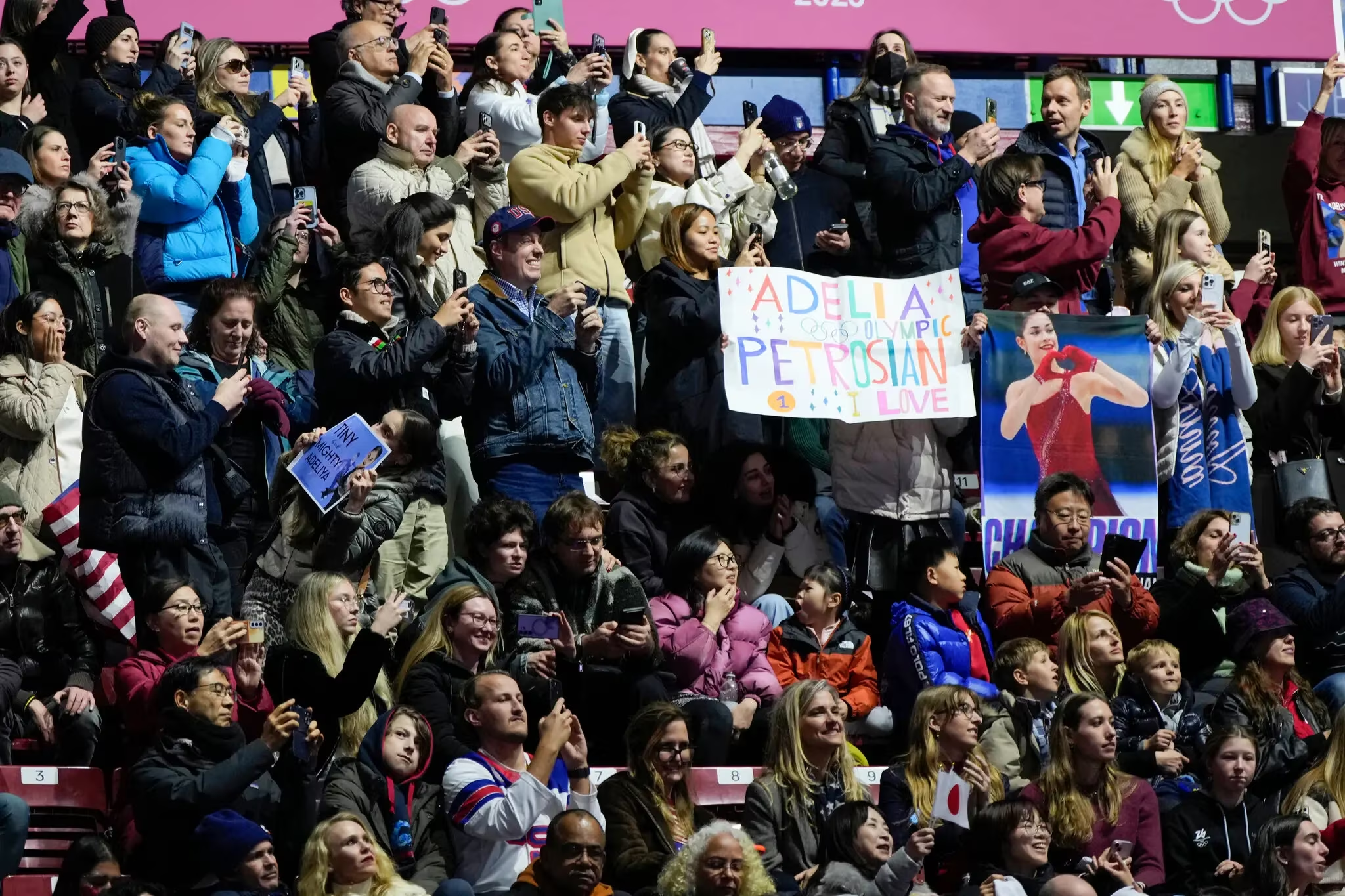
Supporters of Adelia Petrosian hold signs backing her in Milan. February 2025.
Many spectators devised their own ways of showing support. A family from Moscow arrived in matching cherry-red hoodies bearing Petrosian’s image. Others raised handmade cardboard signs. During her warm-up on the ice, the arena announcer introduced the skater as a “three-time national champion,” without specifying which country.
Afterward, Petrosian acknowledged her disappointment with a sixth-place finish but noted the support she had received from “Russian-speaking spectators.”
The International Olympic Committee formally banned Russia following its 2023 move to incorporate official sports institutions in several occupied regions of Ukraine. In recent months, Russian officials have argued that they have introduced administrative changes that, in their view, should lead to the lifting of the ban.
Russia’s sports minister, Mikhail V. Degtyarev, said he expects the I.O.C.’s executive board to decide by May whether to lift the sanctions. That leaves open the possibility that a Russian team could take part in the 2028 Summer Olympic Games in Los Angeles.
Even if Russia’s membership in the I.O.C. is reinstated, individual international sports federations would still have to lift their own restrictions. Some have already done so, including the governing bodies for judo and taekwondo.
A number of senior I.O.C. officials have publicly backed Russia’s return.
“They are clearly showing positive movement forward, and ultimately the Olympic movement is about inclusion, not exclusion, so we have to find a way to bring everyone back,” Prince Feisal Al Hussein, a member of Jordan’s royal family and an I.O.C. executive board member, said in an interview this month. “I believe they are taking the requirements we set seriously and are trying to work through the individual issues.”
Russia’s war against Ukraine has been a source of sharp controversy at the Winter Games. Last week, a Ukrainian skeleton athlete was disqualified after intending to compete wearing a helmet dedicated to compatriots killed in the war—the I.O.C. said this violated existing restrictions on political expression.
Another flashpoint is expected at the opening ceremony of the Paralympic Games on March 6, where the Russian team will be allowed to march under the national flag and in national colors. Several European governments said this week that they would not send official delegations to the ceremony. Estonia’s public broadcaster said it would not air events in which Russian and Belarusian athletes compete under their own flags.