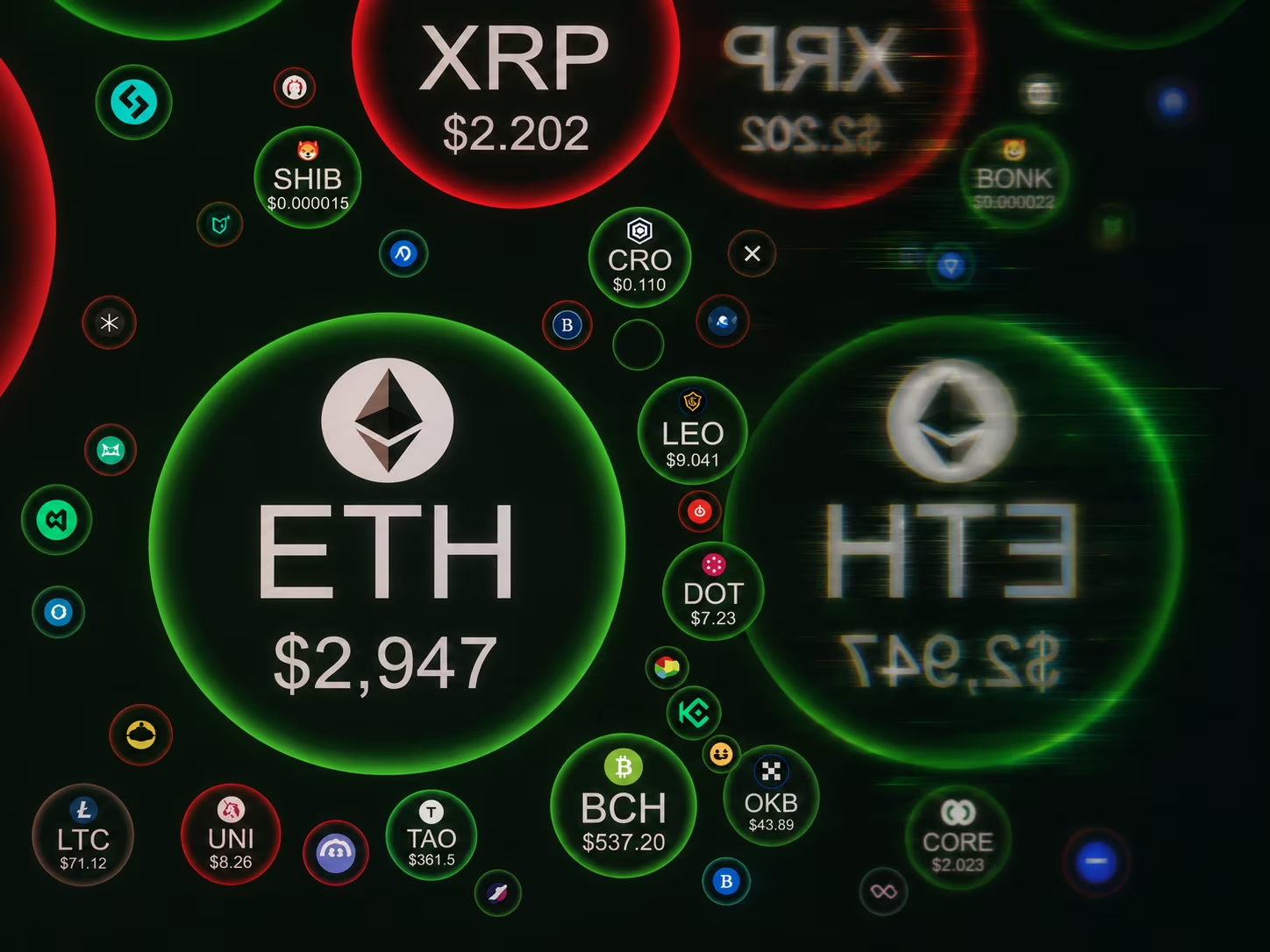
For several hours last weekend, the stablecoin Tether USDT was worth more than Ether by market capitalization. The relationship quickly reversed, but the episode was revealing.
Ether, the token of the Ethereum blockchain, had long been considered one of the key assets of the crypto market and a gauge of growth in decentralized finance. USDT, by contrast, was created to maintain a stable price of $1 and is used mainly as a digital dollar for trading and payments.
The fact that a stablecoin was able, even briefly, to overtake Ether by market value reflects a broader shift in the digital-asset market.
Tether briefly overtook Ether by market value
The recent decline in the crypto market hit hard the tokens that once drew investors with the promise of a future financial system built on blockchains. Ether has fallen sharply from its highs amid a broader sell-off, growing competition from new networks and persistent questions about security, fragmented liquidity and the extent to which activity on the Ethereum network actually creates value for the token itself.
Ethereum’s problem is increasingly described as a value paradox. Activity in parts of the ecosystem continues to grow, but investors are less convinced that this growth automatically translates into greater demand for Ether.
At the same time, stablecoins continue to expand their presence. Governments are advancing legislation intended to integrate them into the financial system, payment companies are testing settlement in digital dollars, and traders increasingly use them as the basic infrastructure of the crypto market.
This contrast highlights one of the industry’s central contradictions. Its most commercially successful products are gaining users and becoming more deeply embedded in the financial system, while many of the assets that once symbolized the crypto market’s growth are struggling to attract capital.
“This tells us that the tangible parts of the crypto industry that are actually seeing adoption continue to grow—including stablecoins, settlement and payments—while in the more speculative and cyclical areas, questions about long-term value are becoming more frequent,” said Zaheer Ebtikar, chief strategy officer of the blockchain project Plasma.
Those doubts appear to have peaked last weekend. Ether’s decline from its August high reached about 70%, as almost all tokens were pulled into the accelerating slump in Bitcoin—the market’s main barometer. At one point early Saturday morning, Ether’s capitalization fell to $182 billion. At the same time, about $187 billion in Tether was in circulation, briefly making the stablecoin the second-largest cryptocurrency after Bitcoin.
Since its launch in 2014, Tether has remained an exception among the thousands of digital tokens that appeared after Bitcoin. If Ether was conceived as an “improved” Bitcoin, Tether was created to solve two basic problems of the early crypto market: high price volatility and the difficulty of moving funds between traditional money and cryptocurrencies.
Ether’s market capitalization is shrinking
Those functions, along with providing liquidity to exchanges, have already made Tether the most traded cryptocurrency by daily transaction volume. This has happened despite Tether still operating largely outside the regulatory framework the Trump administration is building for digital assets in the United States.
“This definitely shows that stablecoins are here to stay and will become a more embedded part of our financial system,” said Tian Zeng, CEO and CIO of the crypto trading firm Third Eye.
Ethereum, meanwhile, continues to confront the same value paradox, in which network upgrades weigh on the price of the Ether token. Ethereum’s most prominent backers now present it as infrastructure for Wall Street—the very institutions the network’s founders once wanted to change. But that adoption remains partial and slow, while competition is intensifying. Although Ethereum remains the most valuable platform for decentralized finance, new projects such as Hyperliquid are already outperforming the original “world computer” by some measures, including fees generated.
Christopher Perkins, CEO of 250 Digital Asset Management, said the overall market environment remains unfavorable for most cryptocurrencies.
“Right now the energy is moving into infrastructure, and the prices of many tokens simply do not reflect” their value, Perkins said. “Retail capital is chasing new, flashy AI projects, and vulnerabilities exposed with the help of AI have undermined confidence in places. A less favorable macroeconomic environment, rising inflation and the prospect of higher rates have not helped either.”