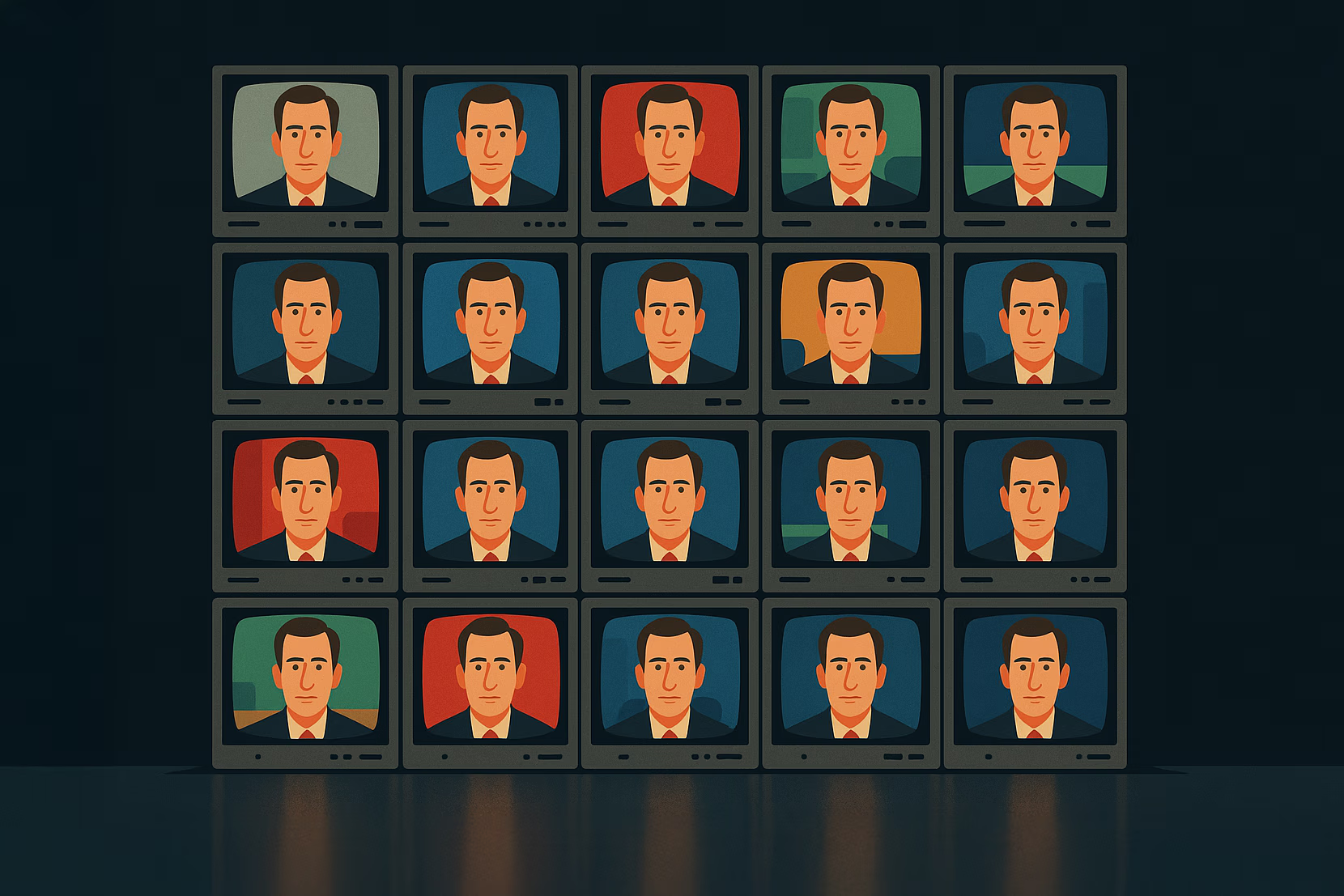
People looking to hear from the most influential figures in the tech industry increasingly find them not in traditional media but on YouTube shows and sprawling conversations on platforms like X and Spotify, where guests are rarely pressed with uncomfortable questions. Some of these platforms are created by tech companies and their investors themselves, giving the CEOs of Palantir, Meta, Microsoft and others the freedom to discuss their products and views without facing rigorous fact-checking.
Against a backdrop of growing distrust toward major tech firms and rising anxiety over AI, an alternative media sphere is taking shape in the United States, where corporate magazines, video shows and friendly interviews edge out direct, critical scrutiny.
An opening montage featuring Palantir CEO Alex Karp and billowing American flags set to an AC/DC Thunderstruck remix introduces his interview for Sourcery—a YouTube show produced by the digital financial platform Brex. As they stroll casually through the office, the hosts never raise a single question about Palantir’s contentious ties to ICE, while Karp praises the company, swings a sword and recalls unearthing the childhood remains of his dog Rosita to rebury them near his current home.
“That’s very sweet,” replies host Molly O’Shea.
Those seeking to hear from the most influential people in tech increasingly have to look to shows and podcasts like Sourcery. They offer the industry a space where it does not have to contend with the critical questions posed by traditional media—outlets many in Silicon Valley view with suspicion or outright hostility. Some of these projects are created by tech companies themselves; others come from niche media that have become comfortable platforms for tech-sector billionaires, like a remora fastening itself to a fast-moving shark.
The heads of the largest companies—from Mark Zuckerberg and Elon Musk to Sam Altman and Satya Nadella—have spent recent months giving long, indulgent interviews, while firms like Palantir and Andreessen Horowitz have launched their own media initiatives this year.
Even as most Americans distrust big tech and believe artificial intelligence poses a threat to society, Silicon Valley is building an alternative media sphere where CEOs, founders and investors are treated as unassailable protagonists. What began as the domain of a handful of enthusiastic podcasters has turned into a fully-fledged ecosystem of publications and shows backed by some of the industry’s most influential players.
Although pro-technology influencers like podcast host Lex Fridman have long operated in a symbiotic orbit with figures such as Elon Musk, some companies have decided this year to dispense with intermediaries altogether. In September, venture-capital firm Andreessen Horowitz announced the launch of its a16z blog on Substack. One of its prominent writers, investor Katherine Boyle, has long been close to J.D. Vance. The firm’s YouTube podcast has already attracted more than 220,000 subscribers, and last month it featured OpenAI CEO Sam Altman, in whose company Andreessen Horowitz is a major investor.
“What if the future of media is shaped not by algorithms or the legacy of old institutions, but by independent voices that work directly with their audiences?” the firm wrote in its Substack announcement. It once invested $50 million in BuzzFeed with a similar vision, only for the outlet’s value to collapse to mere cents per share.
On its Substack, a16z also announced an eight-week media fellowship for “operators, creators and storytellers shaping the future of media.” The programme involves working with the firm’s new media division, described as a space where “online legends” create “a unified arena that gives founders legitimacy, style, brand-building skills, expertise and the momentum they need to win the narrative fight online.”
In addition, Palantir earlier this year launched its own digital and print publication, Republic, styled after academic journals and analytical outlets such as Foreign Affairs. The magazine is funded by the Palantir Foundation for Defense Policy and International Affairs—a nonprofit chaired by Karp, who, according to its 2023 tax filings, works there 0.01 hours a week.
“Far too many people who should not have a platform possess one. And far too many who should have one are denied it,” reads Republic, whose editorial team consists of Palantir’s senior executives.
Among the pieces published by Republic are an essay arguing that U.S. copyright restrictions hinder America’s leadership in AI, and an article by two Palantir employees explaining why Silicon Valley’s cooperation with the military is beneficial for society—a position Karp has repeatedly voiced in public.
Republic has joined a growing pool of pro-tech media outlets, including the magazine Arena. It was founded late last year by Austin venture investor Max Meyer, who chose the motto “New needs friends” from Disney’s Ratatouille.
“At Arena we don’t write about ‘news.’ We write about the New,” the editors declared in the first issue. “Our mission is to support the people who—slowly but surely, and sometimes at breakneck speed!—bring the future into the present.”
The stance aligns with the founder’s views; he has criticised Wired and TechCrunch for what he sees as an excessively negative approach to the industry.
“The magazines that traditionally covered this space have become far too negative. And we, with a bit of audacity and optimism, are going to challenge them,” Meyer told Palantir co-founder Joe Lonsdale on his podcast.
Part of the new tech-media scene has taken shape more organically—without a formal corporate-media label, even if the overall tone remains similar. The video podcast TBPN, which frames the internal life of tech companies—such as executive reshuffles—as drama on the scale of an NFL draft, has gained influence rapidly since launching late last year. Its self-mocking yet tech-optimistic style has drawn prominent guests, including Meta CEO Mark Zuckerberg, who appeared in person in September to promote Meta’s smart glasses.
Another podcaster, 24-year-old Dwarkesh Patel, has also built his own small media sphere in recent years by recording long, friendly conversations with tech-company leaders and AI researchers. Earlier this month, he spoke with Microsoft CEO Satya Nadella, who personally gave him a tour of one of the company’s newest data centers.
As with many trends in the tech world, Elon Musk was among the first to embrace this format of friendly media appearances. After acquiring Twitter in 2022, the company began limiting the reach of links to critical news outlets and automatically replying to journalists’ requests with a poop-emoji. Musk rarely gives interviews to major publications, preferring long conversations with sympathetic hosts like Lex Fridman and Joe Rogan, where his claims go largely unchallenged.
The creation of Musk’s own media cocoons shows how easily such content can drift away from reality and reinforce an alternative worldview. His long-standing irritation with Wikipedia led to the launch this year of Grokipedia—an AI imitation that produces outright disinformation in line with his far-right views. Musk’s chatbot Grok likewise routinely amplifies positions that echo his own or slips into absurdity in its attempts to praise him. Last week, for instance, it claimed that Musk was “in better shape than LeBron James” and capable of beating Mike Tyson in the ring.
The rise of this new tech-media environment is part of a broader shift in how public figures present themselves and how much access they are willing to grant journalists. The tech industry has long had a fraught relationship with the press and a strong instinct to seal off its internal workings—a tendency that grew after scandals such as the Facebook leaks, which exposed internal documents and the potential harms of the company’s practices. Journalist Karen Hao writes in her 2025 book Empire of AI that OpenAI refused to speak to her for three years after she published a critical profile in 2019.
The tech sector’s turn toward friendly platforms and its push to build its own media productions partly mirrors the strategy of the entertainment industry. Film and album press tours have long been tightly stage-managed: actors and musicians cycle through safe interviews on shows like Hot Ones. Politicians have adopted a similar model: during Donald Trump’s 2024 campaign he regularly appeared with podcasters such as Theo Von, while California governor Gavin Newsom launched his own political podcast this year. The format offers access to new audiences and provides a protected space for self-presentation.
And while much of this new media sphere does not aim to expose or scrutinise those in power, it still carries significance. The content produced by the tech industry often reflects how it sees itself and the world it wants to build—with less government oversight and fewer questions about how its own companies are run. Even the most trivial prompts can offer rare glimpses of people who usually operate behind closed boardroom doors and live in insulated residences.
“If you were a cupcake, what kind of cupcake would you be?” O’Shea asked Karp on Brex’s Sourcery.
“I don’t want to be a cupcake because I don’t want to be eaten,” Karp replied. “I resist becoming a cupcake.”