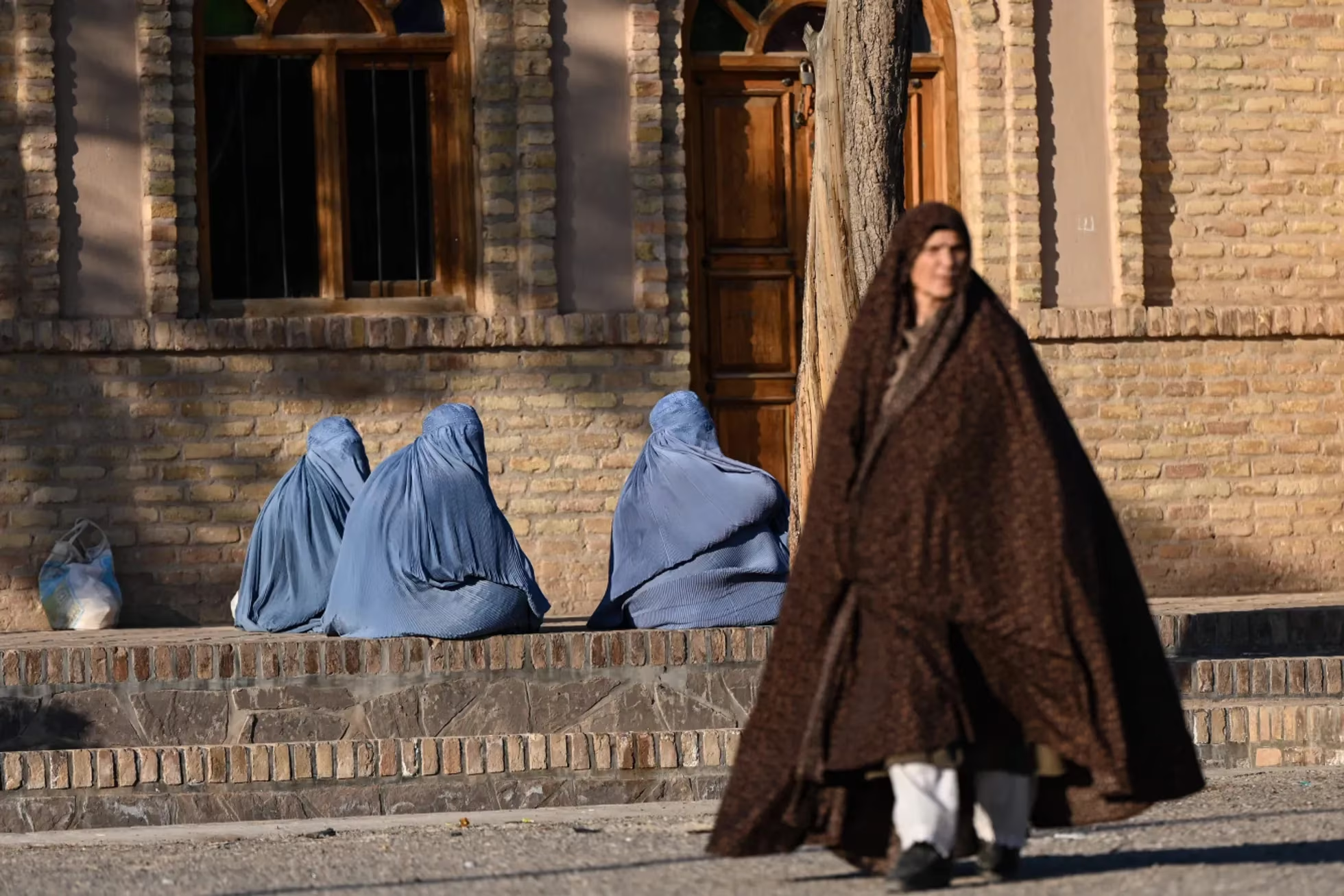
Afghanistan’s supreme leader and head of the Taliban movement, Mullah Hibatullah Akhundzada, has approved a new criminal procedure code. The document was published on the website of the human rights organization Rawadari, which warned that the new provisions effectively entrench discrimination on gender, religious, and social grounds, while legalizing practices associated with slavery, reprisals against dissenters, and violence—primarily against women and children.
According to human rights defender Bilqis Ahmadi, the code is structured in such a way that the rights of animals are more robustly protected than those of women. The Malala Fund, established by Malala Yousafzai, the 2014 Nobel Peace Prize laureate for her advocacy of women’s rights, said that the adoption of the document completes the process of institutionalizing “gender apartheid” in Afghanistan.
Particular attention from human rights and feminist organizations has focused on specific provisions of the code. Article 32 states: “If a husband inflicts excessive beatings on his wife resulting in fractures, wounds, or bruises on her body, and if the wife proves the validity of her complaint to the judge, the husband shall be recognized as a criminal. The judge must sentence him to imprisonment for a term of 15 days.”
At the same time, Article 70 prescribes a different punishment: “A person who forces animals (dogs, camels, sheep, and the like) or birds (chickens, quail, partridges) to fight shall be deemed a criminal. The judge must sentence him to imprisonment for a term of five months.”
As a result, based on the literal wording of the code, organizing, for example, cockfights is classified as a more serious crime than beating one’s wife causing bodily injury.
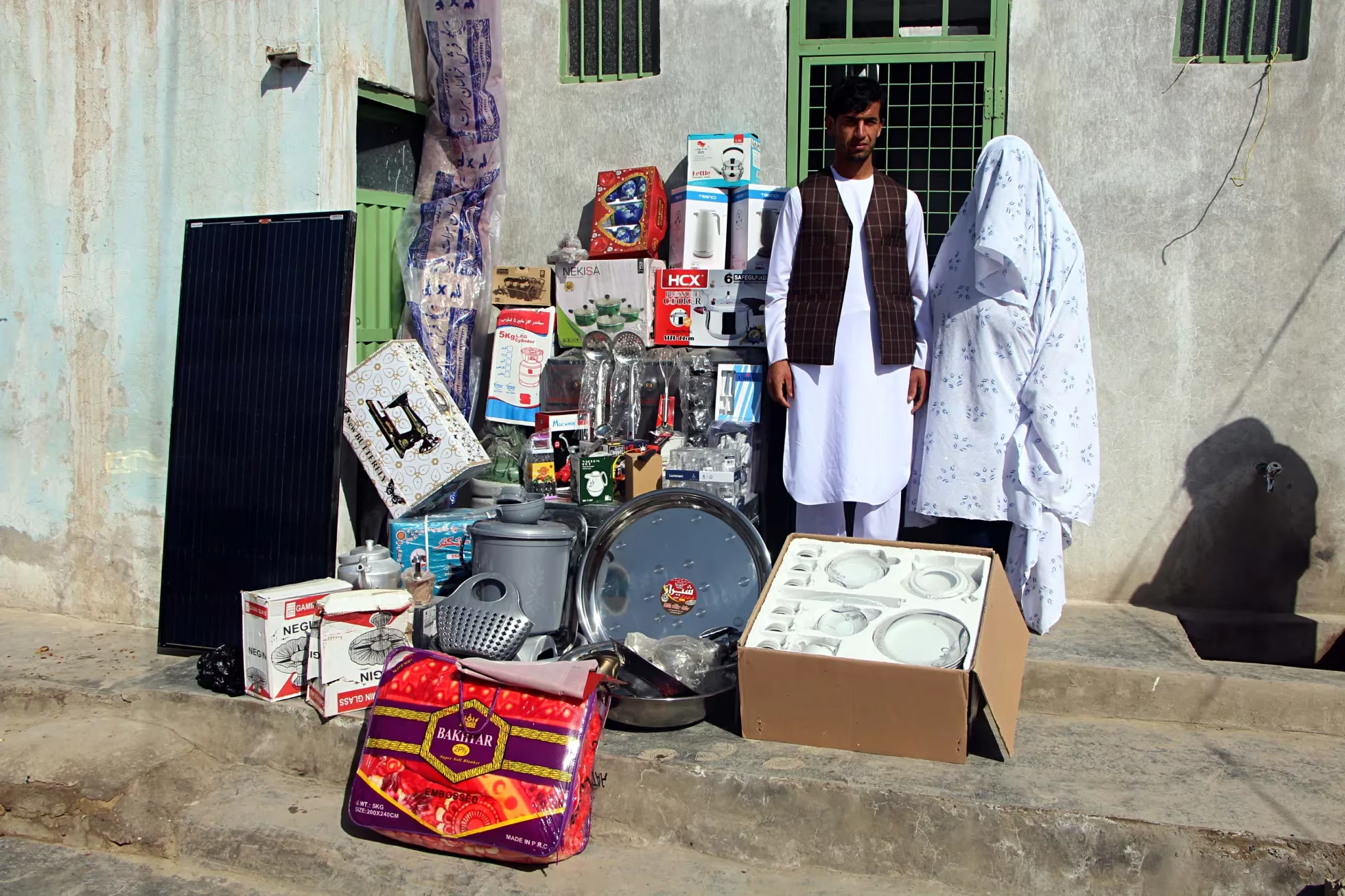
Newlyweds after their wedding in Helmand Province in southern Afghanistan.
Fundamental legal principles—such as equality before the law and the presumption of innocence—do not operate in Afghanistan
The new code disregards a range of legal principles regarded worldwide as fundamental: adversarial judicial proceedings and the full right to a defense, the principle of legality, proportionality of punishment to the offense committed, equality before the law, the presumption of innocence, and others. Instead, it entrenches the near-unlimited authority of husbands over wives, parents over children, and teachers over students.
The document grants extraordinarily broad scope for the application of ta’zir—an institution of Islamic law under which an act is deemed criminal but the specific punishment is not fixed by statute and is determined at the judge’s discretion.
In many cases, however, the role of judge is performed not by a professional jurist but by an official. Moreover, any Muslim who witnesses behavior he considers sinful is granted not only the right but even the obligation to intervene and take action, including the use of violence, in order to “prevent vice.” The code sets out no clear criteria for what precisely constitutes “sinful” behavior. In effect, this amounts to legalized arbitrariness.
At the same time, it would not be entirely accurate to claim that the new code for the first time introduces or legalizes slavery, a caste-based social order, “gender apartheid,” and pervasive violence.
All of these practices were already enshrined in earlier laws adopted by the Taliban.
Thus, the 2024 “Law on the Promotion of Virtue and the Prevention of Vice”—one of the cornerstone acts of the Taliban’s legal system—mandates prayer five times a day, bans Muslims from maintaining friendly relations with non-Muslims, imposes strict religious censorship, prohibits music and dancing, requires women to conceal their faces and voices from unrelated men, and forbids them from leaving their homes without a guardian.
In this sense, the new code is primarily a manual for law enforcement, addressed to local authorities. It does not introduce new prohibitions and does not contain an exhaustive list of crimes and punishments, but rather systematizes and expands the mechanisms for their application.
The Taliban Are Returning to a Legal System Formed in the Eighth–Ninth Centuries
The Taliban, like roughly half of the world’s Muslims today, rely on the theological and legal tradition of the Hanafi madhhab. In Afghanistan, however, its most radical version has been imposed. Sources of law are arranged in a rigid hierarchy—from the most authoritative to the secondary: the Quran, hadiths, the judgments of the Prophet Muhammad’s companions and their closest successors, legal analogies drawn from previously resolved cases, considerations of expediency, and local non-religious customs. Modern legal principles—equality before the law, the presumption of innocence, the right to a defense, and others—are rejected by the Taliban as “innovations,” which in their worldview is almost tantamount to heresy.
At the same time, Islamic law has historically not been a static system. All major madhhabs took shape in the eighth–ninth centuries during the era of the Abbasid Caliphate and, over more than a thousand years, developed through parallel debates, gradually adapting to changing political and social conditions.
The Taliban, by contrast, deliberately proclaim a “return to the origins.” Their legal order reproduces medieval norms in a literal sense. Formally, slavery is not declared lawful; however, normative texts employ a distinction between “azad”—a free person—and “ghulam”—a slave or dependent individual—because this distinction exists in the foundational sources of the Hanafi madhhab. The new code also codifies it, yet offers no explanation of how a person may become a ghulam or lose that status.
The same logic applies to the estate-based structure of society—ulama as religious scholars, ashraf as the nobility, including tribal leaders and merchants, as well as the middle and lower classes. The code does not introduce this hierarchy; it proceeds from its existence as a self-evident fact—because this is precisely how society was described in legal commentaries more than a thousand years ago.
The same holds true for differences in the legal status of Muslims and non-believers, Sunnis and Shiites, Hanafis and followers of other madhhabs. The code does not create these distinctions; it acknowledges them as already existing and provides judges with practical guidance on how to apply them.
The same logic is applied to women’s rights. The document does not impose new restrictions but merely records and systematizes norms that are already in force. Thus, a wife’s departure to live with relatives without her husband’s consent had previously been classified as a crime—the code merely уточifies that the punishment for this is three months of imprisonment for the woman and for those who refuse to return her to her husband.
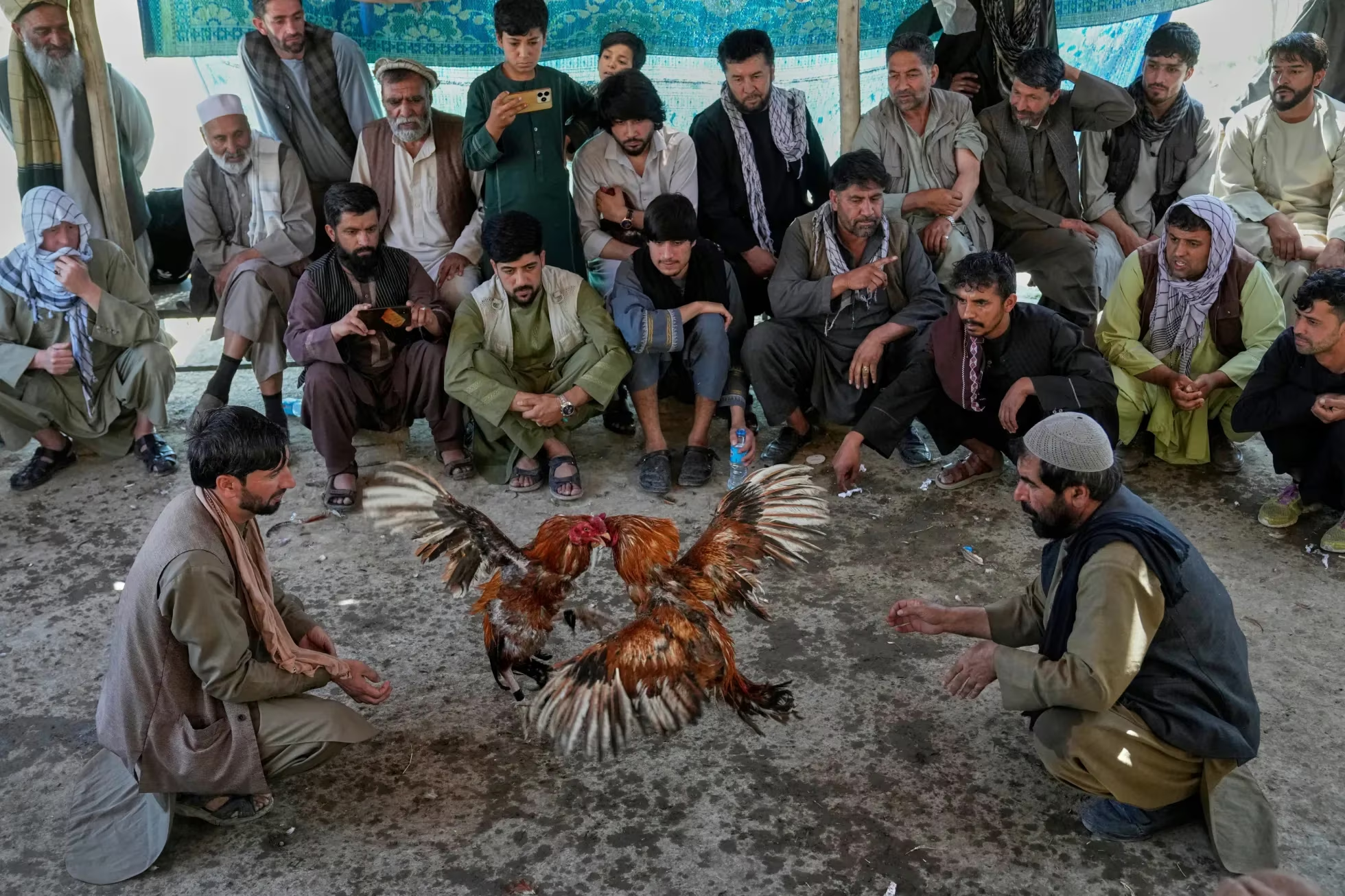
Cockfighting in Kabul. 2025.
Returning to the example already mentioned, within the logic of traditional Islamic law cockfighting is perceived across several dimensions. First, it represents senseless cruelty toward living beings. Second, it constitutes a form of gambling. Third, it is an idle and morally corrosive spectacle. The harm, therefore, is inflicted not only on the birds themselves but also on public morality. Relations between husband and wife, by contrast, are treated within this framework as a strictly private matter.
On January 24, the UN Special Rapporteur on the situation of human rights in Afghanistan, Richard Bennett, said: “We are still analyzing the Taliban’s new criminal procedure code, including from the perspective of human rights and sharia, but it is already quite clear that the consequences for Afghans are a matter of grave concern. I will issue more detailed statements in due course.” No other official reactions from states or intergovernmental organizations to the publication of the document have followed so far.