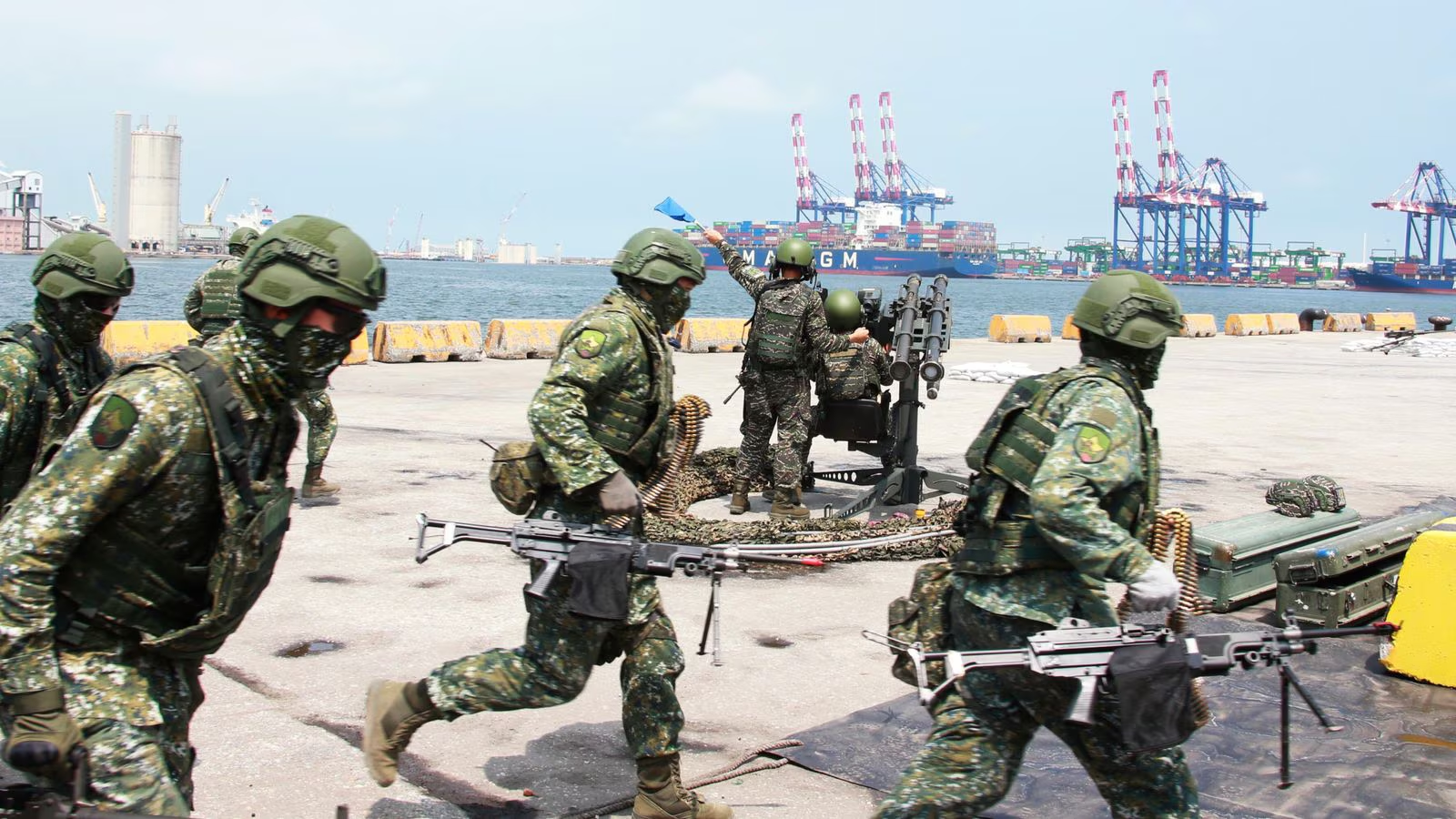
President Lai Ching-te’s attempt to push a nearly $40 billion defence-spending plan through Taiwan’s parliament has stalled: opposition parties are demanding concessions, and in Washington it has drawn sharp criticism from senators who fear a possible Chinese invasion.
Against a backdrop of rising threats from Beijing, US president Donald Trump is insisting that Taipei increase military spending. China regards the island as part of its territory. China’s leader, Xi Jinping—who, according to the American side, has ordered the armed forces to be ready for an invasion as early as next year—recently warned Trump, during a phone call, against supplying weapons to Taiwan. A face-to-face meeting between the two leaders is scheduled for April.
Lai and his Democratic Progressive Party, having lost their parliamentary majority, said they intended to raise defence spending to more than 3 percent of GDP in 2026. Yet political deadlock has meant the defence budget proposal has already been blocked ten times, and there are still no clear signs of a way out.
“I think Taiwan’s political fractures run very deep,” said Lyle Goldstein, director of the Asia programme at the think-tank Defense Priorities. “Society as a whole is becoming increasingly polarised. President William Lai and his party, in my view, have taken a fair number of hits over the past year—and that, I would say, has strengthened the opposition’s position and resolve, which now feels more confident.”
Last week the Kuomintang and the Taiwan People’s Party voted against the Democratic Progressive Party’s bid to begin deliberations on a special defence budget of nearly $40 billion, spread over eight years. The money was meant to fund purchases across eight categories of weaponry, including howitzers, Javelin anti-tank missiles and HIMARS rocket systems—approved as part of an $11 billion US deal in December.
Taiwan’s government warns that blocking a sweeping defence budget will slow the modernisation of the armed forces and send the wrong signal to international partners. Some influential lawmakers in the US Congress agree. Senator Tammy Duckworth, a member of the Armed Services Committee, said that amid China’s relentless threats it is vital for Taipei to have the resources to defend itself. “Over the past year I’ve spoken with my counterparts in Taiwan, urging them not to allow such steep cuts—and I hope they change course,” she said.
Senator Dan Sullivan wrote on X this week that Taiwan’s parliament had ended its session without passing the “budget needed to defend the country”, while the opposition party’s leadership, he said, was in Beijing meeting the Chinese Communist Party and planning further contacts. “You don’t need to be a genius to see what’s going on,” Sullivan said. “I’ve warned before: cutting Taiwan’s defences while currying favour with the CCP is playing with fire.”
Roger Wicker, the chair of the Senate Armed Services Committee, said he was “disappointed” that the opposition had so sharply cut the defence budget proposed by Lai. “The original proposal funded critically needed weapons systems,” he wrote. “Taiwan’s parliament should reconsider—especially as threats from China continue to grow.”
The leader of the Taiwan People’s Party, Huang Kuo-chang, was reported to have accused Raymond Greene, the top American diplomat on the island, of “excessive interference” in Taiwan’s domestic affairs after he backed Lai’s push to raise defence spending. The Kuomintang said it supported strengthening defence capabilities, but stressed the importance of parliamentary oversight and fiscal responsibility. “Multi-year defence budgets can provide strategic continuity, but they must be accompanied by detailed planning, clear allocations of funds and effective oversight to avoid waste and inefficiency,” the party said in a statement. It also said that delays in deliveries of key weapons underscored the need for realistic planning and accountability.
Steve Yates, a senior fellow at the Heritage Foundation focusing on China and national security, called the Kuomintang’s moves “risky” and likewise warned that the party was “playing with fire”. “They are putting Taiwan at risk not only in terms of relations with the Trump administration,” Yates said. “They are effectively accepting additional spending in the billions of dollars that Beijing will not like, while cutting back on the investments they have promised. In Washington, that is unlikely to look sensible.”
Senate Foreign Relations Committee chair Jim Risch and the committee’s top Democrat, Jeanne Shaheen, urged Taiwan’s parties to work together and fully fund the defence budget, noting that China’s military drills off the island in December were “a reminder of Beijing’s intentions and its threats to a free and open Indo-Pacific”. “Rather than chasing photo-ops with the Chinese Communist Party, Taiwan’s leaders should focus on approving funding for key military reforms and strengthening the resilience of society as a whole,” their statement said.
Yates, who previously served as deputy national security adviser to Vice-President Dick Cheney, said he welcomed the remarks from several senators but was disappointed that more lawmakers and the media had not spoken up. Goldstein, for his part, argued that it is inappropriate for American politicians to tell Taipei what defence decisions it should make. “I wouldn’t expect Taiwanese lawmakers to tell Americans what they need for their own defence,” he said. “This is Taiwan’s internal dispute, and in my view we should trust its citizens to sort it out for themselves.”
Under the “one-China” policy, the US does not formally recognise Taiwan’s independence, though American presidents have varied in how they describe their willingness to defend the island if it is attacked. Last year, the Trump administration barred Lai from transiting the United States as it sought to strike a trade deal with China. More recently, however, Trump said he would be disappointed if Beijing invaded Taiwan. “He thinks Taiwan is part of China—that’s his position,” Trump said in a January interview with The New York Times. “But I made it clear that I would be very unhappy with such a move, and I don’t think he will do it. I hope he won’t.”
The White House said it “strongly” supports Taiwan’s efforts to bolster its defence and deterrence “through reforms and a commitment to increasing defence spending”. “We welcome President Lai’s statement that he intends to spend more than 3 percent of GDP on defence in 2026 and 5 percent by 2030,” a senior Trump administration official said, adding that the details of the programmes are for Taiwan’s authorities to determine. The State Department did not immediately respond to a request for comment.